Root Chakra: What It Is and How to Work With It at Home
Discover what the root chakra is, how it feels when steady or unsettled, and simple colours, stones, scents and practices to work with it at home.
On this page
The root chakra, called Muladhara in Sanskrit, is the first of the seven main energy centres in yogic and spiritual traditions. It sits at the base of the spine and is linked with safety, stability and the feeling of having your feet on the ground. Its colour is red.
This guide explains what the root chakra is, how people describe it when it feels steady or unsettled, and the colours, stones, scents and small practices people use at home in the UK to work with it. It is written for anyone curious about chakras, and for anyone choosing a thoughtful gift for a woman who is. It is a spiritual practice, not a medical one.
TL;DR
- The root chakra is the base energy centre, linked with safety, stability and belonging.
- Its colour is red, and its traditional element is earth.
- Red jasper, garnet, black tourmaline, cedar and patchouli are popular companions for the practice.
- Slow breathing, walking outside and a steady routine are the simplest ways to work with it.
- If feeling unsafe or anxious goes on, speak to a GP rather than relying on ritual alone.
What is the root chakra?
In the chakra system, energy is described as flowing through seven centres along the spine. The root chakra is the lowest, placed at the base of the spine, around the pelvic floor.
Traditionally it stands for the basics: a home, food, money, your body and a sense of belonging. When those feel secure, the idea goes, you have a firm base to build on. The other six centres rest on top of it.
Chakras are a spiritual idea, not a scientific measurement. There is no scan that finds them. Many people still find the framework a useful prompt to ask, "Do I feel steady today, and what would help?"
That is how we suggest using it. Treat it as a gentle way to notice yourself, not as a diagnosis. Once the root feels settled, many people move on to the sacral chakra, the centre above it, which is linked with creativity and pleasure.
Signs of a steady or unsettled root
These are traditional descriptions, not symptoms. Use them as questions to reflect on, not as a checklist.
When the root feels steady
- You feel reasonably calm in your own home.
- You can make everyday decisions without much dread.
- You feel at home in your body.
- Routines such as meals and bedtime come fairly easily.
When it feels unsettled
- You feel restless, jumpy or "up in your head".
- Money, housing or work worries loom large.
- You feel disconnected from your body or from other people.
- Your routines have slipped and nothing feels solid.
Life events often shake this centre: a house move, a new job, a bereavement, a difficult winter. That is normal. The practices below are simply ways of making a wobbly week feel a little more anchored.
Root chakra colour and symbols
Red is the root chakra colour. It is a warm, grounded shade, closer to brick, garnet or deep terracotta than to bright fire-engine red. Earth is its element, which is why so many practices involve soil, stone and bare feet.
The traditional symbol is a lotus with four petals, with a square at its centre. The square stands for solidity. The sound linked with the root is "LAM", which is chanted or hummed low in the chest.
You do not need to buy anything to use the colour. Wear a red jumper, put a rust-coloured throw on the sofa, or cook with beetroot, red lentils and tomatoes. Small, ordinary touches count.
If you want to see how the root sits beside the other six, our guide to chakra colours sets them out in order, with simple ways to bring each into your home.
Pro Tip: Pick one red object and keep it where you start the day, such as a mug by the kettle or a candle on the hallway shelf. Seeing it is your cue to take one slow breath before you pick up your phone.
Crystals and scents for the root
Crystals do not treat or fix anything. People use them as touchstones, something to hold that reminds them to slow down. For the root chakra, the usual choices are dark, earthy or red stones.
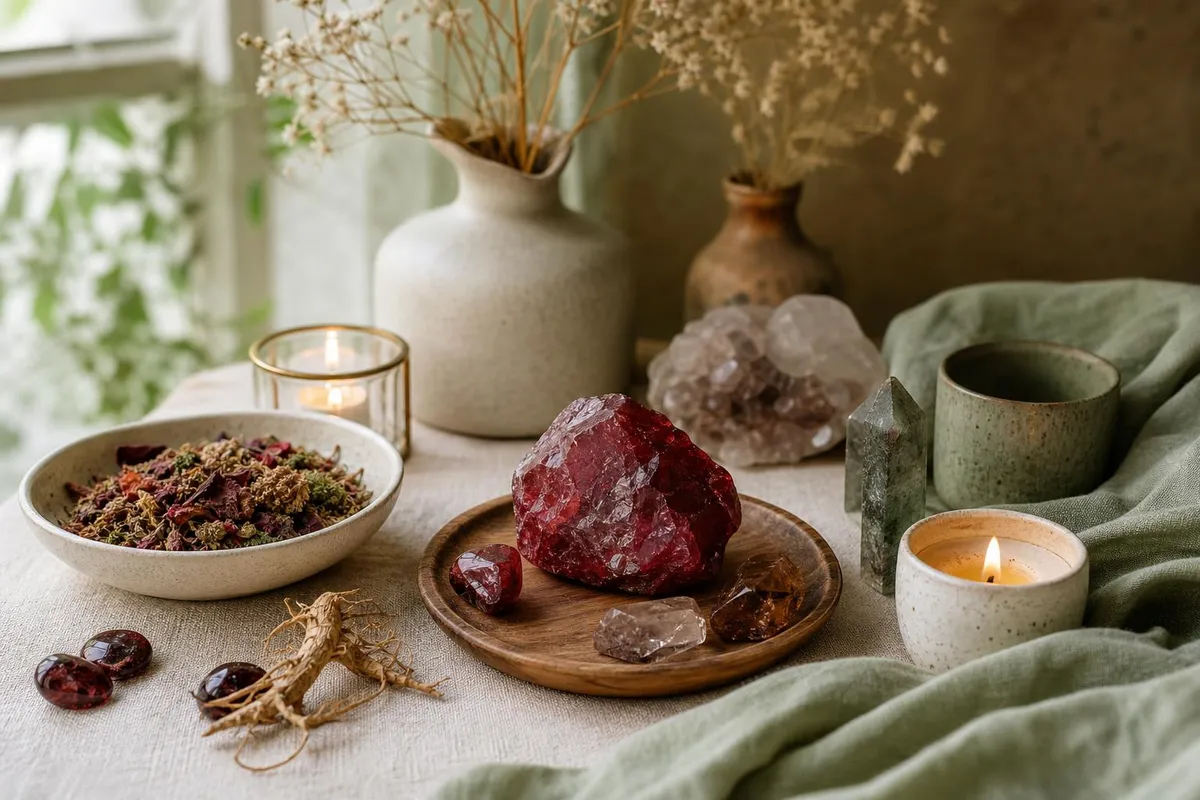
- Red jasper: a matt, brick-red stone, often called the steady one.
- Garnet: deep red and glassy, traditionally linked with energy and commitment.
- Black tourmaline: a dark stone many people keep by the front door.
- Smoky quartz: a soft brown-grey stone for a desk or bedside.
- Hematite: heavy and metallic, pleasantly cool in the palm.
For scent, earthy and woody notes suit the theme: cedarwood, patchouli, vetiver, sandalwood and palo santo. Burn a soy wax candle or light incense, always keeping flames away from fabrics and never leaving them unattended. If you add essential oils to a bath, dilute them first and check the label.
Our guide to crystals for chakras covers all seven centres if you would like to build a set slowly.
Grounding practices for everyday life
The root chakra is all about feeling present in your body, so most practices are physical and simple.
- Walk outside. Even ten minutes round the block, noticing your feet on the pavement, counts. Parks, gardens and woods are a bonus.
- Take your shoes off at home. Feel the floor under you for a minute or two.
- Keep a steady rhythm. Regular mealtimes and a regular bedtime are very root-like. The NHS sleep advice also recommends a regular sleep routine.
- Cook something warming. Soup, a roast vegetable tray or a slow stew keeps you in your kitchen and in your senses.
- Tidy one small space. A cleared bedside table is enough.
If you want more ideas, our list of fast grounding rituals is written to be gentle and trauma aware.
Pro Tip: Try the 5-4-3-2-1 check when your mind is racing. Name five things you can see, four you can touch, three you can hear, two you can smell and one you can taste.
A ten-minute root chakra ritual
You can do this on a weekday evening. You need a quiet spot, a blanket and, if you like, a red candle and a stone.
- Set up (2 minutes). Dim the lights. Light the candle and place your stone nearby or in your hand.
- Sit down (1 minute). Sit on the floor or a firm chair with both feet flat. Feel the weight of your body being held.
- Breathe (3 minutes). Breathe in through your nose for a count of four and out for a count of six. Let your shoulders drop on every out-breath.
- Picture red (2 minutes). Imagine a warm red glow at the base of your spine, like a lamp in a window.
- Say a line (1 minute). Quietly say, "I am safe enough here, and I have what I need for tonight."
- Close (1 minute). Wiggle your toes, blow out the candle and drink a glass of water.
Slow, steady breathing is a common way to unwind, and Mind lists breathing exercises among its relaxation techniques. Try it for a week and see how your evenings feel.
Root chakra meditation
Meditation gives the practice a little more structure. For the root, the focus is the body and the ground beneath you.
Sit or lie down. Bring attention to the points where your body touches the floor or chair. Notice the heaviness of your legs, hips and feet. When your mind wanders, which it will, bring it back to those points of contact.
This is close to what the NHS describes as mindfulness: paying attention to the present moment, including your body and the world around you. It is not a replacement for medical care.
Five to ten minutes is plenty to start. If sitting in silence feels hard, a guided session helps, because someone else's voice does the steering. Our chakra meditation for beginners guide walks through all seven centres, starting at the root, with one guided session.
When to ask for support
Feeling unsafe, on edge or ungrounded is sometimes about money, housing, health or past experiences, not about energy. Rituals can sit alongside real help. They should not stand in for it.
Speak to your GP if low mood, anxiety or poor sleep keeps going, or if it is affecting work or relationships. The NHS Every Mind Matters pages offer practical self-help advice. The Mental Health Foundation also publishes guidance on looking after your wellbeing.
If you are in crisis, call 999 or contact Samaritans on 116 123, free at any time.
Once you feel steadier, you may want to move upwards. The solar plexus chakra is next after the sacral, and the heart chakra sits in the middle. There is no rush. Many people stay with the root for weeks, and that is fine.
When we started the shop, we assumed people wanted lots of tools. In fact, the women we hear from most want one small thing they can repeat. For the root chakra, that is often a red stone by the bed and five slow breaths at the end of the day. We would rather you did that every night for a fortnight than bought a whole set and let it gather dust. Keep the ritual small enough to survive a tiring Tuesday, and it will last.
- The Well In Spirit team
About Well In Spirit
If you would like a little help setting up a grounding evening, Well In Spirit has candles, incense, palo santo and crystals such as red jasper and black tourmaline. If you are choosing for someone else, our gift collection is a good place to start. None of it is essential. A candle and a quiet ten minutes will do the job.
Frequently asked questions
What does the root chakra do?
In spiritual teaching, the root chakra is the foundation of the system. It is linked with safety, stability, basic needs and feeling at home in your body. It is a symbolic idea rather than something science can measure, so many people use it as a prompt for reflection and routine.
What colour is the root chakra?
Red. Many people picture a deep, warm red, like garnet or brick. Its element is earth. You can bring the colour in through clothes, candles, food such as beetroot and tomatoes, or a red stone like jasper kept somewhere you will see it daily.
Which crystals are used for the root chakra?
Red jasper, garnet, black tourmaline, smoky quartz and hematite are the most common. People hold them during meditation or keep them near the bed or front door. They are not a treatment for anything. Think of them as a physical reminder to pause and breathe.
How do I know if my root chakra is blocked?
There is no test. Traditional descriptions mention feeling restless, anxious about security or cut off from your body. These feelings have many ordinary causes, so treat them as prompts to rest, ground yourself and, if they continue, talk to a GP.
Sources
- Mindfulness, NHS
- Relaxation, Mind
- Every Mind Matters, NHS
- Sleep and tiredness, NHS
- Mental Health Foundation, Mental Health Foundation