Lapis lazuli meaning: what it stands for and how to use it
Discover the lapis lazuli meaning, from truth and wisdom to simple, low-fuss ways to use this deep blue stone at home.
On this page
Lapis lazuli is traditionally linked with truth, clear communication, inner calm and wisdom. In crystal practice it is the stone people reach for when they want to speak honestly, think clearly and make space for quiet reflection. These are symbolic meanings, not medical ones.
This guide explains what lapis lazuli is, where its meanings come from and how to use it at home in simple, low-fuss ways. It is for anyone curious about the deep blue stone, and for anyone choosing a thoughtful gift for a crystal-loving friend.
TL;DR
- Lapis lazuli stands for truth, honest speech, wisdom and calm reflection.
- It is a rock made of several minerals, which is why it has gold-coloured flecks and white veining.
- It is linked with the throat and third eye chakras in crystal tradition.
- Use it for journalling, a short evening pause or a desk stone, and treat it as a prompt for reflection.
- Keep it dry, wipe it with a soft cloth and buy from sellers who are open about how the stone is treated.
What is lapis lazuli?
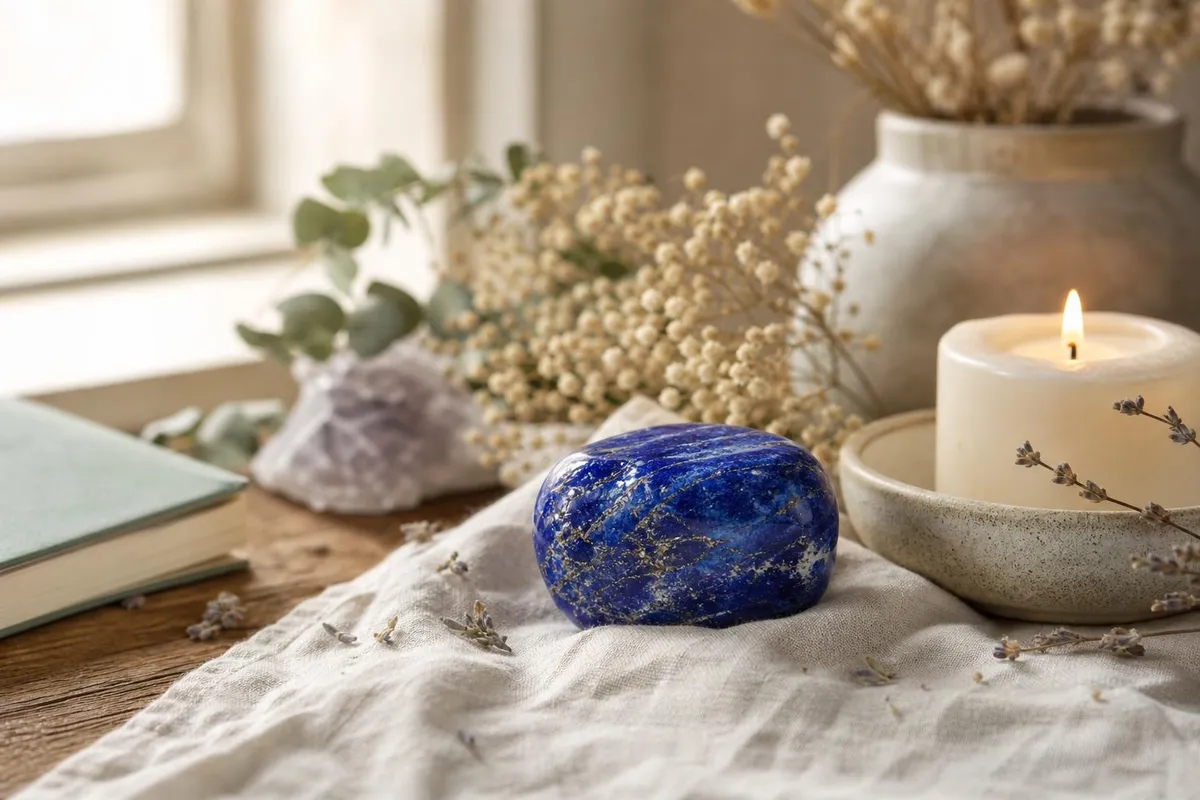
Lapis lazuli is a deep blue rock. Strictly speaking it is not a single mineral. It is mostly lazurite, which gives the blue, mixed with white calcite and flecks of golden pyrite.
That mix is why every piece looks different. One stone might be almost solid midnight blue. Another has pale streaks like cloud, or a scatter of gold like stars across a night sky.
The name comes from Latin and Persian words that roughly mean blue stone. Historically, the finest material came from mines in Afghanistan, and it travelled along trade routes for thousands of years.
What it looks like in the shop
You will usually find it as tumbled stones, polished spheres, bracelet beads, pendants and small carved pieces. A tumbled stone about the size of a thumbnail is a good starting point. It fits in a pocket, a purse or a dish by the bed.
Look for rich blue with some gold. Very pale, streaky blue with lots of white is more calcite and is usually less prized, though it can still be pretty.
What lapis lazuli stands for
The central meaning is truth. People associate lapis lazuli with saying what you actually mean, listening properly and being honest with yourself first.
Around that sit a few related ideas:
- Clear communication: finding calm words for a difficult conversation.
- Wisdom: trusting what you already know instead of second-guessing it.
- Self-awareness: noticing your own patterns without harsh judgement.
- Quiet reflection: a deep blue stone as a cue to slow down.
None of this is scientific. A crystal does not change what you say or think. What it can do is act as a small, physical reminder of an intention you have set, and many people find that reminder useful.
If you are new to crystals, our plain guide to 10 common stones puts lapis lazuli alongside other popular choices, so you can see how the meanings compare.
Pro Tip: Choose one intention per stone, such as "I speak calmly" or "I tell the truth kindly". A single clear phrase is easier to hold in mind than a list of hopes.
A short history of the blue stone
Lapis lazuli has been prized for a very long time. Ancient Egyptians used it in jewellery and amulets, and it appears in the famous funerary mask of Tutankhamun. Ancient Mesopotamian cultures carved it into seals and beads.
It was also ground into a pigment. Ultramarine, the intense blue seen in many Renaissance paintings, was made from lapis lazuli and was famously expensive. Artists often kept it for the most important figures in a painting.
This history explains much of the symbolism. A stone linked with royalty, the heavens and sacred art naturally came to stand for wisdom and truth.
Why it still appeals
The colour does a lot of the work. Deep blue is often associated with calm, evenings and the night sky. A piece of lapis on a bedside table or desk looks quietly serious, which suits the meanings people give it.
The gold flecks catch candlelight beautifully, which makes it a lovely object for an evening corner at home.
Lapis lazuli and the chakras
In crystal tradition, lapis lazuli is linked mainly with the throat chakra and the third eye chakra. The throat chakra is associated with speaking and expressing yourself. The third eye is associated with intuition and insight.
That fits the stone neatly, because its meanings are about honest speech and clear seeing. People who work with chakras often place lapis lazuli on the relevant area while lying down, or wear it as a pendant or bracelet.
Chakras are a spiritual framework, not a medical one. Treat the idea as a way of organising your reflection, not as a diagnosis of anything.
If you want to see how lapis sits beside the other six, our guide to crystals for chakras sets out which stone is traditionally paired with each one.
A simple throat chakra pause
- Sit or lie down somewhere comfortable.
- Hold or place the stone near the base of your throat.
- Breathe in for four counts and out for six, for about two minutes.
- Finish by saying one honest sentence aloud, such as "I can ask for what I need".
How to use lapis lazuli at home
You do not need special equipment. A stone and a few quiet minutes are enough. Here are some ordinary, realistic ways to use it.
- On your desk: keep it near your keyboard as a cue to pause before sending a difficult email.
- In your pocket: hold it before a conversation you are nervous about.
- By the bed: let it be the last thing you look at, with a glass of water and a book.
- As jewellery: a bracelet or pendant gives you something to touch when you want to steady yourself.
Some people like to set an intention while holding the stone. Hold it in both hands, take three slow breaths and say your phrase quietly or in your head. That is the whole ritual.
Many also like to cleanse stones before first use. A few seconds of incense smoke, or leaving the stone on a windowsill at night, are the usual choices. Keep it dry, and see the care section below. Our clear quartz guide covers cleansing ideas in more detail, though lapis is softer, so use only gentle methods.
An evening reflection ritual
Lapis lazuli suits the end of the day, when you are ready to be honest about how things went. This takes about ten minutes and needs a notebook, a pen, a candle and your stone.
- Dim the lights and light the candle. Put your phone out of reach.
- Hold the stone in your non-writing hand for a minute and breathe slowly.
- Write down one thing you said today that you are glad you said.
- Write down one thing you left unsaid, and what you might say tomorrow, if anything.
- Close the notebook, blow out the candle and put the stone back by the bed.
The point is not to judge yourself. It is to notice. The NHS describes mindfulness as paying attention to the present moment, including your thoughts and feelings, and a short ritual like this is one gentle way to practise that.
Pro Tip: Keep the notebook beside the stone and use the same one every night. A familiar routine makes the habit easier to keep up on tired evenings.
Using it as part of a calmer evening
Many people keep lapis lazuli by the bed as part of a wind-down. To be clear, no stone will fix poor sleep. What helps is the routine around it.
The NHS suggests a regular bedtime, a relaxing wind-down and a cool, dark, quiet bedroom. The Sleep Charity also offers practical advice on building better sleep habits. A candle, a warm drink and a stone you find soothing can all be part of that routine.
If you want a few ideas, try this order:
- Switch off screens about an hour before bed.
- Have a warm bath or wash your face slowly.
- Light a candle and spend two minutes with your stone.
- Write tomorrow's top three tasks so they are out of your head.
If you struggle to sleep for weeks, or low mood or worry is getting in the way, speak to your GP. The NHS Every Mind Matters pages are a good place to start for practical help.
Buying and caring for lapis lazuli
Lapis lazuli is relatively soft compared with many popular crystals, so it scratches more easily than quartz. It also contains calcite, which can react badly to acids and harsh cleaners.
Care in four steps
- Wipe it with a dry or barely damp soft cloth.
- Avoid soaking it, and keep it away from bath products, perfume and cleaning sprays.
- Store it separately or wrapped in cloth, so harder stones do not scratch it.
- Take bracelets off before washing up, swimming or showering.
Buying well
Imitations exist. Dyed howlite, glass and reconstituted stone are sometimes sold as lapis. Colour that looks very even, with no gold flecks or white at all, is worth a second look. Dyed or stabilised stones are not always sold as such, so ask the seller how the piece has been treated.
Also be wary of claims that a stone will cure anything. A trustworthy seller will describe meanings as traditional or symbolic and will not promise health results.
Pro Tip: Small gold flecks that look like glinting specks within the blue are usually pyrite. If the flecks look painted on or smeared, the piece may be dyed or fake.
Pairing lapis lazuli with other stones
Lapis lazuli works well on its own, but it also sits comfortably with other stones. Pairing is mostly about building a small, meaningful set for a shelf or a gift.
- With amethyst: for a calm, reflective evening corner. Our amethyst meaning guide explains why it is such a popular partner.
- With clear quartz: for a clear, simple intention. In crystal tradition, quartz is thought to amplify whatever you are focusing on.
- With labradorite: for change and intuition. Read about labradorite if you like a stone with a shimmer.
Start with two or three stones at most. A small set you actually use beats a crowded shelf you never touch.
Looking after your wellbeing is bigger than any single object. Mind and the Mental Health Foundation both share practical ideas for everyday life, and a ritual works best alongside those basics.
We have found that people rarely keep a crystal habit because of the crystal. They keep it because it gives them a small, predictable pause. Lapis lazuli is a good example. Its colour is calming, it looks lovely by a candle, and it is easy to hold while you think. We would always rather you buy one stone you love and use it nightly than a bag of ten you forget. And if something is weighing on you, talk to someone you trust.
- The Well In Spirit team
About Well In Spirit
If you like the idea of a calm evening ritual but do not want to assemble it piece by piece, our ritual gift boxes bring the elements together. The Better Sleep Ritual suits the wind-down described here, and The Sunday Reset works well for a slower weekend. Both are easy to give as a thoughtful present. You can browse everything at Well In Spirit, or look at our gift ideas for her. Our members' library also holds guided meditations, which pair nicely with a few quiet minutes and a stone in your hand.
Frequently asked questions
What is the spiritual meaning of lapis lazuli?
Spiritually, lapis lazuli is linked with truth, wisdom, honest speech and inner awareness. In crystal tradition it is connected with the throat and third eye chakras. These are symbolic meanings that people use for reflection, not proven effects, and it is best treated as a prompt for your own intentions.
Can I keep lapis lazuli in my bedroom?
Yes. Many people keep it on a bedside table or shelf because the deep blue looks calm. Keep it dry and away from perfume or cleaning sprays. It will not fix sleep problems, so if sleep is a persistent struggle, speak to your GP.
Is lapis lazuli safe to put in water?
It is best not to. Lapis lazuli is fairly soft and contains calcite, which can be damaged by water, soaps and acids. Clean it with a dry or barely damp soft cloth, and take lapis jewellery off before washing, bathing or swimming.
How can I tell if lapis lazuli is real?
Real lapis usually has gold pyrite flecks and some white calcite veining, and no two pieces look the same. Very even colour with no flecks can suggest dye or imitation. The surest approach is to buy from a seller who explains plainly how the stone has been sourced and treated.
Sources
- Mindfulness, NHS
- Sleep and tiredness, NHS
- The Sleep Charity, The Sleep Charity
- Every Mind Matters, NHS
- Tips for everyday living, Mind
- Mental Health Foundation, Mental Health Foundation