Labradorite meaning: what it stands for and how to use it
Labradorite meaning explained: the traditional associations of transformation, intuition and protection, plus simple ways to use this stone at home.
On this page
In crystal lore, labradorite stands for change, intuition and protection. People who work with it often call it a stone for inner journeys, and the shifting flash of blue and gold across its surface is why. None of this is proven science, so think of it as a tradition you can use as a focus for a quiet ritual at home.
This article explains where labradorite comes from, what it is said to mean, what its colours are taken to stand for, and how to use it in simple ways. It is written for anyone curious about the stone, and for anyone choosing a thoughtful gift for someone who loves crystals.
TL;DR
- Labradorite is a feldspar mineral known for a flash of colour called labradorescence.
- Traditionally it stands for transformation, intuition, protection and a calm mind.
- Use it as a pocket stone, a bedside ornament or a focus during journalling and meditation.
- Pair it with amethyst or rose quartz for a gentler, more soothing ritual.
- It is a keepsake for your routine and does not treat any health condition, so see a GP if symptoms persist.
What labradorite is
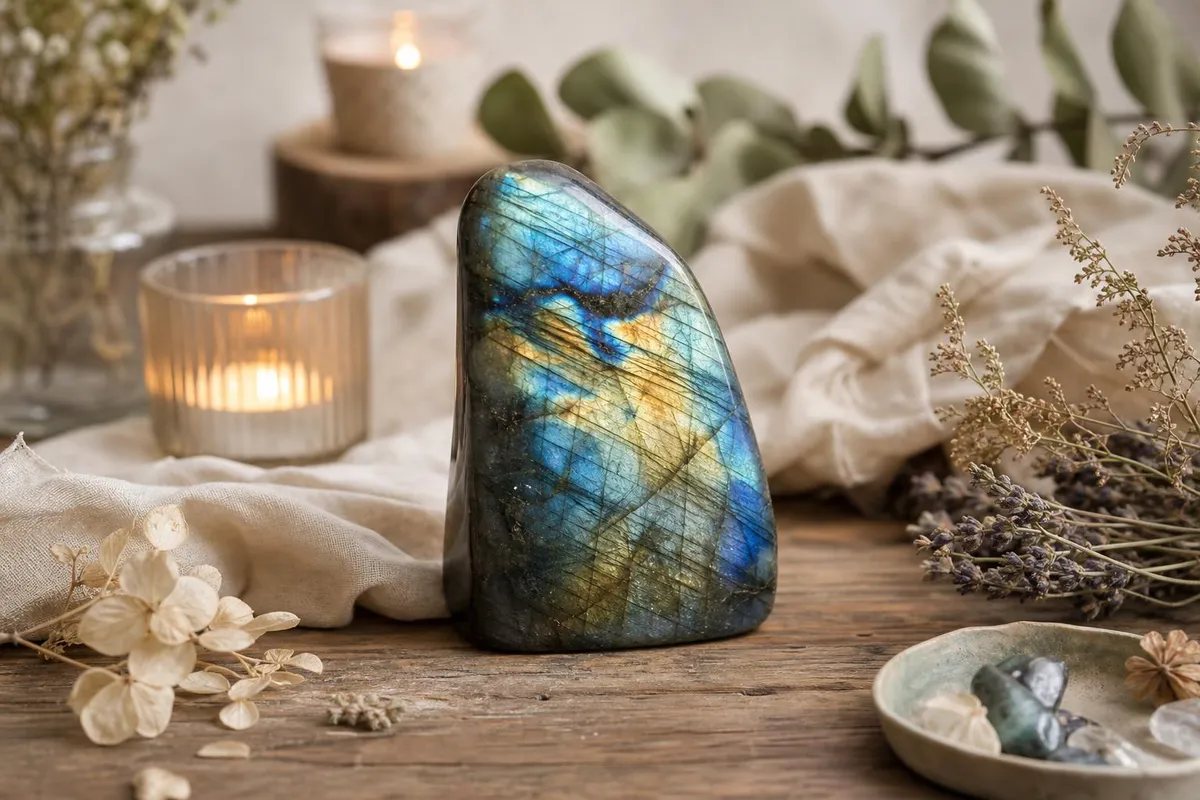
Labradorite is a type of feldspar. It is usually grey, greenish grey or dark, and it looks fairly plain until you tilt it towards the light. Then a sheet of blue, green, gold or even orange seems to move across the surface.
That effect is called labradorescence. It happens because light interacts with thin layers inside the stone, which is simply the way the mineral is built. It is also why no two pieces look quite the same.
The name comes from Labrador in Canada, where the stone was described in the eighteenth century. Today it is also found in places such as Madagascar and Finland. A particularly vivid Finnish form is often sold as spectrolite.
Labradorite is fairly hard but can chip if it is dropped. That is worth knowing if you plan to carry it around.
If you are new to crystals, our plain guide to 10 common crystal meanings puts labradorite in context alongside other popular stones.
Labradorite meaning in crystal lore
Most crystal writers describe labradorite as a stone of transformation. It is linked with moments of change, such as a new job, a house move, the end of a relationship or simply a new season of life.
The other common themes are these:
- Intuition: a nudge to listen to your own instincts before asking everyone else.
- Protection: a sense of a quiet shield around you, especially in busy or draining places.
- Imagination: a stone for writers, artists and daydreamers.
- Calm reflection: a reminder to pause and look beneath the surface of a situation.
These are traditional associations, passed on by crystal writers and shops. They are not medical or scientific claims, and no stone will change your circumstances by itself. What it can do is act as a small, physical reminder of the intention you set.
Many people choose labradorite as a protective stone for the home or handbag. If that interests you, our guide to crystals for protection covers seven stones and simple ways to place them.
Pro Tip: Write your intention on a small slip of paper, such as "I trust my own judgement", and keep it under your labradorite on your desk. It gives the stone a clear job.
What the colours of labradorite are said to mean
Part of the appeal of labradorite is that the flash changes with the angle. Crystal traditions give each colour its own flavour, though sources vary, so treat the list below as a loose guide rather than a rulebook.
- Blue flash: very common. Linked with calm communication and clear thinking.
- Green flash: linked with growth, patience and a steady pace.
- Gold or yellow flash: linked with confidence and optimism.
- Orange or pink flash: less common, and linked with warmth and creativity.
You do not need a particular colour for the stone to be meaningful. Plenty of people simply choose the piece that catches their eye.
Grey body, bright flash
Some people like the idea that the dull grey body hides a bright centre. It is a neat image for days when you feel low-key but know you have something to offer. Holding the stone and tilting it slowly can be an absorbing, grounding thing to do.
How to use labradorite at home
You do not need special equipment. A few minutes and a stone you like is plenty. Here are four simple ways to begin.
- Carry it. Keep a small tumbled piece in a coat pocket or bag. When you feel rushed, hold it for three slow breaths.
- Place it on your desk. Use it as a visual cue to take a proper break and step away from the screen.
- Journal with it. Put it beside your notebook and write for ten minutes about a change you are facing. Finish by writing one small next step.
- Meditate with it. Hold it in your palm, watch the flash of colour for a minute, then close your eyes and notice your breathing.
The last two work well alongside mindfulness. The NHS describes mindfulness as paying attention to the present moment, including your thoughts, feelings and body, and a stone gives your attention something simple to rest on.
For a brighter ritual, you could set a piece of labradorite beside a citrine on a sunny windowsill. We cover that stone in our citrine crystal meaning guide.
Pro Tip: Turn the stone slowly in your hand while you breathe out for longer than you breathe in. The movement gives your hands something to do and keeps your mind from wandering.
A calm evening ritual with labradorite
Evenings are when many of us use crystals most, because that is when the house goes quiet. This is a ten-minute routine you can repeat as often as you like.
- Dim the main lights and light a soy wax candle.
- Put your phone in another room or on silent.
- Hold the labradorite and tilt it until you see the flash.
- Write down three things on your mind, then close the notebook.
- Place the stone on your bedside table as a signal that the day is done.
The point is the routine, not the stone itself. The Sleep Charity offers practical advice on sleep habits, including keeping a steady pattern before bed.
If you have had trouble sleeping for a long time, a ritual is not a substitute for advice. The NHS guidance on insomnia explains when to speak to a GP.
Stones that pair well with labradorite
Labradorite has a cool, thoughtful feel. Pairing it with other stones lets you shape the mood of a ritual.
Amethyst for rest
Amethyst is traditionally linked with calm and rest. A piece beside your labradorite makes a good bedside pairing. Read our amethyst crystal meaning guide for more on how it is used.
Rose quartz for kindness
Labradorite is about looking inward, and rose quartz is about being gentle with yourself while you do it. If you are going through a change and feeling tender, this is a kind pairing. Our rose quartz meaning post explains why.
You can also group stones on a small dish or tray. Keep it simple: one main stone, one or two supporting ones, and a candle. Too many can feel cluttered, which defeats the purpose.
Choosing and caring for your labradorite
When you buy labradorite, look at it in natural light and tilt it. A good piece shows a clear flash from at least one angle. A tumbled stone suits a pocket, while a larger polished piece suits a shelf.
Be a little wary of very cheap stones with unusually vivid colours. Some crystals are dyed or treated, so it is fair to ask a seller whether a piece is natural.
Care is easy:
- Wipe it with a soft, dry or barely damp cloth.
- Keep it away from knocks, as it can chip.
- Store it separately from harder stones that might scratch it.
- If you like to cleanse your crystals, many people pass them through incense smoke or leave them in moonlight. This is a personal ritual and not a practical necessity.
Labradorite also makes a considered gift. A small piece in a pouch, with a short note about why you chose it, feels personal without being showy.
What labradorite cannot do
It is worth being honest here. Labradorite is a lovely object, and rituals built around it can feel calming and meaningful. But it does not treat, cure or prevent any illness, and it is not a replacement for medical or mental health support.
If you feel anxious, low or exhausted and it does not ease, speak to your GP. Mind has clear information and support for mental health problems, and the NHS Every Mind Matters pages offer practical self-care ideas that sit well alongside any ritual.
Used sensibly, a stone is a prompt. It reminds you to slow down, breathe and check in with yourself.
In our experience, labradorite is the stone people pick up and then do not want to put down. We think that is because it asks for a moment of attention: you have to tilt it to see it properly. We suggest treating it like a small pause button, with a few slow breaths, one flash of colour and then back to your evening. It does not need to be more than that.
- The Well In Spirit team
About Well In Spirit
If labradorite has made you curious about crystals and small rituals, you might like to browse Well In Spirit, where we sell crystals, botanical soy wax candles, incense and palo santo, and tarot and oracle cards. We also put together gift boxes that bring a few calming pieces into one place, and our members' library of guided meditations is a simple next step if you would like some company in your evening routine. None of it is essential, but it can make a slower evening feel a bit more deliberate.
Frequently asked questions
What does labradorite mean spiritually?
Spiritually, labradorite is linked with transformation, intuition and protection. People who use crystals often reach for it during times of change, or when they want to trust their own instincts. These are traditional associations rather than proven effects, so treat it as a focus for reflection.
Who should wear or use labradorite?
Anyone who likes the stone can use it. It is often chosen by people going through a change, creative people, and those who like the idea of a quiet, protective stone. There are no rules, and the best piece is usually the one you are drawn to.
Can I keep labradorite in my bedroom?
Yes. Many people keep a small piece on a bedside table as part of an evening wind-down. It is a keepsake and not a treatment, so if you are struggling to sleep for weeks, speak to a GP or read the NHS advice on insomnia.
How do I tell if labradorite is real?
Real labradorite shows a flash of colour that shifts as you tilt it and disappears from other angles. Overly even, bright colour across the whole stone can suggest a treated or imitation piece. Buying from a seller who is open about their sourcing is the easiest safeguard.