10 Fast Grounding Rituals to Copy Today, Trauma Safe and UK Informed
Copy 10 fast grounding techniques and three short ritual templates. NHS informed and trauma safe, with simple scripts you can use today.
On this page
A grounding ritual is a short practice, built from breath, movement or the senses, that brings your attention back to the present moment and settles an overwhelmed nervous system. If you need relief right now, try the 5-4-3-2-1 technique: name five things you can see, four you can feel, three you can hear, two you can smell and one you can taste.
- ✓Curated ritual collections
- ✓Aromatherapy products
- ✓Guided meditations
- ✓Spiritual wellbeing experiences
Key Takeaways
Grounding techniques are quick, sensory-based practices that help reset the nervous system and reduce distress by redirecting attention to the present moment.
| Point | Details |
|---|---|
| Use the five senses | Name five things you see, four you feel, three you hear, two you smell, and one you taste. |
| Keep practices short | Engage in grounding for 30 seconds to a few minutes, pairing quick exercises with daily routines. |
| Personalize grounding methods | Select techniques based on your state, such as movement for restlessness or sensory jolt for numbness. |
| Incorporate physical cues | Use small objects or scents to reinforce rituals and make grounding easier to repeat. |
| Well In Spirit approach | We recommend structured, simple routines with sensory items to support consistent grounding practice. |
What grounding does and who it helps
Grounding works by shifting your attention away from racing thoughts and onto direct sensory input: the weight of your feet on the floor, the temperature of the air, a sound nearby. This redirection interrupts the spiral of anxious or dissociative thinking and gives your nervous system something concrete to settle on instead.
Clinical guidance from the Tavistock and Portman NHS Foundation Trust frames grounding as a stabilisation tool rather than a quick fix: it creates distance from distressing thoughts or memories so you can return to the present on your own terms. That framing matters because grounding is not about forcing calm, it is about building a bridge back to now.
People reach for grounding in quite different states:
- Anxiety or panic: racing heart, shallow breath, a feeling of losing control.
- Dissociation: a sense of unreality, numbness or disconnection from your body.
- Everyday overwhelm: too many tabs open in your head before a big meeting or a hard conversation.
Research on trait mindfulness, including acting with awareness and non-judgemental acceptance, has found these qualities linked to fewer symptoms of post-traumatic stress, which lends some scientific weight to why present-moment attention practices help so many people.
Immediate grounding techniques for a crisis moment
When distress hits hard, you do not need a long routine, you need something fast and reliable. These techniques work because they give your attention somewhere specific to land.
- 5-4-3-2-1 sensory scan: name five things you see, four you feel, three you hear, two you smell, one you taste, moving slowly through each sense in turn, as described in NHS guidance on managing anxiety.
- Square breathing: inhale for 4 seconds, hold for 4, exhale for 4, hold for 4, and repeat for a minute or two, a pattern recommended in NHS breathing technique guidance.
- Diaphragmatic breathing: place a hand on your abdomen and breathe so that hand rises and falls, keeping the exhale slow to avoid light-headedness.
- Cold anchor: hold an ice cube or run cold water over your hands, a sharp, safe sensory jolt that pulls focus into the body.
- Feet to floor: press both feet flat into the ground and notice the pressure, the texture, the temperature beneath them.
- Butterfly hug: cross your arms over your chest and tap your shoulders alternately, a gentle, rhythmic self-soothing motion.
- Tapping: lightly tap your fingertips against your thigh or collarbone in a steady beat.
- Movement release: stomp your feet, shake out your arms or take a brisk walk, letting the body discharge some of the tension.
- Strong taste or smell: eat something crunchy or sharply flavoured, or smell a strong scent such as citrus or peppermint, both listed in Royal Berkshire NHS grounding guidance.
- Speak it aloud: say out loud what you can see, hear and feel, or simply state your name, the date and where you are.
Different states call for different tools. Movement suits restlessness and a racing heart, while a sensory anchor such as ice or scent often works faster for dissociation or numbness. NHS leaflets also suggest pairing a sensory anchor with movement for faster orientation back to the present.
Pro Tip: Keep one small grounding object (a smooth stone, a textured keyring) in your bag or pocket so a physical anchor is always within reach.
Ritual templates you can copy today
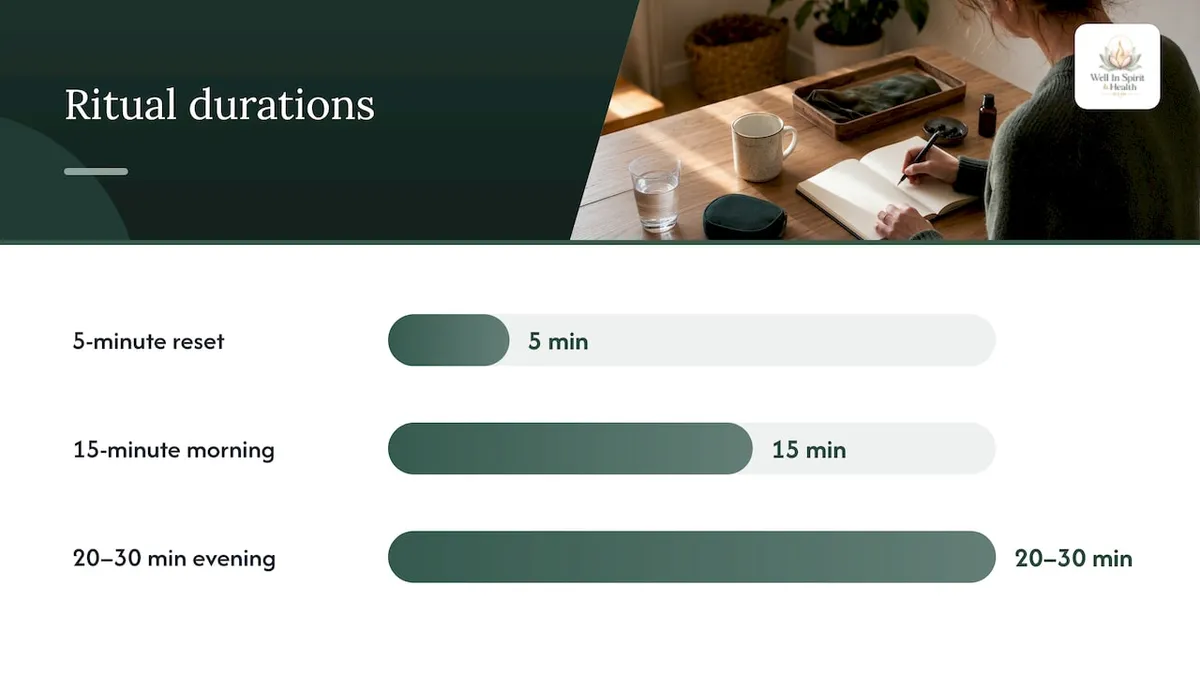
A ritual is simply a grounding technique given structure and repetition. These templates need no special kit, just a few quiet minutes.
The five-minute reset
- Minute 1: sit or stand still, feet flat, and take a few diaphragmatic breaths.
- Minutes 2 to 3: run through the 5-4-3-2-1 sensory scan.
- Minute 4: do the butterfly hug for several slow rounds.
- Minute 5: name one thing you are grateful for in this exact moment.
The 15-minute morning ritual
- Five minutes of gentle movement: stretching, stomping, or a short walk.
- Three minutes of square breathing to settle the nervous system.
- Two minutes setting a single intention for the day, spoken or written.
- Five minutes with a sensory anchor, a scented oil, a warm drink held in both hands, or sunlight on your skin.
The 20 to 30-minute evening ritual
- Dim the lights and spend five minutes on a slow sensory wind-down: warm water on your hands, a soft blanket, quiet music.
- Journal for ten minutes on one prompt: what grounded you today, or what you want to release before sleep.
- Close with five to ten minutes of diaphragmatic breathing, lying down if that feels safe.
A little kit can make rituals feel more deliberate without adding cost or complexity: a smooth object to hold, a candle, or a few drops of a calming oil on your wrists. None of this is required, the breath and the senses are always available, but a small physical cue can make a ritual easier to repeat daily.
How to personalise grounding so it actually sticks
The right technique depends on your baseline state. If you are wired and restless (hyperarousal), movement-based grounding such as stomping or brisk walking tends to work faster than stillness. If you feel numb or shut down, a strong sensory jolt, cold water, a sharp taste, often breaks through more effectively than breathing alone.
- Anchor grounding to existing habits: a 30 to 60 second practice before sleep, before a stressful call, or after a difficult meeting increases adherence far more than trying to remember a new routine from scratch.
- Start small: a single breath or a ten-second sensory check-in counts. Frequent, short practices build the habit faster than one long session you dread.
- Track what works: a simple note of which technique helped on which day turns trial and error into a personal toolkit.
- Watch for signs it is not helping: if grounding consistently increases distress, or you find yourself avoiding it out of dread, that is worth raising with a GP or therapist rather than pushing through alone.
Trauma-sensitive grounding: safety first
Stillness-based practices are not universally calming. For some people, especially those with recent trauma, sitting in silence or closing their eyes can intensify distress rather than settle it, a caution raised in guidance on trait mindfulness and post-traumatic stress symptoms and echoed in clinical trauma-sensitivity reviews. The nervous system can read enforced quiet as a loss of control rather than safety.
Practical adaptations help:
- Keep practices short, thirty seconds to two minutes, rather than insisting on a long session.
- Offer movement-first options (stomping, arm swings) for anyone who finds stillness destabilising.
- Let the person choose and set limits: an agreed “exit” cue, such as a word or hand signal, preserves a sense of agency during home practice.
Grounding works best when it offers a sense of choice and control. A menu of brief practices tends to serve people better than insistence on one correct method.
If a technique increases panic, dizziness or flashback-like symptoms, stop and seek support from a GP, therapist or crisis line rather than continuing alone.
How Well In Spirit & Health supports your ritual practice
We build our ritual collections around the same principle clinical guidance points to: choice and simplicity beat a single rigid method. Each kit pairs a guided sequence with a small number of sensory items, so there is less decision-making involved when you are already stretched thin.
When choosing tools for your own practice, favour portability (something pocket-sized), scent you actually enjoy rather than what is trending, and simplicity over elaborate steps you will not repeat.
The science behind why grounding calms you down
Grounding techniques work in good part by interrupting the attentional loop that keeps anxious or traumatic thoughts cycling. When you focus on a specific sensory detail, cold water, a textured object, the sound of traffic, your brain has less spare capacity for rumination, and the shift in focus itself tends to ease physical tension.
Breath-based grounding adds a second mechanism. Slow, deliberate exhalation is widely recommended by UK health services as a way to calm the body during hyperventilation and to support a general relaxation response. Square breathing’s structured count (4 seconds in, hold, 4 out, hold) gives the mind a simple task to follow, which further reduces the mental space available for spiralling thoughts.
The research on trait mindfulness supports a broader version of this idea. A synthesis of findings linked mindfulness facets, particularly acting with awareness and accepting experience without judgement, to a meaningful reduction in post-traumatic stress symptoms, suggesting that the skill of returning attention to the present has measurable value beyond the moment it is practised.
None of this means grounding erases distress. It gives the nervous system a foothold, a way to step out of escalation long enough to think clearly or seek further support if needed.
Common myths about grounding rituals
Several ideas about grounding circulate that do not hold up well against how these practices actually work.
Myth: grounding has to involve sitting still and silent. For many people it does not, and for some it actively makes things worse. Movement-based grounding, stomping, walking, shaking out the arms, is a legitimate and often faster-acting alternative.
Myth: one technique works for everyone. Clinical guidance consistently favours offering a menu of options over insisting on a single method, because what calms a racing heart is not always what helps someone who feels numb or disconnected.
Myth: grounding fixes the underlying problem. Grounding is a stabilisation tool. It creates enough distance from distress to think or act, but it is not a substitute for addressing what caused the distress in the first place.
Myth: you need special equipment. Your breath, your feet on the floor and your senses are always available. A scented oil or a textured object can support a ritual, but they are not prerequisites.
Myth: grounding is only for severe anxiety or trauma. Many people use short grounding practices simply to manage everyday overwhelm, before a meeting, after a stressful call, or during a hectic afternoon.
Where grounding practices come from
Grounding as a clinical term emerged from trauma therapy, where practitioners needed reliable, teachable ways to help people manage dissociation and flashbacks without requiring insight-oriented talk. The sensory and breath-based techniques used today draw on a mix of occupational therapy, somatic practice and mindfulness traditions that developed across the twentieth century.
Many of the individual components, however, are far older. Attention to breath has roots in contemplative traditions across Asia going back centuries, while the idea of using nature and physical contact with the earth to restore a sense of calm appears across numerous cultures long before modern psychology adopted the language of “grounding”. Ecotherapy programmes in the UK now draw explicitly on this lineage, with clinical teams reporting that outdoor, nature-attuned sessions help participants feel calmer and more connected.
What has changed is the packaging: short, structured, repeatable techniques designed for a crisis moment, built out of practices that were once embedded in longer spiritual or communal rituals.
Grounding versus mindfulness and meditation
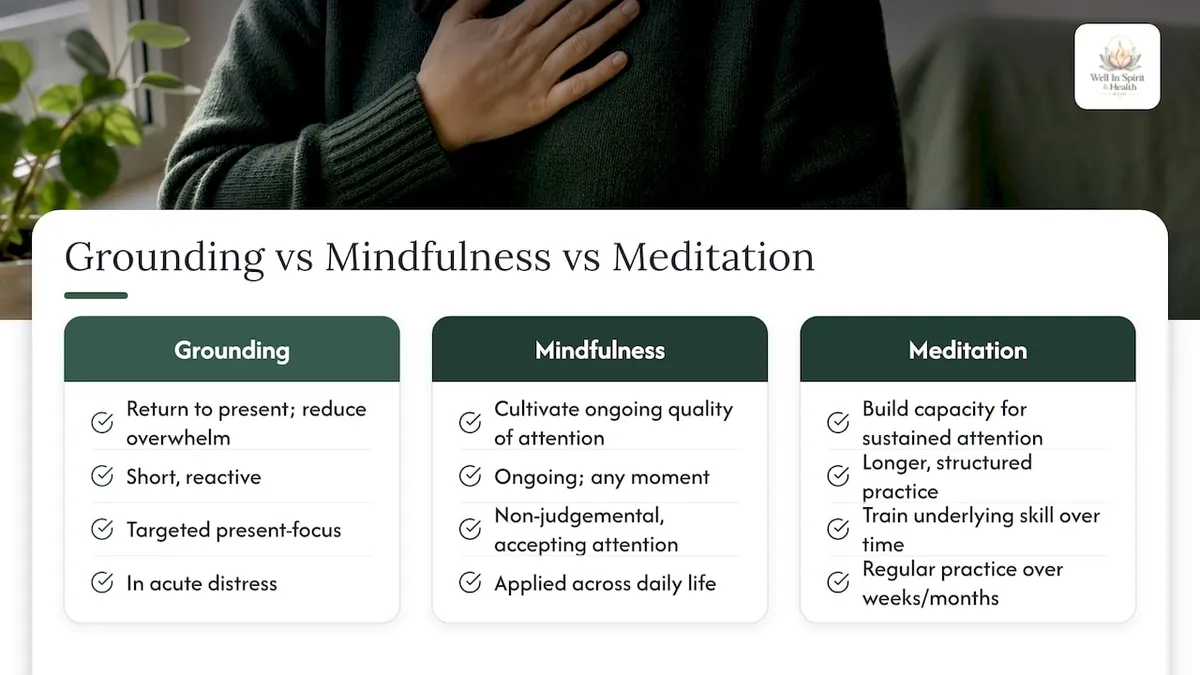
Grounding, mindfulness and meditation overlap but are not interchangeable. Grounding is typically short, targeted and reactive: a specific technique reached for in a moment of distress, with the explicit goal of returning to the present and reducing overwhelm quickly.
Mindfulness is broader. It describes an ongoing quality of attention, non-judgemental, aware, accepting, that can be cultivated over time and applied to any moment, not just distressing ones. Grounding techniques often draw on mindfulness principles, but mindfulness itself is not a single exercise.
Meditation is a dedicated practice, usually longer and more structured, often used to build the capacity for sustained attention or stillness over weeks and months. Where grounding is reaching for a tool in a crisis, meditation is closer to training the underlying skill over time.
In practice, the three work well together: grounding for the acute moment, mindfulness as the attitude you bring to daily life, and meditation as the longer practice that strengthens both.
A personal note on keeping it simple
My own grounding habit is unglamorous: three slow breaths with a hand on my chest before I open my laptop each morning. It is not profound, but it is reliable, and reliability is what makes a ritual stick.
— Rob
Bring grounding into your everyday rituals
Our ritual collections combine a guided sequence with sensory items and prompts to help make grounding feel like a complete moment rather than one more task on a list. The Awakening Ritual suits anyone starting out, while our Chakra & Third Eye Awakening Ritual offers a deeper sequence for those wanting more structure.

For an ongoing practice rather than a single kit, our Well In Spirit Membership gives you continued access to guided content and seasonal ritual collections. Browse the full range and find the starting point that suits you.
FAQ
What are grounding rituals?
A grounding ritual is a short, repeatable practice, often combining breath, movement or sensory focus, used to bring attention back to the present moment. NHS guidance frames techniques like the 5-4-3-2-1 method as a practical way to redirect attention during distress.
How long should you ground each day?
There is no fixed daily duration, but short, frequent practices, thirty seconds to a few minutes, tend to build the habit more reliably than occasional long sessions. Clinical guidance suggests pairing brief grounding moments with daily triggers, such as before sleep or after a stressful call.
What are the five rules of grounding?
There is no single official “five rules” framework; definitions vary across sources. A common approach draws on the five senses, as in the 5-4-3-2-1 technique: naming five things you see, four you feel, three you hear, two you smell and one you taste.
How do I ground myself immediately?
Try square breathing: inhale for 4 seconds, hold for 4, exhale for 4, hold for 4, repeated for a minute, as described in NHS breathing guidance. Pressing your feet flat into the floor or holding an ice cube can work just as quickly if breathing alone feels difficult to focus on.