What Are Oracle Cards? A Plain UK Guide for Beginners
Find out what oracle cards are, how they differ from tarot, and how to choose and use a first deck at home with this plain UK beginner's guide.
On this page
Oracle cards are decks of illustrated cards, each carrying an image and usually a word or short message, that people draw to prompt reflection. There is no fixed set of cards and no fixed rulebook, so every deck works a little differently. They are tools for thinking and journalling, not a way of predicting the future.
This guide explains how oracle cards work, how they differ from tarot, what to look for in a first deck and how to do a simple reading at home. It is written for curious beginners, and for anyone buying a first deck for a friend or relative.
TL;DR
- Oracle cards are freeform decks of images and messages used to prompt reflection.
- Unlike tarot, they have no standard 78-card structure, so each deck sets its own themes.
- Choose a first deck by the artwork and the tone of the guidebook, not by the number of cards.
- A simple reading is one card, one question and five minutes with a notebook.
- Oracle cards support reflection, and they are not a substitute for professional advice.
What oracle cards are
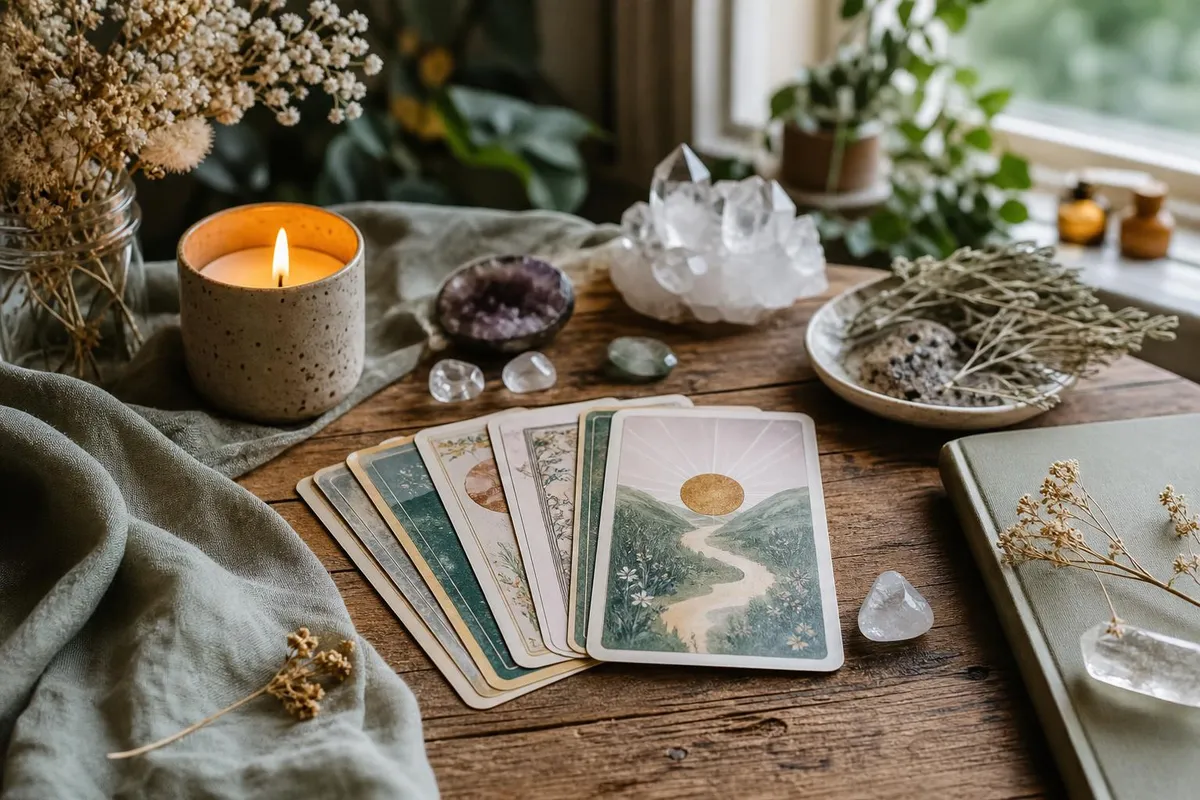
An oracle deck is a set of cards made by an artist or author around a theme. The theme might be animals, moon phases, plants, goddesses, gentle affirmations or the seasons. Each card has an image, often a title, and usually a short message in the accompanying guidebook.
Many decks hold somewhere between 30 and 60 cards, though there is no rule. You shuffle, ask yourself a question, and draw one or more cards. Then you read the image and the message and see what it stirs up.
The word oracle can sound grand. In practice, most people use the cards the way they might use a journalling prompt. You draw a card showing a lantern in a dark wood, and it nudges you to think about what feels uncertain this week and what small light you already have.
The cards do not know anything about you. They simply give you a gentle excuse to pause and notice what you already think.
Oracle cards and tarot: the difference
Tarot has a set structure. A standard deck has 78 cards: 22 major arcana and 56 minor arcana in four suits. Readers learn established meanings and spreads, and that history is part of the appeal.
Oracle decks have no such structure. The creator decides how many cards there are, what they mean and how to use them. That makes them simpler to pick up, because there is nothing to memorise.
Which suits a beginner?
Many beginners start with oracle cards because the messages are often written in everyday language. Tarot can feel like learning a small language. Some people enjoy that, and some find it puts them off before they begin.
- Choose oracle if you want something gentle, quick and journalling-friendly.
- Choose tarot if you like structure, symbolism and slowly building skill.
Neither is better. Plenty of people own both and reach for oracle cards on tired evenings and tarot when they have time to study a spread.
Pro Tip: If you cannot decide, start with oracle. A deck with a clear guidebook lets you learn how you like to read cards before you commit to the larger tarot system.
What you will find in a deck
Open a typical oracle box and you will find the cards, a guidebook and sometimes a short leaflet on how to shuffle and lay them out.
The cards
Look at the card stock, the edges and the size. Larger cards are easier to read but harder to shuffle with small hands. Matt finishes feel softer, while glossy ones slide more easily. Some decks come with gilded edges, which look lovely on a shelf.
The guidebook
This matters more than people expect. A good guidebook gives each card a short message and perhaps a question to journal on. A thin one that gives only a single keyword per card leaves you to do more of the interpreting.
Some decks also include reversed meanings, where a card is drawn upside down. Many oracle decks ignore this, which keeps things simple.
The best way to judge a deck is to read the guidebook's tone. If the language is warm, plain and not preachy, you will probably enjoy using it. If it makes grand promises about your future, put it back.
How to choose your first deck
Choose the artwork first. You will be looking at these images for months, so they should make you want to sit with them. Then check the tone of the messages, and finally the practical size and finish.
- Pick a theme you already like. Plants, the moon, animals, the seasons or gentle affirmations all work well.
- Read a few sample cards. Many shops and publishers show sample cards. Notice whether the messages feel kind and useful.
- Check the guidebook. A full paragraph per card gives you more to work with than a single word.
- Think about when you will use it. A small deck fits in a bag. A larger one suits a bedside table or altar.
Be wary of decks that use fear or urgency. A card should leave you more thoughtful, not more anxious. If a message makes you feel worse, it is fine to skip it.
Pro Tip: Hold the deck in a shop if you can. If you are buying online, look for a buyer's photo of the cards in a hand so you can judge their real size.
A simple first reading at home
You do not need a cloth, candles or a special moment. You need a quiet corner, a notebook and about five minutes. Many people like to do this in the evening with a cup of tea.
- Settle. Take three slow breaths and put your phone out of reach.
- Choose a question. Keep it open, such as: what do I need to notice today?
- Shuffle. Do this for as long as feels right, then draw one card.
- Look first, read second. Spend a minute with the image before opening the guidebook.
- Write. Jot down two or three lines on how the card lands for you.
If you like the idea of pairing the cards with a short, structured practice, our five-minute intention setting ritual works well alongside a single card.
One card a day is plenty. Pulling five because the first did not feel right usually just adds noise.
Using oracle cards in a ritual
Cards sit naturally inside small rituals because they give you a clear start and end. Draw a card, think, write, close the deck. That rhythm can help an evening feel more settled.
The Mental Health Foundation is a good place to read more about looking after your wellbeing day to day. A short card ritual is one small way to build in a pause.
Ways to build a ritual
- Sunday reset: draw one card to set a theme for the week ahead.
- Evening wind-down: draw a card, write three lines, then turn off the lights.
- New and full moons: use the cards for reflection and release. Our full moon ritual guide shows how.
A candle, a mug of chamomile tea or a stick of incense can mark the start. These are cues for your mind rather than anything the objects do on their own. What matters is that you do it at roughly the same time and in the same place.
What oracle cards cannot do
Oracle cards cannot predict the future, diagnose anything or tell you what to decide. They are prompts. Any meaning comes from you, and that is a strength, not a flaw.
If you are feeling low, anxious or struggling to sleep, cards are no replacement for proper support. The NHS Every Mind Matters pages offer practical advice, and your GP is the right person to speak to if symptoms continue. Mind also publishes plain guidance on looking after yourself day to day.
Be cautious, too, about anyone who charges a lot for readings that promise specific outcomes. A card can start a conversation with yourself, but it should never make a big money, health or relationship decision for you.
If you enjoy the more hopeful side of card work, it helps to know what people mean by intention and manifestation. Our plain UK guide to manifestation explains it without the hype.
Pro Tip: Write the date beside each card in your notebook. In a few months you can look back and see which themes keep returning, which tells you far more than any single draw.
Giving oracle cards as a gift
A deck is a thoughtful, low-pressure present. It is small, easy to post and suits someone who likes journalling, quiet evenings or a little ritual. It works for newcomers and old hands alike.
Choose a theme that matches the person. A plant lover might enjoy a botanical deck. Someone who likes the moon may prefer lunar artwork. If you are unsure, pick gentle affirmation-style cards over anything heavily symbolic.
Pair the deck with something that makes the moment feel complete:
- a soy wax candle for the evening draw
- a small notebook for journalling
- a tin of herbal tea or a bath treat
If you are shopping for someone who is more into the witchy side of things, our guide to witchcraft gifts and what to avoid helps you pick well.
A screen-free card draw can also be part of an evening wind-down routine. The Sleep Charity shares practical advice on sleep if you want to read more.
We have watched people open a deck on Christmas morning and go quiet for ten minutes, just turning the cards over. The best ones are never the most elaborate. They are the ones with artwork you want to keep looking at and a guidebook that talks to you like a kind friend. We would rather you pick one deck you love than three you feel you ought to use. Start with one card, a notebook and a quiet evening, then see whether it becomes a habit.
- The Well In Spirit team
About Well In Spirit
At Well In Spirit we sell self-care gifts including candles, crystals, incense and bath treats, so a card ritual is easy to build around a deck. You can browse everything in our gifts collection and choose whatever feels right.
Frequently asked questions
Are oracle cards the same as tarot cards?
No. Tarot follows a set 78-card structure with established suits and meanings. Oracle decks have no standard structure, so the creator chooses the number of cards, the themes and the messages. That makes oracle cards simpler to start with, while tarot suits people who enjoy learning a symbolic system.
Do I need to be spiritual to use oracle cards?
No. Many people use them purely as journalling prompts. You draw a card, look at the image and write down what it brings up. You can treat them as a creative reflection tool and ignore any spiritual language in the guidebook if it does not suit you.
How many cards should I draw?
One card is plenty for a daily practice. Three cards can work for a weekly check-in, perhaps for past, present and future themes, or for mind, body and spirit. More than that tends to add confusion. Start small and add cards only if it feels useful.
Can oracle cards predict the future?
No. They cannot foretell events, and a good deck will not claim to. They work as prompts that help you notice your own thoughts and feelings. For decisions about health, money or relationships, speak to a qualified professional, and see your GP if symptoms persist.
Sources
- Every Mind Matters, NHS
- Tips for everyday living, Mind
- Mental Health Foundation, Mental Health Foundation
- The Sleep Charity, The Sleep Charity