Incense Meaning: What It Symbolises and How to Use It
Discover the incense meaning behind common scents and rituals, plus simple, safe ways to burn incense at home to mark a calm, intentional pause.
On this page
Incense meaning depends on the culture, the scent and your own intention. Across history, burning incense has stood for offering, purification, focus and a marker between the busy part of the day and the quiet part. At home today, it most often means one simple thing: I am pausing now.
This article explains where incense symbolism comes from, what the common scents are traditionally said to represent, and how to use incense safely in a UK home. It is for anyone curious about the meaning behind the smoke, and for people choosing a thoughtful gift for someone who loves a ritual.
TL;DR
- Incense traditionally symbolises offering, purification, focus and the start of a quiet moment.
- Each scent carries its own folklore, such as lavender for calm or frankincense for reverence, but these are traditions rather than treatments.
- Sticks, cones and resins all work, so choose by how much smoke and scent you like.
- Ventilate the room, use a proper holder and never leave incense burning unattended.
- If smoke bothers you or someone in your home, a candle, diffuser or smoke-free ritual carries the same intention.
What incense means at its simplest
Incense is aromatic material burned for its scent. The meaning people attach to it grows from three ideas: rising smoke, changing the feel of a space, and marking a moment.
Rising smoke has long been read as a message travelling upwards. That is why incense appears in so many religious and ceremonial settings as an offering. The act of lighting it says: this time is set apart.
In a modern self-care ritual, the meaning is gentler and more personal. Lighting a stick can mean:
- I am finished with work for today.
- I am giving this space my attention.
- I am starting something new, such as a bath, a journal page or a meditation.
None of this requires belief in anything specific. The meaning is the cue. Doing the same small thing at the same time each evening signals that it is time to slow down, much as a bedtime routine does. The NHS advice on sleep includes setting up a regular, relaxing bedtime routine, and a scent ritual can sit comfortably inside one.
A short history of incense symbolism
Incense is very old. Resins such as frankincense and myrrh have been burned in temples and homes across the Middle East, Egypt, India and China. They were valuable, traded over long distances, and often reserved for sacred use.
Offering and purification
In many traditions, fragrant smoke was an offering to the divine and a way to purify a space before prayer or ceremony. In some Christian churches, frankincense is still burned at services. In Buddhist and Hindu practice, incense is often part of devotion at home shrines.
Japan and the art of listening
In Japan, the practice of kodo treats incense as something to be quietly appreciated, often described as "listening" to the scent rather than smelling it. That idea suits modern self-care well: the point is attention, not performance.
Folk and witchy traditions
Modern spiritual and witchcraft practice borrows from many of these sources. Incense is used to open a ritual, to represent the element of air and to set an intention. If you are buying for someone in that world, our guide to witchcraft gifts explains what tends to be welcome.
Treat the symbolism as inheritance, not rulebook. Borrow what feels right and be respectful of traditions that are not your own.
Common incense scents and what they traditionally mean
The meanings below come from folklore and tradition. They describe associations, not effects on the body. Scent is personal, so a smell that signals calm to one person may be too strong for another.
- Lavender: calm, rest and gentle endings. A natural pick for an evening ritual.
- Frankincense: reverence, stillness and prayer. Warm, resinous and slightly lemony.
- Myrrh: reflection and remembrance. Earthier and deeper than frankincense.
- Sandalwood: grounding and meditation. Soft, creamy and woody.
- Palo santo: a fresh start and gratitude. Sweet, with a hint of citrus and pine.
- White sage: traditionally linked with cleansing in Indigenous North American practice, which is why many people now prefer other herbs or a smoke-free option out of respect.
- Rose: self-love, tenderness and comfort.
- Cedar and pine: protection, steadiness and winter hearth rituals.
- Jasmine: romance and the night.
- Cinnamon and clove: warmth, welcome and festive gatherings.
Choose by feeling first and folklore second. If a scent gives you a headache or makes your throat tickle, put it out and open a window, whatever its symbolism says.
Pro Tip: Buy a small sampler of three scents before committing to a big box. Burn each at the same time of day for a week and note in your phone which one you looked forward to.
Sticks, cones, resins and herbs: what is the difference?
The form changes how the scent behaves, and how much smoke you get.
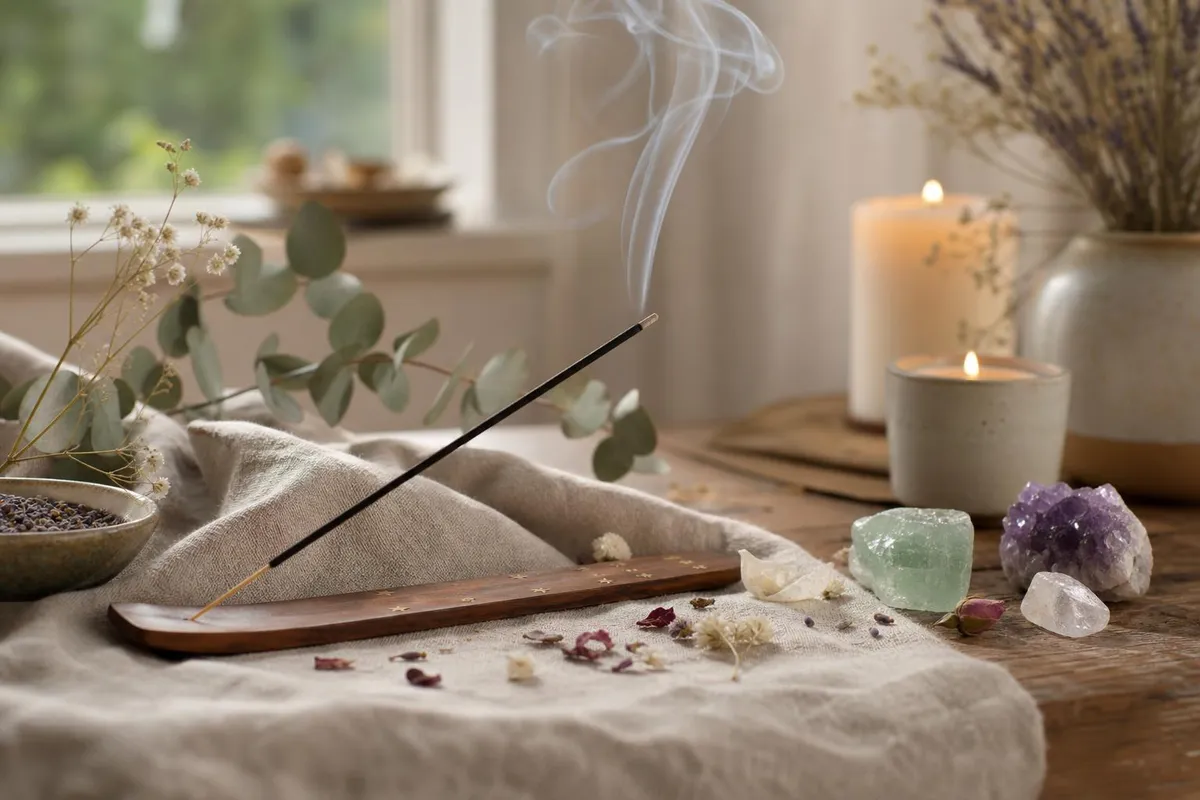
Sticks
The most common choice. A thin stick usually burns for a short while, with timings varying by brand, and is simple to light and extinguish. Look for sticks made with natural plant materials and avoid very cheap ones with a heavy synthetic smell.
Cones
Shorter and denser, cones produce a lot of scent in a small space. They need a heatproof dish and can feel strong in a small room.
Resins
Frankincense and myrrh tears are burned on a charcoal disc in a heatproof bowl with sand. They are the most traditional and the most involved. The charcoal gets very hot, so they are not ideal for beginners or homes with small children or pets.
Wood and herbs
Palo santo sticks, dried lavender bundles and cedar chips are burned or smouldered in small amounts. Use palo santo sparingly and buy from a seller who says it comes from fallen, ethically sourced wood.
For most readers, sticks are the easiest start. Our guide on how to use incense sticks walks through lighting, holders and putting them out.
How to use incense to set an intention
Meaning becomes real when you attach it to an action. This takes about five minutes.
- Tidy the space you will use, even if it is only a coffee table.
- Open a window a few centimetres.
- Choose a scent that matches how you want to feel, not how you feel now.
- Light the tip, let it flame for a few seconds, then blow it out so it smoulders.
- Place it in a holder on a stable, heatproof surface.
- Sit for three slow breaths and say one sentence in your head, such as: I am letting today go.
- When you finish, extinguish it fully.
Keep the sentence short and in the present tense. You are not making a wish. You are naming a direction.
Pair the ritual with something you already enjoy: journaling, stretching, a bath or a cup of tea. The Mind relaxation pages describe simple ways to unwind, and a scent cue can sit alongside any of them. For a monthly rhythm, try incense as the opening to our full moon ritual.
Pro Tip: Light incense before you start your ritual, not during. The first few minutes are the strongest, and you can then enjoy the lingering scent instead of fussing with matches.
Burning incense safely at home
Incense is a naked ember, so treat it like a candle. Most problems come from rushing or leaving it alone.
- Use a proper holder or ash catcher that is heatproof and wider than the stick.
- Keep it away from curtains, books, bedding and dried flowers.
- Never leave it burning when you leave the room, and never fall asleep with it lit.
- Keep it out of reach of children and pets.
- Put it out by pressing the tip into sand or a ceramic dish until it stops glowing.
- Make sure the room has fresh air, especially in small flats and bedrooms.
Smoke of any kind can irritate some people. If you or someone in your household has asthma, the NHS asthma pages are a good place to read about triggers, and it is sensible to avoid burning incense in shared rooms and to stop if anyone coughs or wheezes. If symptoms continue, speak to your GP.
Also check your smoke alarm works. It is a boring tip, but it matters more than the scent.
Pro Tip: Put a small tray of sand or a ceramic dish on a tile or coaster. It catches ash and gives you a safe place to extinguish the stick in one move.
Smoke-free ways to keep the meaning
If smoke is not for you, the meaning travels well. What matters is the cue, the pause and the intention, not the ember.
Alternatives that keep the ritual:
- A soy wax candle: a flame, a scent and a clear start and end to your evening.
- A reed or ultrasonic diffuser: gentle scent without smoke or flame. Our comparison of a diffuser or candle covers burn times and safety.
- Dried herbs in a bowl: lavender, rosemary or cedar, simply held and smelled.
- Sound: a bell, singing bowl or one slow track to mark the beginning.
If you want to refresh your home without any smoke at all, our low sensory home cleansing ritual uses open windows, tidying and gentle scent instead.
The Mental Health Foundation shares guidance on everyday wellbeing habits. A small, repeatable ritual is a good place to begin, however you light it.
Giving incense as a gift
Incense makes a good small gift because it is consumable and personal. It also carries meaning without needing explanation, which suits a card message well.
Choose with the recipient in mind:
- For a friend who likes a slow evening: lavender or sandalwood, with a ceramic holder.
- For someone starting a new chapter: palo santo, with a note about fresh starts.
- For a spiritual or witchy friend: frankincense, myrrh or cedar, plus a crystal or oracle deck. Our list of witch gifts compares ideas for different tastes.
- For someone sensitive to smoke: a candle or diffuser instead, and say you chose it with care.
Always include a holder. A stick with nowhere safe to sit is a frustration, not a gift. Add a line on safe use too. If you are unsure what to write, the NHS Every Mind Matters site has gentle self-care ideas that make a lovely card note to go with the present.
The simplest incense gifts tend to be the best: one scent, one holder and a handwritten line about why you chose it. People rarely want a big collection. They want one small ritual they can begin tonight. It is also worth asking, lightly, whether the person enjoys smoke. When in doubt, a candle needs no explanation at all.
- The Well In Spirit team
About Well In Spirit
If this has made you curious, a ritual box is an easy place to start. Well In Spirit is a UK self-care gift shop with ritual boxes, incense, palo santo, candles and crystals, each put together so there is nothing to work out on the night. You can browse everything on our gifts page.
Frequently asked questions
What does burning incense symbolise?
Traditionally, burning incense symbolises offering, purification, focus and the start of a sacred or quiet moment. Rising smoke is often seen as a message travelling upwards. In modern self-care, it usually means you are pausing and giving your attention to the present, without needing any particular belief.
Is incense the same as palo santo?
Not quite. Incense is a broad term for aromatic material burned for scent, often as sticks or cones. Palo santo is one type: a fragrant wood from South America, burned in small pieces or sticks. It smells sweet and slightly citrusy and is associated with fresh starts and gratitude.
Is it safe to burn incense every day?
Burning incense involves smoke, so keep the room ventilated, use a proper holder and never leave it unattended. Some people find smoke irritating, particularly if they have asthma or a sensitive chest. If you notice symptoms that persist, stop and speak to your GP or the NHS. A candle or diffuser is a smoke-free alternative.
Which incense scent is best for relaxing?
Lavender, sandalwood and rose are the scents most often chosen for evening rituals, and frankincense for stillness. These are traditional associations, not treatments, and scent is personal. Try a few in small amounts and choose the one you look forward to. If a smell feels too strong, put it out.
Sources
- Asthma, NHS
- How to get to sleep, NHS
- Relaxation, Mind
- Mental Health Foundation, Mental Health Foundation
- Every Mind Matters, NHS