40–60 Hours or 2–3 Months: Safe Scent Rituals With Candle or Diffuser
Choose a candle or diffuser by duration, safety, and ritual. Candles offer 40–60 hours of warm ambiance; diffusers give 2–3 months of steady scent.
On this page
Choose a candle when you want a short burst of strong scent and warm, visual ambiance for a specific moment, and choose a diffuser when you want steady background fragrance with almost no upkeep. Homes with young children, pets, or a higher fire risk should lean toward diffusers or skip open flame altogether. Most rooms actually benefit from both: a diffuser running quietly in the background, with a candle lit for occasions that call for atmosphere.
TL;DR:
- Candles release deeper, warmer notes by heat, making them ideal for scents like vanilla, amber, or spice blends, especially in larger rooms.
- Diffusers provide a steady, low-maintenance scent for several months, favoring lighter top notes such as citrus, mint, or fresh florals without fire risk.
- Candle fires caused an average of 81 civilian deaths per year in the US from 2014 to 2018, requiring constant supervision and careful placement.
- Reed diffusers pose ingestion risks, particularly for children, due to high alcohol and essential oil content, while active diffusers create microdroplets that can affect pets.
- Cost efficiency favors diffusers for long-term use, with refills lasting months and candles costing more per hour of scent, but candles offer more control over scent strength.
Pros and cons of candles
A lit candle does something a diffuser cannot: it warms the wax pool, which pushes fragrance oils into the air fast and pulls out the deeper, warmer notes in a scent, like vanilla, amber, or sandalwood. You also get direct control. Burn it longer for a stronger throw, blow it out the moment it’s strong enough, and enjoy the flicker of light that no other format replicates.
The tradeoff is risk and upkeep. Candles need supervision every time they’re lit, and they carry a real fire hazard when left unattended or placed too close to curtains or bedding.
- Ambiance and control: heat releases scent quickly and lets you adjust intensity by burn time.
- Cost per use: a single candle is a one-time purchase with a fixed burn life.
- Air quality: soot buildup and smoke can affect indoor air, especially with poor wick trims or drafts.
- Fire risk: requires constant attention near flammable materials, pets, and children.
Between 2014 and 2018, U.S. fire departments responded to an average of 7,610 home structure fires per year started by candles, causing an average of 81 civilian deaths annually. That’s a meaningful reason to treat every lit candle as something that needs your full attention, not background ambiance you walk away from.
Pros and cons of diffusers (reed and active types)
Reed diffusers work through simple evaporation: porous sticks pull scented liquid up from a bottle and release it slowly into the air, with no electricity or flame involved. Active diffusers, whether ultrasonic or nebulizing, use vibration or pressurized air to break oil into a fine mist, which spreads scent faster and more evenly across a room.
Both formats run for weeks or months with almost no attention, which makes them the lower-maintenance choice for everyday scenting. The scent is milder than a candle’s, and reed diffusers in particular depend on the liquid’s alcohol or glycol-ether content to work well, which introduces its own set of ingredients to be mindful of.
- Reed diffusers: passive, flame-free, and steady, but scent intensity is fixed by the number of reeds and their surface area.
- Active diffusers: stronger, more even scent distribution, but higher upfront cost and a cleaning routine.
- Household risk: young children can access open reed bottles, and active diffusers create fine droplets that settle on surfaces, fur, and feathers.
Pro Tip: Start with fewer reeds than you think you need. You can always add more for a stronger throw, but you can’t take scent back once it’s in the air.
How heat and delivery change fragrance character and room fit
Heat and evaporation don’t just move scent into the air, they change which part of the fragrance you actually smell. A candle’s flame warms the wax evenly, which draws out heavier base notes like wood, musk, and resin, the ingredients that need heat to open up. A diffuser works at room temperature, so it favors lighter top notes: citrus, herbs, and fresh florals that evaporate on their own without help.
That difference should guide what you buy for each room. A citrus or eucalyptus blend shines in a reed diffuser, while a spiced or woody candle earns its keep in a larger living space where heat can carry the scent further.
- Candles suit: amber, sandalwood, vanilla, spice blends, and any scent that benefits from warmth.
- Diffusers suit: citrus, mint, lavender, and green florals that read as fresh rather than deep.
- Ventilation matters: an open room dilutes both formats faster, so closed doors intensify perceived strength.
Safety: fire, indoor air, pets, and children
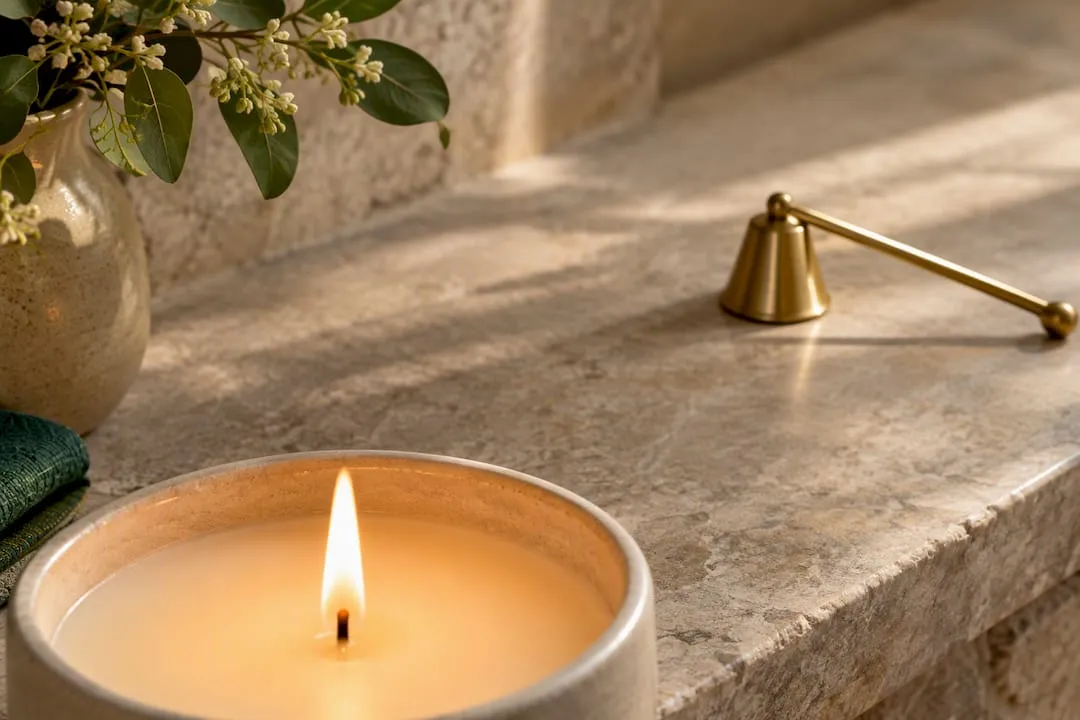
Fire is the clearest risk with candles. Unattended flames, candles left burning during sleep, and placement too close to flammable material account for most incidents, and the numbers back that up: U.S. fire departments logged an annual average of 677 civilian injuries from candle fires between 2014 and 2018. Never leave a candle burning in an empty room or near curtains, papers, or bedding.
Diffusers trade fire risk for ingestion and chemical exposure risk. Poison Control warns that reed diffuser liquid can contain high percentages of isopropyl alcohol plus concentrated essential oils, and swallowing it can cause vomiting, drowsiness, or worse. A New Zealand study on reed-diffuser poisoning in young children found the fluid often contains glycol ethers or ethanol at 70 to 90%, with most reported ingestion cases involving children under five.
Pets face a different exposure path. Veterinary toxicology guidance from the Merck Veterinary Manual notes that active diffusers create microdroplets that can settle on fur or feathers and get ingested during grooming, which makes cats and birds especially vulnerable.
- Candles: keep flames away from pets, curtains, and sleeping areas; never leave one burning unattended.
- Reed diffusers: store bottles out of reach and check labels for alcohol or glycol-ether content.
- Active diffusers: run in short bursts with ventilation, and keep pets out of the room during and after use.
Longevity and cost: hours, months, and refill economics
A standard candle burns for roughly 40 to 60 hours before it’s spent, which means the cost is fixed the moment you buy it. By contrast, a reed diffuser can scent a room for two to three months on a single bottle with almost no daily cost. Active diffusers sit in between: the unit is reusable, but oil refills need to be bought regularly and the device itself draws power the whole time it runs.
To compare fairly, work out cost per hour of use for candles and cost per month for diffusers, since that’s how each format is actually consumed.
- Candles: fixed burn hours mean the price you pay is the total cost, no refills involved.
- Reed diffusers: the container can be reused, so only the refill liquid adds ongoing cost.
- Active diffusers: the device is a one-time cost, but oil refills are the recurring expense.
Setup and upkeep for best performance
- Let a new candle burn long enough for the wax pool to reach the edges on its first light, and trim the wick to about a quarter inch before every burn to avoid tunneling and soot.
- Flip reed diffuser sticks every few days to refresh the scent, and store spare bottles upright and sealed.
- Clean an active diffuser’s reservoir weekly to prevent oil residue buildup, and dilute oils according to the bottle’s guidance.
- Store both wax and essential oils away from direct sunlight and heat to preserve scent strength over time.
Pro Tip: A candle that tunnels down the middle is usually a sign the first burn was too short. Give it the time to melt edge to edge.
Which format to use in living rooms, bedrooms, bathrooms, kitchens and entryways
A living room handles both formats well: keep a reed diffuser running for baseline scent and light a candle when guests are over for a stronger, warmer feel. Bedrooms are better suited to a mild diffuser or a candle burned only while you’re awake and in the room, never left lit overnight.
Bathrooms favor reed diffusers or short bursts from an active diffuser, since humidity affects how scent disperses. Kitchens are trickier, delicate reed scents get lost among cooking smells, so a candle works better for a quick ritual, as long as ventilation is good. Entryways benefit most from a diffuser’s steady, welcoming scent that greets you every time you walk in.
- Living room: layer a diffuser baseline with a candle for entertaining.
- Bedroom: low-intensity diffuser, or a candle only while awake and present.
- Bathroom: reed diffuser or brief active-diffuser bursts to handle humidity.
- Kitchen: short candle rituals with good airflow rather than delicate reed scents.
- Entryway: a diffuser for consistent scent with no daily attention needed.
Using scent as a mindful ritual, not just a fragrance choice
The candle versus diffuser question isn’t really about which wins. It’s about matching the format to the moment you’re trying to create. A diffuser running quietly through the day gives you a steady sense of calm without a single decision required, while lighting a candle in the evening turns scent into a deliberate act, something you choose rather than something that’s just there.
That’s the idea behind Well In Spirit’s curated ritual collections: pairing a low-key daytime diffuser with an evening candle ritual gives a home two distinct moods instead of one flat scent all day. Consistency handles the background, and intention handles the moments that matter.
— Rob
Where to start if you want curated scent without the guesswork
If you’d rather not build a scent routine from scratch, Well In Spirit’s ritual collections pair candles, oils, and guided routines so the layering described above is already done for you.

Collections like The Awakening Ritual combine both formats with a simple guided routine, and the essential oils shop covers refills for anyone building their own diffuser rotation. Browse the current ritual collections to find a starting kit that fits your space.
Sources
The NFPA’s candle fire report breaks down U.S. candle fire causes and outcomes. Poison Control’s reed diffuser warning covers ingestion risks in the home. The Merck Veterinary Manual details essential oil toxicity in pets. The NZMJ study examines child poisoning cases tied to reed diffuser fluid, and Livingetc’s comparison offers a consumer-facing look at layering both formats at home.
- Home candle fires — NFPA research report
- Toxicoses from essential oils in animals — Merck Veterinary Manual
- Reed diffusers: a potential cause of poisoning in young children — NZMJ
- Reed diffusers: potential household risk — Poison Control
FAQ
Are diffusers better for you than candles?
Neither format is universally better, they carry different risks. Diffusers avoid fire hazards but introduce ingestion and chemical exposure concerns, particularly detailed by Poison Control, while candles carry fire risk that requires supervision.
Are diffusers ok for lungs?
Reed diffusers generally pose a lower inhalation concern than active diffusers, since they release scent slowly through evaporation. Active diffusers create fine microdroplets that some veterinary and toxicology guidance recommends running only in short, ventilated sessions.
What are the downsides of using a reed diffuser?
The main downsides are milder scent throw compared to candles and the risk of the liquid being swallowed if left within reach. Poison Control notes some formulas contain up to 70% isopropyl alcohol, which makes secure placement important in homes with children or pets.
Do diffusers last longer than candles?
Yes, a reed diffuser can scent a room for two to three months on one bottle, while a typical candle burns out after roughly 40 to 60 hours of use. Active diffusers last as long as their oil refills allow, with the device itself being reusable indefinitely.