How to Use Incense Sticks: A Safe, Simple Guide
Learn how to use incense sticks step by step: lighting, holders, airflow, how many to burn, putting them out safely, and when to choose a smoke-free option.
On this page
To use an incense stick, put it in a holder that catches the ash, stand the holder on a flat, heat-proof surface, light only the very tip for a few seconds, then blow out the flame so the tip glows and smoulders. Open a window slightly, stay in the house, and put the stick out properly when you are done. That is the whole method. The rest of this guide is the detail that makes the difference between a calm, fragrant room and a smoky, headachy one.
Key takeaways
- Light only the tip, for about 2 to 3 seconds, then let the flame go out so a small steady ember forms.
- Always use a holder made for incense, on a stable, heat-resistant surface, because the embers and ash are the fire risk, not a flame.
- One stick is enough for an average room. Ventilate gently, never burn it where people are sleeping, and never leave it unattended.
- Treat incense as an occasional ritual rather than a constant background smoke.
- If smoke does not suit your home, scented candles, oils and diffusers can create a similar mood.
What you need before you light anything
You need very little, but each item matters.
- Incense sticks. Straight sticks on a thin bamboo core are the most common. Some are “solid” sticks with no core, which are usually thicker and burn longer.
- A holder. A flat wooden “boat” or “coffin” burner, a ceramic holder or a small pot of sand or rice all work. What matters is that it is designed to catch every falling piece of ash.
- A heat-resistant base. A ceramic tile, a metal tray or a stone coaster underneath the holder.
- A match or lighter. A long match is easier on the fingers.
- A small dish of water or a snuffing tool for putting the stick out, if you need to stop early.
The fire services are consistent on the holder. Greater Manchester Fire and Rescue Service says you should place an incense holder on a stable, flat, heat-resistant surface and use one designed to catch all the ash. Scottish Fire and Rescue Service makes the point that although there is no flame, the embers of incense sticks get very hot and can start fires. So the dish of cheap pottery you found in a drawer is not a holder, and neither is a saucer on a pile of magazines.
Choosing where to burn it
Pick the spot before you strike the match. A good place has:
- A firm, level surface that nobody will knock, such as a shelf, a side table or a windowsill that is not crowded.
- Clear space around it. Keep curtains, paper, books, fabric and carpet edges well away. Fire services warn that burning embers can ignite fabrics, papers and carpets if they fall from a poorly secured stick.
- Out of reach of children and pets.
- Gentle, indirect airflow. A window opened a crack is ideal. Burning a stick directly under a fan or beside an air-conditioning vent, according to one incense retailer’s guide to common mistakes, disperses the scent too fast and makes the stick burn unevenly. A sealed room, on the other hand, lets the smoke build up.
Ventilation is also a safety point. The Greater Manchester Fire and Rescue Service guidance advises burning incense in a well-ventilated area, with windows or doors open, to prevent smoke and carbon monoxide building up, and having a working carbon monoxide detector in rooms where you burn it regularly.
How to light an incense stick, step by step
- Set up the holder. Slide the stick into the hole at an angle that lets the ash fall onto the tray, not onto the surface. With a straight holder, the ash should land on the dish beneath.
- Hold the flame to the tip only. Many people light incense like a candle, holding the flame against the stick until a large area catches. The advice in the same guide is to apply the flame to the very end for only 2 to 3 seconds, until a small, steady ember forms. Lighting too much of the stick makes a hot, fast ember that releases its fragrance all at once and shortens the burn.
- Let the flame go out. Wave the stick gently or blow softly. You should see a small glowing red tip and a thin ribbon of smoke. If you see a flame, blow it out again.
- Do not rush it. If the tip goes black and the smoke is thin, hold the flame to it for another second or two. If it smells acrid, the stick has probably been lit too aggressively or is in a draught.
- Step back and settle. Sit with it for a minute. The goal is not a cloud of smoke. As that guide puts it, practitioners aim for a slow, steady release of fragrance from a glowing ember, and the lighting itself is part of the ritual.
If the stick goes out by itself
This is common with damp sticks, draughty rooms or a holder angled too steeply. Relight the tip for a couple of seconds, move the holder away from the airflow, and store the rest of the packet somewhere dry and cool.
How many sticks, and for how long
One. In a standard-sized room a single stick is usually plenty, and a larger open-plan space might take two if they are spaced well apart, according to the mistakes guide. Burning several at once tends to overwhelm the senses rather than improve the scent, and over-saturated air can irritate the throat, eyes and airways. Ten Thousand Villages gives similar advice: one stick at a time in smaller rooms.
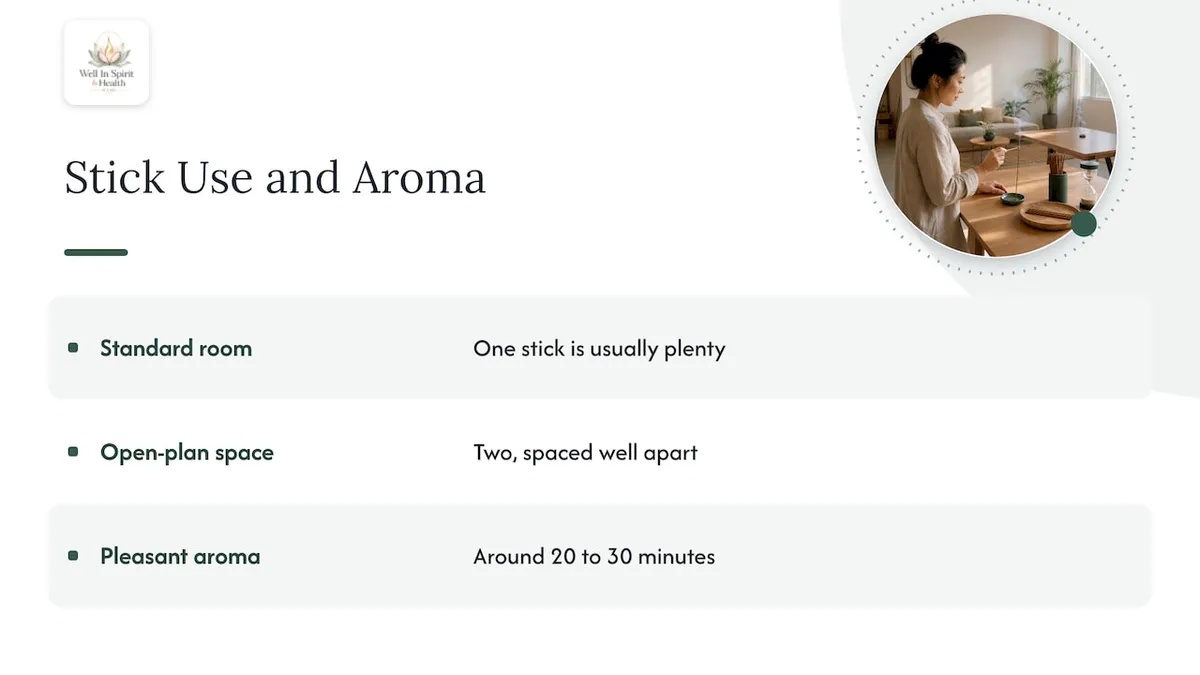
A stick burned properly typically gives a pleasant aroma for around 20 to 30 minutes, per the same source. Thicker or longer sticks run longer, so check the packet.
Do incense sticks burn out on their own? Yes, they burn down to the end if left. But that does not mean you should leave them. See the next section.
Putting incense out safely
The safest habit is never to leave incense burning in a room you are not in. Staffordshire Fire and Rescue Service advises never leaving candles, incense or bukhoor unattended, and the guidance warns against letting a stick smoulder out when you are leaving the house or going to bed.
If you need to stop early:
- Dip the burning tip in water, then break off the charred end. The rest of the stick can be dried and relit later.
- Alternatively, press the tip into sand or a snuffing dish until the ember is out. Some people do this halfway through a stick to save the rest for another session.
- Let the ash cool completely before you tip it away, and never put hot ash in a bin with paper or other rubbish.
Once the stick is finished, check that the ember has gone, then leave the window open a little longer to clear the air.
Choosing a scent you will actually enjoy
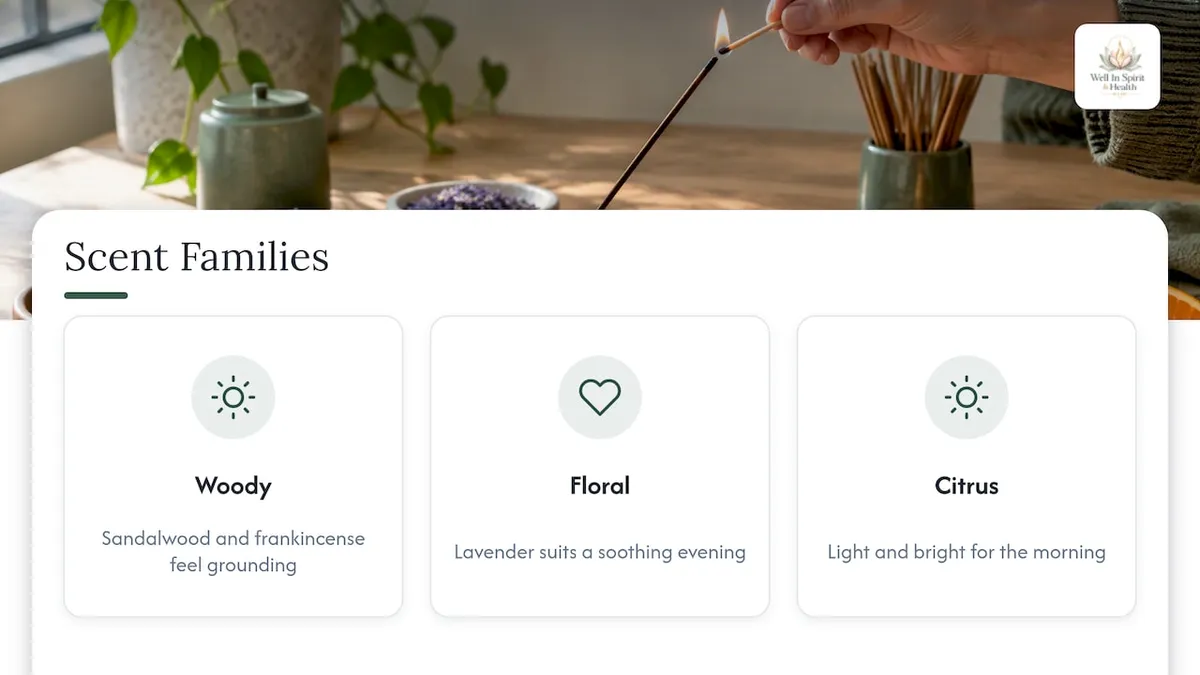
A scent that is lovely for ten minutes can be tiring for an hour, so start with a gentle one and see how you feel. Woody and resinous notes such as sandalwood and frankincense tend to read as grounding. Floral and herbal ones, like lavender, are more soothing for the evening. Citrus is light and bright for the morning. If you are unsure which direction you like, a short explainer on fragrance families for beginners is a useful way to learn the vocabulary of woody, floral, fresh and so on, and apply it to what you buy.
Look for sticks with a short, clear ingredients list. Sticks are made from a mix of aromatic materials and a combustible binder, as Healthline explains, and the binder is what actually burns. Very cheap, heavily perfumed sticks often smell harsher in the smoke than they do in the packet.
Using incense for meditation or a wind-down
Incense works well as a cue: a small, repeatable signal that it is time to slow down. Here is a simple routine for ten to fifteen minutes.
- Open the window a crack and tidy the space around you.
- Light one stick using the method above.
- Sit comfortably, a few steps from the holder, and take five slow breaths.
- Choose a single intention for the session, such as letting go of the day, or noticing what you feel.
- When the stick has burned for around 20 to 30 minutes, or sooner if you prefer, put it out and close the session with a last slow breath.
If you would like a structure for the intention part, our guide to a five-minute intention setting ritual is a good companion.
How often is too often?
There is research worth knowing about here. One study of regular indoor incense burning in older adults found that persistent exposure to incense smoke was associated with differences in cognitive function and brain connectivity. It was an observational study in a specific group, so it does not prove harm for an occasional stick at home. It does support the sensible conclusion: enjoy incense as an occasional, mindful ritual with fresh air, not a constant fixture in a closed room.
Separately, laboratory work has looked at agarwood essential oil inhalation and anxiety-like behaviour in mice. That is not the same as burning a stick in your living room, so we would not read it as a promise of any effect on people.
A few situations call for extra caution, and for a conversation with your GP or pharmacist if smoke affects you:
- You have asthma or another breathing condition, or smoke triggers a cough or wheeze.
- You are pregnant, or there are babies or very young children in the house.
- You share a small, poorly ventilated flat or a bedsit, where smoke has nowhere to go.
- You keep birds or small pets, which can be sensitive to airborne irritants.
If you notice a headache, a scratchy throat or watery eyes, put the stick out and open the windows. That is your signal to use less, or to switch to a smoke-free option.
Common mistakes, quickly fixed
| Mistake | What to do instead |
|---|---|
| Lighting a long section of the stick | Light the tip only, for 2 to 3 seconds |
| Using a saucer, a mug or no holder | Use a holder designed for incense, on a heat-resistant base |
| Burning under a fan or next to a vent | Choose a spot with gentle, indirect airflow |
| Lighting several sticks at once | One stick for an average room |
| Closing every window | Crack one open |
| Leaving it to smoulder while you sleep or go out | Put it out, and never burn it where people are sleeping |
| Burning it daily for hours | Keep it an occasional ritual |
Our perspective: slow down the lighting
At Well In Spirit we think of any scent ritual as a small act of attention, not a way to fill a room with fragrance as fast as possible. The lighting, the pause and the choice of one gentle scent are where the calm comes from. The smoke is the least important part.
That is why we design our collections around ease, beauty and a routine you can actually repeat. Incense suits some homes and some people brilliantly. In others, such as a small flat, a house with young children or a home where someone has sensitive airways, a candle or a few drops of essential oil are kinder and simpler. We have written about this too, in our piece on safe scent rituals with a candle or diffuser. Our rule is simple: choose the version of the ritual you will do calmly and safely, and do that one.
— Rob
Smoke-free ways to get the same mood
If you read the section on ventilation and thought “that is not my home”, you have options.
- Aromatherapy candles. A candle gives you a defined burn, a contained flame and a steady scent. Our Be Chilled aromatherapy candle and Creativity aromatherapy candle suit an evening wind-down or a focused work session. Candles need their own care: the London Fire Brigade has guidance on using candles and incense safely, including keeping flames away from anything that can burn.
- Essential oils. Sandalwood and frankincense are two of the notes people most often look for in incense. You can find them as a 10 ml sandalwood essential oil and a 10 ml frankincense essential oil, for use in a diffuser according to the instructions on the bottle.
- Smudge sticks. If what you want is a cleansing, ceremonial moment, a bundle of dried herbs is a different thing from an incense stick, but the same safety rules apply: a heat-proof dish, an open window and constant supervision. Take a look at our lavender sage smudge stick or our white sage and lavender smudge stick.
- A low-sensory approach. For a gentler way to reset a room, see our smoke-free home cleansing ritual.
Make it a ritual, not just a scent
If you like the idea of a repeatable calming routine but do not want to assemble it yourself, our ritual collections bring together carefully chosen products with a guided routine. The Awakening Ritual and the Forest Spirits Spa Ritual start from £30.00, and the Chakra & Third Eye Awakening Ritual from £50.00, which makes them a considered gift or a treat for yourself. For occasions, browse our birthday rituals or, as the season turns, our Christmas rituals. If you would like something to read or listen to alongside, our blog is full of calm habits and ideas.
FAQ
How do I use incense sticks for beginners?
Put one stick in a proper holder on a heat-resistant surface, light the very tip for 2 to 3 seconds, and blow out the flame so it smoulders. Open a window a little and stay in the room or the house while it burns. Put it out fully when you are done.
Do incense sticks burn out on their own?
Yes, they burn down to the end. A stick typically gives a pleasant scent for about 20 to 30 minutes. Fire services still advise never leaving incense unattended, and not letting it smoulder when you go out or go to bed, so put it out yourself.
How many sticks of incense should I burn?
One stick is usually enough for an average room. A larger open-plan space can take two if they are spaced well apart. More than that tends to overwhelm the scent and can irritate the throat and eyes.
Can I put out an incense stick and use it again?
Yes. Dip the burning tip in water, break off the charred end, let the rest dry, and relight it another day. Pressing the tip into sand also works for a brief pause.
Is it safe to burn incense in a bedroom?
We would not. Fire services advise against burning incense where people are sleeping or in rooms without air circulation. Use it in a ventilated living space while you are awake, and choose a different scent method for the bedroom, such as a pillow spray used well away from any flame.
Sources
- Ceremonial Burning Practices, Greater Manchester Fire and Rescue Service
- Candle safety, Scottish Fire and Rescue Service
- Candle safety, Staffordshire Fire and Rescue Service
- How to use candles safely, London Fire Brigade
- Common Mistakes When Burning Incense, and How to Fix Them
- A How-to and Why-to Burn Incense Guide, Ten Thousand Villages
- What Is Incense? Ingredients and Facts, Healthline
- Indoor incense burning impacts cognitive functions and brain functional connectivity in community older adults, PMC
- Agarwood essential oil inhalation and the Glu/GABA system, Biomedical Reports