Candle Meditation: 15 Minutes of Flame Gazing, Safely
Try candle meditation in a guided session lasting 15 minutes, with research on benefits and safety advice for choosing candles and setting up.
On this page
Candle meditation, known traditionally as Trataka, is a focused-attention practice built on steady gazing at a flame, and it reliably helps most people sharpen concentration and settle a busy mind within a short session. You do not need special equipment or years of training to start. The rest of this guide walks through the evidence, a ready-to-follow session, and the safety details that make the practice something you can begin tonight.
Key Takeaways
Candle meditation improves focus and mental relaxation through simple, focused gaze practices backed by early research and traditional awareness, suitable for beginners and experienced practitioners.
| Point | Details |
|---|---|
| Practice structure | A 10-12 minute session involves steady gaze on a candle flame followed by observing the afterimage with eyes closed. |
| Benefits supported by research | Studies indicate improved reaction time, visual perception, attention, emotional control, and sleep quality from regular practice. |
| Equipment and safety | Use a stable holder and heat-resistant surface, and consider flameless candles for safety, especially around children or pets. |
| Start small and build | Begin with 3 to 5 minutes daily, gradually increasing duration to avoid eye strain and develop a consistent routine. |
| Well in Spirit approach | We offer curated ritual collections and guides, including candle gazing to help you establish a safe and effective meditation habit. |
What candle meditation is: short origins and main types
Trataka comes from the Hatha-yoga tradition, where it appears as one of the six cleansing practices, or shatkarmas, aimed at steadying the mind through a single point of concentration. In Sanskrit, the word roughly means “to gaze” or “to look steadily”, and classical texts describe it as a way to train the eyes and the attention together.
Two main approaches exist:
- External gazing (bahiranga Trataka): you keep your eyes open and focused on a physical object, usually a candle flame.
- Internal gazing (antaranga Trataka): you close your eyes and hold the afterimage of the flame in your mind’s eye.
Both fall under dharana, the yogic term for concentrated, single-point attention, which makes candle meditation less about relaxation for its own sake and more about training the mind to hold one thing steady.
Benefits and evidence: what research actually shows
Modern research on Trataka is still young, but a handful of trials offer useful signals. A randomised controlled trial of Jyoti Trataka, the variant that uses a flame specifically, found that eight weeks of 20-minute daily practice significantly reduced reaction time and lowered susceptibility to optical illusions in a group of 120 young adults, according to a parallel-group RCT published in the International Journal of Yoga. That points to measurable gains in visual perception and processing speed after consistent short sessions, not a single long one.
Broader reviews support the pattern. A 2021 review in Frontiers in Psychology links focused-attention practices like candle gazing to improvements in selective attention and mental relaxation, while a 2024 review in Yoga Mimamsa collected traditional references alongside 16 modern studies and reported gains in cognitive function, emotional control and eye comfort.
Sleep is the other area worth noting. A small pretest-posttest study on ScienceDirect found that an intensive ten-day programme of 45-minute daily practice reduced insomnia severity and improved sleep quality scores. The sample was small, around 29 participants, so this is a promising early signal rather than a settled finding.
A few consistent threads run through this research:
- Short, regular sessions outperform occasional long ones in the trial data available.
- Reviewers across multiple papers call for larger, better-controlled studies before drawing firm conclusions.
- Traditional claims about eye and mind benefits are increasingly matched, though not yet proven, by early clinical findings.
How to do a guided candle-gazing practice
Candle meditation rewards a simple, repeatable structure more than any special technique. Here is a session you can follow from start to finish.
Preparation
- Choose a quiet room where you will not be disturbed for 15 minutes.
- Sit comfortably, either cross-legged on a cushion or upright in a chair, spine relaxed but not slumped.
- Place a candle at eye level, roughly an arm’s length away, on a stable, heat-safe surface.
- If you would rather avoid an open flame, a flameless LED candle works as a safe substitute for the visual anchor.
Starting the session 5. Close your eyes and take three slow breaths, letting your shoulders drop with each exhale. 6. Set a simple intention, such as “I am here to settle my attention,” without over-thinking it. 7. Open your eyes and let your gaze rest softly on the tip of the flame, blinking naturally rather than forcing your eyes to stay open.
Practice rounds 8. Gaze steadily for 1 to 2 minutes, then close your eyes and observe the afterimage of the flame for the same length of time. 9. Repeat this open-eyes, closed-eyes cycle for 10 to 12 minutes in total. 10. Finish with a minute of stillness, eyes closed, noticing how your mind feels compared with when you started. 11. Gently rub your palms together and cup them over your closed eyes for a few seconds before opening them.
For a shorter version on busy days, a 5-minute micro-practice works well: two minutes of open-eyed gazing, two minutes of closed-eyed afterimage work, and one minute of stillness.
If your eyes water, sting, or you feel dizzy at any point, close your eyes, breathe normally, and stop the session. You can always return to it tomorrow.
Pro Tip: Keep a small notebook nearby and jot down one word describing your mental state after each session; the pattern over a week often says more than any single sitting does.
Variations and session length: choosing what suits you
Jyoti Trataka, the flame-specific version used in the trial above, is the most studied form and a good default for beginners. Classical texts also describe adho drishti (downward gazing) and madhya drishti (gazing at a fixed midpoint) as related concentration techniques, though these are less commonly practised with a candle specifically.
- New to the practice: start with 3 to 5 minutes and build up slowly.
- Comfortable with the basics: aim for a steady 10 to 20 minutes, following the structure above.
- Experienced practitioners: some classical protocols describe gazing until the eyes water naturally, but modern practice generally favours shorter, timed rounds with clear stop cues to protect eye comfort.
Candles, equipment and safety
Fire safety matters more than it might seem for a practice built around sitting still and staring at a flame. A stable holder, a heat-resistant surface, and a candle kept well away from curtains, books or loose hair are the basics, and you should never leave a lit candle unattended, according to London Fire Brigade guidance on candle safety. The same guidance recommends flameless LED candles as a safer alternative, which also makes a reasonable choice if you practise near children, pets, or simply prefer not to manage an open flame.
A few practical rules worth keeping in mind:
- Many container candle manufacturers suggest limiting continuous burning before extinguishing and letting the container cool, a guideline meant to prevent the glass from overheating.
- Extinguish candles with a snuffer rather than blowing them out, which avoids spraying hot wax.
- Keep matches, lighters and lit candles out of reach of children and pets at all times.
If a candle’s container feels hot to the touch, put the flame out and allow it to cool fully before relighting.
Making it stick: habits and quick fixes
A brief session in the morning sharpens focus for the day ahead, while an evening sitting works well as a wind-down before sleep. On days when 15 minutes feels like too much, the 5-minute micro-practice keeps the habit alive without adding pressure.
- Pair your practice with an existing habit, such as just after your morning coffee or just before switching off your bedroom light.
- If your eyes feel dry, blink more during the open-eyed phase rather than forcing a fixed stare.
- If intrusive thoughts crowd in, simply return your attention to the flame or its afterimage without judging the distraction.
- If you feel panicky or overwhelmed, stop, open your eyes fully, and breathe normally until the feeling passes.
Progress gently. A consistent 5 minutes most days beats an occasional 20-minute session that you dread repeating.
Using candle meditation for chakra balancing and spiritual awakening
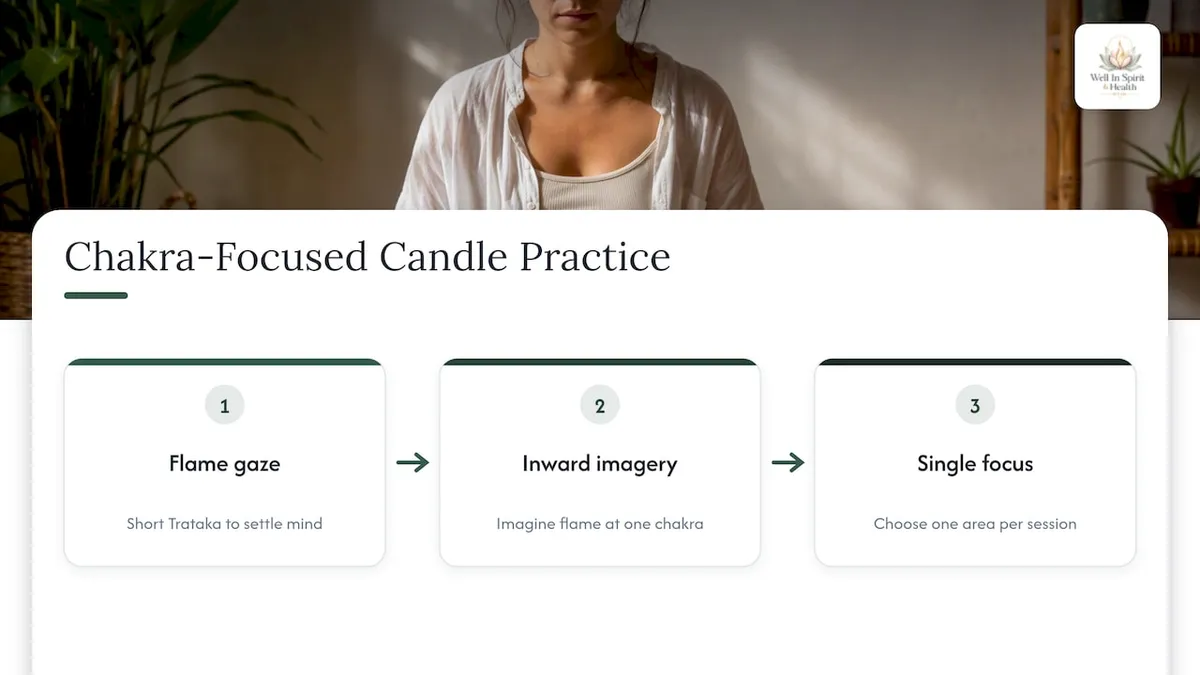
Candle gazing has long been used alongside chakra-focused practices because the steady flame gives the mind a single point to rest on while attention moves inward to the body’s energy centres. A common approach is to begin with a short Trataka session to settle the mind, then shift to closed-eyed visualisation, imagining the flame’s light moving to the area associated with a particular chakra, such as the heart or the third eye between the brows.
This pairing suits anyone drawn to candle meditation as part of a broader spiritual or reflective routine rather than a purely cognitive exercise. If you want a structured starting point, The Chakra & Third Eye Awakening Ritual combines guided steps with curated items designed for exactly this kind of practice, and The Awakening Ritual offers a gentler entry point for readers newer to ritual-based reflection.
Many people find that dedicating a short, repeated sequence, flame gazing followed by a few minutes of inward attention, helps the practice feel less abstract and more like a routine they can return to. There is no need to rush through every chakra in one sitting; a single focus area per session tends to feel more grounded than trying to cover the whole system at once.
Breathing techniques to pair with candle meditation
Breath and gaze work together naturally, and adding a simple breathing pattern can deepen the sense of calm that candle meditation produces. Before you begin gazing, three to five rounds of slow diaphragmatic breathing, a long inhale through the nose followed by an even longer exhale, helps settle the nervous system and makes it easier to hold a soft, steady gaze once you start.
During the practice itself, keep your breathing natural rather than controlled; forcing a breathing pattern while also trying to focus visually can create tension rather than ease. If you want a slightly more structured option, a simple count, such as inhaling for a count of four and exhaling for a count of six, can be used during the closed-eyed afterimage phase to extend the sense of relaxation.
Finishing a session with a few rounds of slower breathing, hands resting on your knees or lap, helps transition out of the focused state gradually rather than snapping back into normal activity. This small addition often makes the difference between a session that feels abrupt and one that feels complete.
Preparing your environment for a better session
The room you practise in shapes how easily your mind settles. A space with dim, warm lighting, free from screens and clutter, reduces the visual competition your eyes face once the candle becomes the only point of focus. Closing curtains or blinds, even during the day, can help remove distracting movement from your peripheral vision.
Temperature matters too: a room that is too cold makes it hard to relax into stillness, while one that is too warm can make you drowsy rather than alert. A cushion or chair that supports an upright but relaxed posture keeps you comfortable enough to sit still for the full session without shifting around.
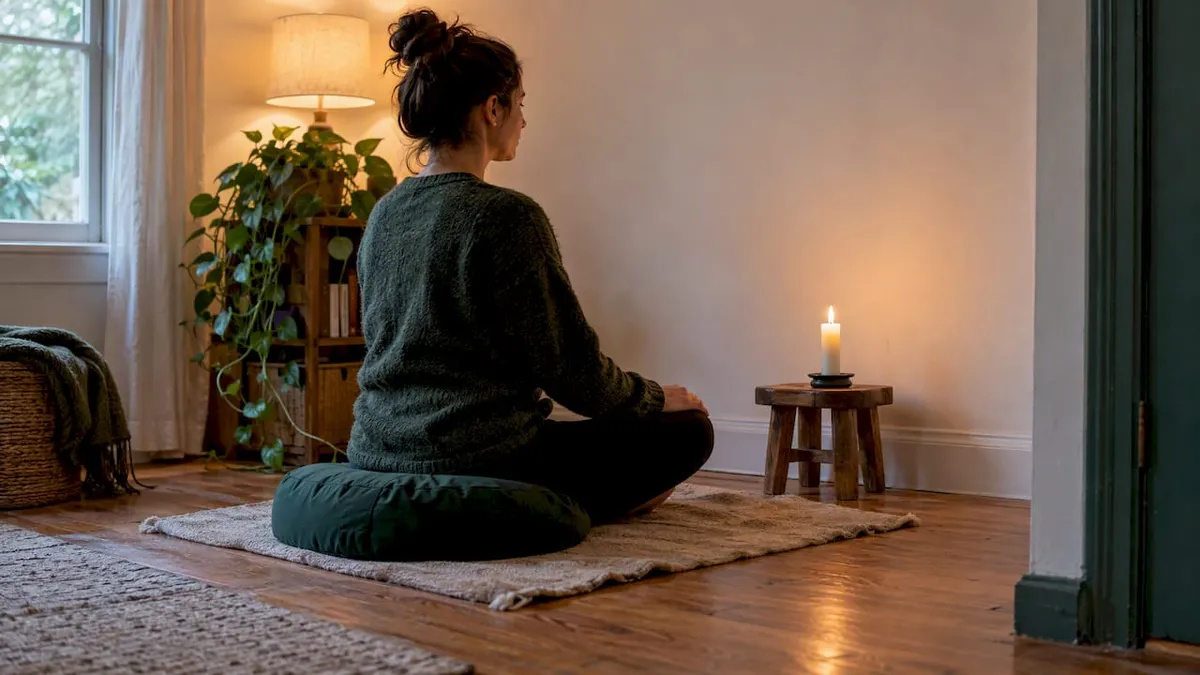
Some people find that creating a small, dedicated spot, even a corner of a room with a cushion, a candle holder and a soft mat, makes it easier to return to the practice regularly, since the space itself becomes a cue to sit down and begin. Our calm corner ideas cover practical ways to set up a small dedicated space like this without needing much room or budget.
A short note on ritual and starting small
We believe guided rituals work because they lower the barrier to starting, not because they demand perfection. Try one short candle-gazing session tonight. If you want more structure, our guided resources are there when you are ready.
— Rob
How Well In Spirit can help you begin
We put together ritual collections that take the guesswork out of starting a candle practice, pairing curated items with guided steps so you are not left working it out alone. If chakra work and spiritual reflection draw you in, The Chakra & Third Eye Awakening Ritual gives you a complete starting point, and our broader wellness category covers calming rituals suited to everyday practice.

For those who want a simple ritual structure to draw on, this cord-cutting ritual script from Phone Psychic Readers shows how a guided sequence can be laid out step by step, which is a useful reference if you are building your own routine around candle gazing. When you are ready to bring a guided ritual into your own space, visit Well In Spirit to browse our collections and find the one that fits your intention.
FAQ
How do you do Trataka meditation?
Sit comfortably with a candle flame at eye level, about an arm’s length away, and gaze softly at the tip of the flame for one to two minutes before closing your eyes and holding the afterimage for the same length of time. Repeat this cycle for 10 to 15 minutes, finishing with a minute of stillness and gently cupping your palms over your closed eyes.
Does lighting a candle help with anxiety?
A lit candle itself is not a treatment for anxiety, but the focused-attention practice of candle gazing has been linked in small trials to improved relaxation and reduced reaction time, according to research summarised in Frontiers in Psychology. Clinical summaries also note that focused practices like this can suit people who find open-awareness mindfulness styles overwhelming, according to an NHS mindfulness research summary.
What are the main types of meditation?
Common categories include focused-attention practices like Trataka, open-awareness or mindfulness meditation, body-scan practices, loving-kindness meditation, mantra-based meditation, movement-based practices such as walking meditation, and visualisation techniques; definitions and groupings vary between traditions and teachers. Candle meditation sits within the focused-attention category because it trains the mind to hold a single point of concentration.
What is the three-hour rule for candles?
Many container candle manufacturers recommend burning a candle for no more than around three hours at a time before extinguishing it and letting it cool, a guideline intended to prevent the container from overheating. If a candle feels hot to the touch, put it out and allow it to cool fully before relighting, and always follow fire safety guidance on stable holders and never leaving a flame unattended.
Sources
- Yoga Mimamsa (tradition and science of Trataka kriya review)
- International Journal of Yoga (Jyoti Trataka RCT)
- London Fire Brigade — candles safety at home
- ScienceDirect — effect of Trataka on insomnia severity