Start a Gift-Ready Calm Corner in 10 Seconds, Kits from £30
Create a gift-ready calm corner fast with curated ritual kits, research-backed scent picks, and 2–10 minute scripts. Kits start from £30.
On this page
A calm corner is a small, dedicated spot in your home set up for quiet self-care: a seat, soft light, a chosen scent and a short ritual you return to on purpose. You can build one in minutes with a comfortable chair, a warm lamp and a scent you like paired with a two-minute breathing ritual. Curated ritual collections make this faster because they bundle the right items with a guided script already written for you.
TL;DR:
- Using a dimmable warm light, natural textiles, and a single scent, creates an effective and calming atmosphere in a small space.
- Incorporating a short, consistent ritual, like breathing and scent, builds a habit more effectively than irregular, longer sessions.
- Select essential oils like lavender or jasmine for moderate anxiety reduction, but always dilute and avoid oils near children or pets.
- Curated ritual collections streamline setup by combining items and instructions, reducing decision fatigue and increasing routine adherence.
- Adjust a calm corner to your space and schedule, such as a portable setup for small apartments or a nightstand ritual for pre-sleep relaxation.
Core elements every calm corner needs
Every calm corner rests on six physical choices, and getting these right matters more than how much space you have.
Lighting sets the mood before anything else. A warm-toned lamp with a dimmer beats overhead light, and flameless options like battery candles or a Himalayan salt lamp give a soft glow without fire risk. Place the light source at eye level or lower so it never shines directly into your face when you sit down.
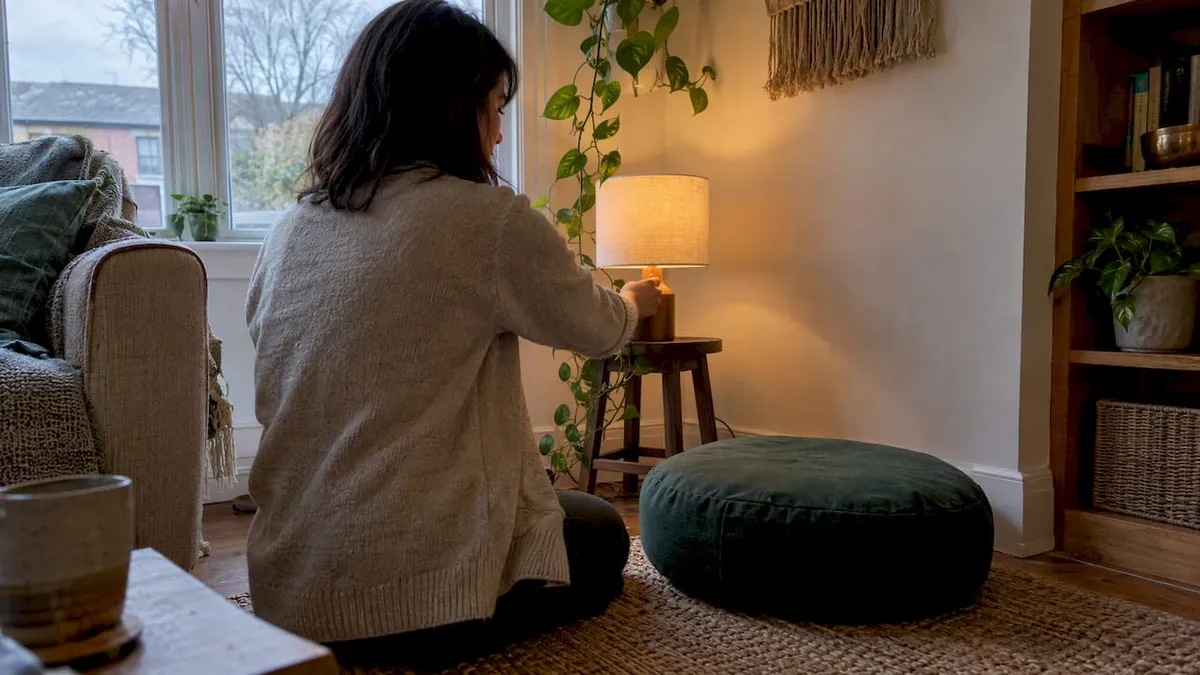
Seating depends on how long you plan to stay. A low armchair suits a 10-minute wind-down, a meditation cushion suits seated breathing work, and a simple floor cushion works for stretching or journaling. Whatever you choose, keep your spine upright rather than slumped, since posture affects how deeply you breathe.
Textiles add warmth and a reason to linger. A soft throw blanket, a weighted or silk eye mask and natural fibers like cotton, linen or wool feel better against skin than synthetic blends and hold up to repeated use.
Sound should calm rather than distract. A short playlist, a guided-audio app or a small speaker placed a few feet away (not right next to your ear) keeps the volume low enough to avoid overstimulation.
Surface and storage keep the ritual tidy. A small tray or shallow box holds your oils, matches and journal together so the corner never looks cluttered, and a lidded container keeps the rest of the room from absorbing scent when you’re not using it.
- Choose a dimmable warm light over a bright white bulb.
- Pick one seat that matches how long you actually plan to sit.
- Favor natural-fiber textiles over synthetic ones for comfort.
- Keep sound sources a few feet away and below conversation volume.
- Store everything in one small tray so setup takes seconds.
Pro Tip: Group every item for your ritual on a single tray so your calm corner takes ten seconds to set up and ten seconds to put away.
Designing a calm corner for your actual space and schedule
Not everyone has a spare room, and most people need their calm corner to work at a specific time of day. The fix is matching the setup to the space and the moment rather than copying a generic layout.
- Tiny home or studio: Use a folding chair that lives behind a door, hang a curtain to section off a corner visually, and carry your ritual items on a small portable tray you can set up and clear away in under a minute.
- Bedroom nook for pre-sleep rituals: Keep a pillow spray on the nightstand, set a lamp timer so light fades automatically, and follow the same short sequence each night: wash your face, spray the pillow, dim the light, so your body learns the cue.
- Bathroom shelf or bath corner: Swap a standard diffuser for a shelf tray with a few drops of oil on a cotton pad, since open diffusers don’t hold up well to steam and humidity.
- Workstation pause point: Keep a personal aromastick, a pair of headphones loaded with a five-minute guided pause, and a rolled towel for lower-back support within reach for a quick reset between meetings.
Each of these adapts the same core elements, light, seat, scent, sound, to wherever you actually spend time, which matters more for consistency than having a dedicated room.
Aromatherapy for relaxation: what the evidence supports and how to use it safely
Scent is one of the fastest ways to shift mood, and the research on essential oils backs this up with real caveats. A network meta-analysis of randomized controlled trials found that jasmine, citrus aurantium, damask rose and lavender produced measurable moderate reductions in anxiety measures, with some oils showing larger effects than others.
Jasmine, citrus aurantium, damask rose and lavender showed moderate, measurable reductions in anxiety scores in a systematic review of RCTs, which means these four are a reasonable starting point if you’re choosing a first oil.
A separate systematic review of inhalation aromatherapy found potential benefit for stress and anxiety in clinical settings but flagged inconsistent dosing across studies, recommending standardized, measured applications rather than improvised blends.
- Never apply undiluted essential oil to skin; always dilute before topical use and avoid sensitive areas entirely.
- Some oils can be photosensitizing, so check before sun exposure.
- Keep all oils away from children and pets, and never diffuse near an open flame.
- Prefer a personal aromastick or pillow spray over continuous room diffusing in shared living spaces, as these confine scent to the individual rather than the whole household.
When you want something more complex than a single oil, a standardized, commercially measured blend is safer than a DIY mix, and a qualified aromatherapist can help with anything beyond basic relaxation use.
Three ready-made rituals to use right away
A ritual works better than a random routine because it pairs a physical cue with a repeatable sequence. The APA notes that short, consistent practice builds the habit more reliably than occasional long sessions.
- Two-minute breath-and-scent reset: Sit, inhale your chosen scent twice, then breathe in for four counts and out for six, repeating until the two minutes pass.
- Ten-minute evening quieting ritual: Wash your face or hands with warm water, apply a diluted body oil, follow an eight-minute guided meditation, then write one line in a journal before bed.
- Five-minute midday clarity ritual: Hold your aromastick to one nostril, breathe slowly for ten rounds, then answer one journaling prompt like “what does this next hour need.”
A curated ritual box supplies the oil, the tool and the written script together, so you’re not assembling separate items before you can start.
Pro Tip: Anchor each ritual to something you already do, like closing your laptop or turning off the bathroom light, so the cue triggers the habit automatically.
What to buy: a checklist and three sample setups
Before you shop, confirm you have a seat, a light source, a chosen scent, one textile, a small surface, an audio option and a storage container or box. That’s the full list; everything else is a preference.
- A low chair or floor cushion that matches your posture needs.
- A dimmable lamp or flameless candle alternative.
- One essential oil or pre-measured blend suited to relaxation.
- A soft throw or eye mask in a natural fiber.
- A small tray or shelf to keep items together.
- A speaker or headphones for guided audio.
- A box or container to store the kit when not in use.
A starter setup covers the basics: one seat, one scent, one light. An elevated setup adds textiles and a body product, something like a Soothing Emulsion applied correctly in diluted amounts pairs well here. A gift-ready setup is fully assembled and scripted, which is where a curated collection like The Awakening Ritual (from £30) fits a reflective starter kit, while The Chakra & Third Eye Awakening Ritual (from £50) suits someone wanting a more elevated ceremony-style corner.
Calm corners for different ages
An adult calm corner and a child’s version share the same basic logic, soft light, a seat, a sensory anchor, but the details shift with age. For adults, the priority is usually a ritual that marks the end of a workday or the start of a wind-down routine: scent, breath work, a short meditation.
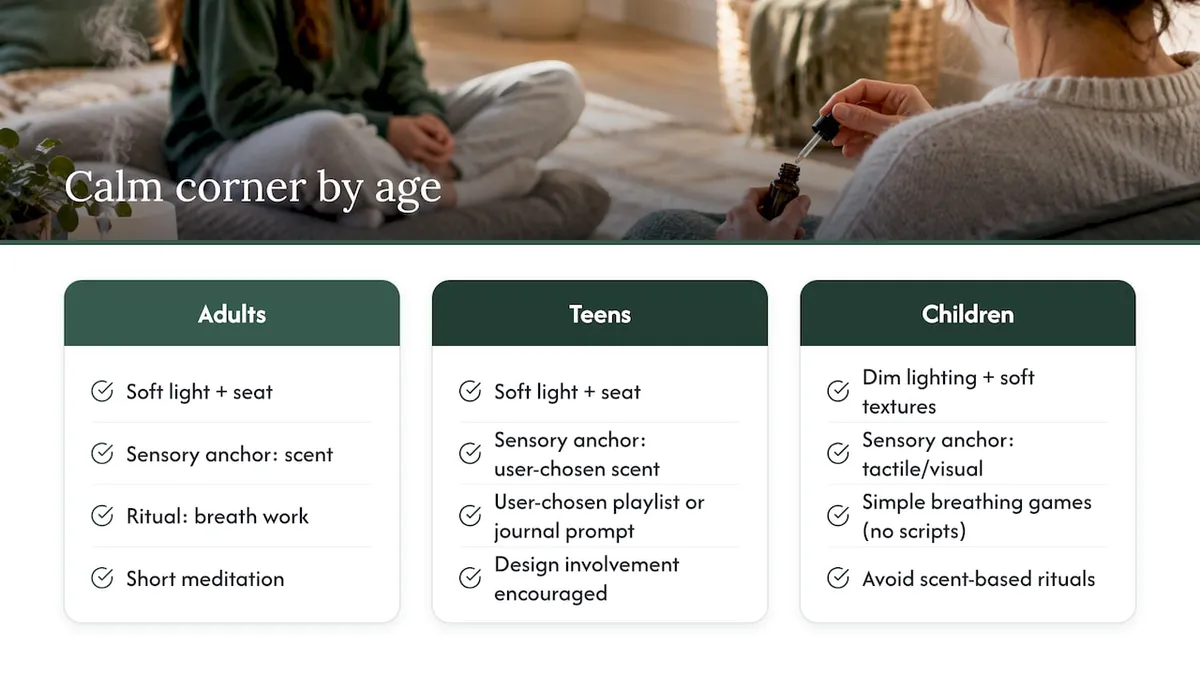
Teens often respond better to a calm corner they’ve had a hand in designing themselves, since autonomy matters more at that age than a prescribed sequence. Letting a teen choose their own scent, playlist or journal prompt increases the odds they’ll actually use the space rather than treat it as a parent’s idea imposed on them.
For younger children, the focus shifts away from scent-based rituals (which require more caution given skin sensitivity and ingestion risk) toward tactile and visual comfort: soft textures, dim lighting, simple breathing games rather than guided meditation scripts written for adults.
Across all ages, the same principle holds: match the ritual’s complexity to the person’s independence and attention span, and keep oils and any small items that pose a choking risk out of reach for the youngest users in a shared household.
Adding calming technology without overloading the space
A calm corner doesn’t need to be screen-free to work, but technology should support the ritual rather than compete with it. A white noise machine placed a few feet from your seat can mask household noise without the variability of a streaming playlist, which makes it a steady option for a bedroom nook or a shared living space.
Guided meditation apps are worth including if you use them consistently. An APA-published study on a workplace meditation app found that short, app-based sessions practiced multiple times a week improved wellbeing and reduced distress among working adults, which suggests the format itself isn’t the limiting factor, consistency is.
Keep the tech minimal: one speaker or set of headphones, one app you actually open, and a light timer if you want the room to dim automatically at a set time. Resist the urge to stack multiple devices in a small corner, since too many options at once can turn a two-minute ritual into a five-minute decision about which tool to use first.
Personalizing your calm corner for anxiety, ADHD or stress
A calm corner built for anxiety benefits from predictability: the same seat, the same scent, the same short sequence every time, since familiarity itself can lower the activation energy needed to start. Weighted textiles like a heavier throw blanket or a weighted eye mask can add a grounding sensation that some people with anxiety find settling.
ADHD often calls for more structure, not less. A visible checklist of the ritual steps, kept on the tray itself, removes the need to remember a sequence from memory, and a timer for each step (two minutes of breathing, three minutes of journaling) can make the practice feel more like a game than an open-ended task.
For general stress, the goal is usually just slowing down. A meta-analysis of mindfulness-based stress reduction programs found small-to-moderate reductions in cortisol with sustained practice, which points to consistency mattering more than any single session’s length. Pairing a short daily ritual with one fixed anchor cue, like right after your morning coffee, tends to stick better than an elaborate routine you only attempt occasionally.
Keeping your calm corner working over time
A calm corner loses its effect when it starts blending into the background of the room. Refreshing the scent every few weeks, even rotating between two or three oils you already own, keeps the sensory cue from going stale.
Check your supplies on a simple schedule: oils typically lose potency within a year or two of opening, so smell-test before replacing automatically. Swap textiles seasonally, a lighter cotton throw in warmer months and a heavier wool one in winter, which also gives you a natural reason to revisit the space rather than letting it go unused.
If a ritual starts to feel routine in the flat sense rather than the meaningful one, changing a single element, a new journal prompt, a different piece of music, a repositioned chair, is usually enough to reset the habit without rebuilding the whole corner. Keep the tray or storage box as the one constant, since that’s what makes setup effortless no matter how often you change the rest.
Why curated rituals build the habit faster
A ritual with a structure already built in gets used more often than one you have to invent each time, because the decision fatigue is already solved for you. Curated collections bundle the scent, the tool and the script together, which removes the friction that usually keeps a good intention from becoming an actual Tuesday evening habit.
That’s the gap most calm corners fail to close: not the idea, but the follow-through.
— Rob
Getting started with a ready-made ritual collection
Building a calm corner item by item takes time most people don’t have, and a curated collection solves that by shipping the seat-side items and the script together. Well In Spirit’s ritual collections are built around that exact gap, picking the oils, textiles and guided steps so you start with a finished routine rather than a shopping list.
- For a seasonal or gift-ready setup, The Snowfall Stillness Ritual (from £40) brings the winter wind-down theme together in one box.
- For a birthday or personal milestone corner, The Zodiac Self-Care Collection (from £30) pairs product with ritual script.
Every order arrives with the curated items and a written guide, and the Well In Spirit Membership adds ongoing access to guided content for readers who want to keep building their practice. Browse the full range at Well In Spirit when you’re ready to start.
Sources
- Mindfulness meditation: A research-proven way to reduce stress — APA
- Essential oils for treating anxiety: a systematic review and network meta-analysis
- Benefit of inhalation aromatherapy as a complementary treatment for stress and anxiety in a clinical setting – A systematic review
- Mindfulness-based stress reduction interventions and cortisol regulation: A systematic review and meta-analysis
FAQ
What is the fastest way to set up a calm corner?
Start with a comfortable seat, a warm dimmable light and one scent you already like, then add a two-minute breathing ritual. A curated ritual box speeds this up further by supplying the items and a guided script together.
Which essential oils are best for relaxation?
Jasmine, citrus aurantium, damask rose and lavender showed moderate, measurable reductions in anxiety scores in a systematic review of RCTs, making these four a reasonable starting point if you’re choosing a first oil. Always dilute oils before skin contact and avoid using them undiluted or near children and pets.
How often should I use my calm corner for it to help?
Consistency matters more than session length, since the APA notes that short, repeated practices build lasting habits more reliably than occasional long sessions. A daily two to ten minute ritual tends to work better than a weekly hour-long one.
Can I use essential oils safely in a shared living space?
Yes, if you use a personal aromastick or pillow spray instead of continuous room diffusing, since a systematic review of inhalation aromatherapy notes these confine scent to the individual rather than spreading it through shared air. This also makes them easier to gift to someone in a shared household.
What does Well In Spirit include in its ritual collections?
Well In Spirit ritual collections pair curated self-care items, such as scent, textiles or bath products, with a written guided ritual script, so the setup and sequence are ready to use on arrival. Collections range from spiritual and seasonal themes to birthday-focused sets, with prices starting from £30 depending on the collection.