Tonight: 5–35 Minute Guided Sleep Meditations for Beginners
Try guided sleep meditations tonight: 5, 10–15, or 20–35 minute sessions, quick device and bedroom setup tips, and when to see a GP or try CBT I for...
On this page
Guided meditation can help you relax and fall asleep faster, especially when paired with steady sleep habits. Tonight, try a 5-minute breath or body-scan practice before you switch off the light. If sleeplessness has lasted for months, meditation is a useful companion but a proper assessment, often through CBT-I, may be what actually solves it.
Key Takeaways
Guided meditation effectively promotes sleep when paired with proper sleep habits, but it should complement clinical treatment for chronic insomnia rather than replace it.
| Point | Details |
|---|---|
| Use appropriate session length | Choose a meditation session based on your available time and current state, from five to thirty-five minutes. |
| Match technique to tension | Select breath work for racing thoughts, muscle relaxation for physical tension, or visualization for mental restlessness. |
| Set up your environment properly | Create a dark, cool space with dim lighting, low volume, and minimal distractions to enhance your meditation practice. |
| Incorporate a consistent ritual | Practice the same short relaxation routine every night with a calming scent, soft blanket, and brief intention for better sleep. |
| Wellinspirit as a next step | We recommend integrating guided reflections and sensory cues from Wellinspirit’s ritual collections into your nightly routine. |
Three session lengths to try tonight, from five minutes to half an hour
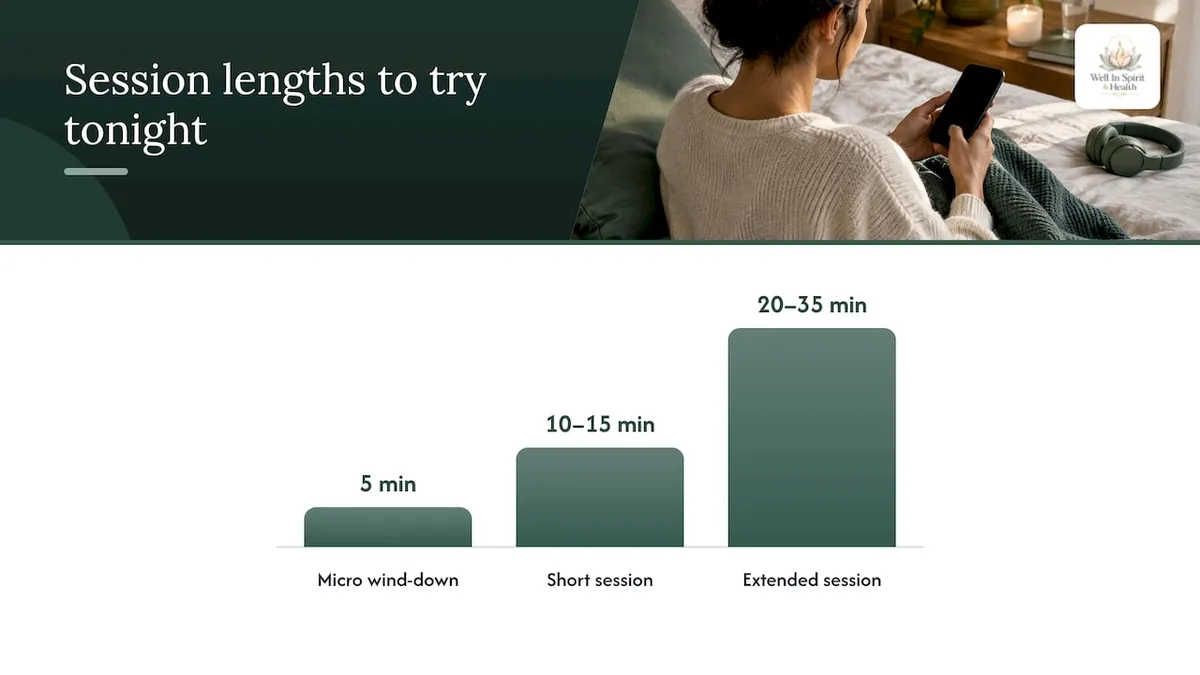
You do not need to commit to a long practice to feel the benefit. The right length depends on how much time you have and how wound up you are.
- 5-minute micro wind-down: paced breathing (four counts in, six counts out) followed by a brief sweep of attention from your toes to your head. Best for busy nights when you just need to downshift before lights out.
- 10 to 15 minute session: breath awareness for the first few minutes, then a short guided visualisation, such as picturing a quiet beach or forest path, to quieten racing thoughts.
- 20 to 35 minute session: progressive muscle relaxation or an extended body scan, similar in pace to the NHS Beditation video, which runs around 30 to 35 minutes.
If you prefer a calmer voice or find a particular narrator distracting, switch tracks rather than persevering. A technique only works if you can actually settle into it. You can shorten any of these by skipping muscle groups in the progressive relaxation or cutting the visualisation short, and you can lengthen the 5-minute version into the 15-minute one simply by slowing your pace and adding more body regions.
Pro Tip: Keep two or three favourite tracks saved offline so a buffering screen never pulls you out of a half-asleep state.
How breath work, muscle relaxation and visualisation calm you down
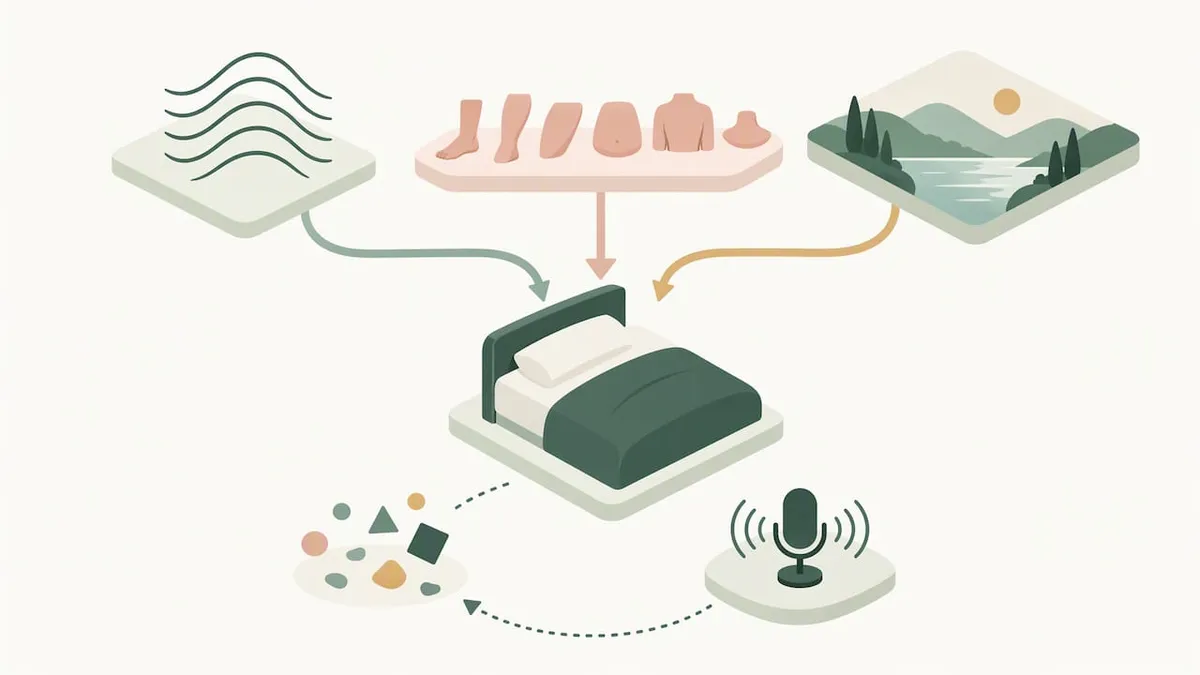
Each core technique works on a different source of bedtime tension, so it helps to match the method to what is actually keeping you awake.
- Breath awareness: inhale for four counts, hold briefly, exhale for six, repeating for several minutes; this slows your breathing and heart rate, producing a calmer state rather than forcing sleep outright, as NHS guidance explains.
- Progressive muscle relaxation: tense each muscle group for a few seconds, then release and notice the contrast, moving from feet to face; Oxford Health’s guidance recommends finishing with three slow, deep breaths once you have worked through the body.
- Guided visualisation or body scan: a narrator prompts you to imagine a sensory scene, a sound, a smell, a texture, or simply guides your attention through each part of your body in turn.
- Matching method to symptom: choose progressive muscle relaxation if you feel physically tense, and breath work or visualisation if your mind is racing with thoughts.
One method, backed by health guidance, stands out for accessibility: the NHS frames guided meditation as especially approachable for beginners, since you are simply following a teacher’s prompts rather than directing your own practice. That lower barrier to entry is often the difference between actually trying it and never starting.
If your thoughts wander mid-session, that is normal. The guidance is to gently notice the drift and return to the narrator’s voice rather than treating it as a failed attempt.
Setting up your bedroom and device for a guided track
A good script does little if your phone screen is glaring at you or the volume keeps spiking. Small setup choices make a real difference to whether a session actually helps you drop off.
- Device: dim or switch off your screen once playback starts, set a sleep timer so the track does not loop all night, and choose a single uninterrupted file rather than one broken up by adverts or chapter breaks.
- Volume and sharing a bed: keep the volume low and comfortable; if your partner is not listening too, a single earbud in one ear is a practical compromise.
- Room and routine: aim for a dark, cool room, cut caffeine in the afternoon and evening, and keep your bedtime and wake time consistent, measures that both the NHS and nidirect’s insomnia guidance list alongside relaxation practices.
- Lighting: if you read or wind down with a lamp beforehand, a soft, dimmable bedside light such as those covered in this bedroom lighting guide makes the transition to darkness less jarring.
Treat a wind-down session, not an all-night loop, as your target. There is no good evidence that playing meditation audio continuously through the night improves sleep, so use it to help you fall asleep rather than as background noise for hours afterwards.
What meditation can’t fix, and when to get it checked
Guided meditation lowers arousal before bed, but it is not a treatment for chronic insomnia on its own. Clinical guidance names cognitive behavioural therapy for insomnia, or CBT-I, as the first-line treatment for persistent cases, with relaxation techniques serving as a helpful adjunct rather than a substitute.
A randomised trial following 1,711 adults using digital CBT-I found sustained improvements in functional health, wellbeing and sleep-related quality of life at week 48, according to this follow-up report, supporting digital CBT-I as an evidence-based option when sleeplessness does not resolve with self-care alone.
See a GP if sleeplessness has lasted for months, if it affects your daytime functioning, or if you suspect an underlying condition is involved. Keep meditation as a nightly companion, not a replacement, for that kind of clinical support.
A simple nightly ritual worth repeating
A short ritual works better than a one-off session because your body learns to associate the steps with sleep. Dim the lights, choose a 5 to 15 minute track depending on your mood, and add one sensory cue, a soft blanket, a cool pillow, or a calming scent, to signal that the day is done. Set a brief intention, even just “let go of today”, before you press play.
Give it two or three weeks before judging whether it is working. One good night proves little; a fortnight of consistency tells you much more about whether this particular routine suits you.
— Rob
Well In Spirit & Health: sleep-inspired rituals to wind down with
We built our ritual collections around exactly this kind of evening routine: a guided track paired with something to touch, smell or hold while you settle. Rather than leaving you to assemble candles, oils and audio separately, we put them together so the whole wind-down takes less effort on a tired night.

- Our ritual collections, including The Awakening Ritual and The Forest Spirits Spa Ritual, pair aromatherapy and bath products with a guided practice for calm, reflective evenings.
- Our seasonal ritual sets, such as The Snowfall Stillness Ritual, suit the quieter, slower evenings of the colder months.
- Our Well In Spirit Membership gives ongoing access to guided content and curated wellness pieces for readers who want to build this into a regular habit.
If tonight is the night you want to try pairing a scent and a sound with your wind-down, our ritual collections are a straightforward place to start.
This article is general information, not a substitute for advice from a qualified doctor. Consult a qualified healthcare professional about your own circumstances before acting on anything here.
FAQ
Is it good to listen to guided meditation while sleeping?
Listening to a guided track as you settle into bed is fine and can help you relax into sleep, but there is no good evidence that continuous overnight playback improves sleep quality. Use a single uninterrupted track with a sleep timer so the audio stops once you have likely drifted off, as the NHS recommends.
What is the best guided meditation for sleep?
There is no single best option; it depends on what keeps you awake. If physical tension is the problem, progressive muscle relaxation suits you, while breath awareness or visualisation tends to help more if your mind is racing, and the NHS Beditation video is a well-known longer example to try.
What is a good 5-minute sleep meditation to fall asleep fast?
A simple five-minute option is paced breathing, four counts in and six counts out, followed by a brief body sweep from your toes to your head. This can be built from a shortened version of progressive muscle relaxation, using fewer muscle groups than the full sequence.
Which meditation is best for sleep?
No single technique suits everyone; breath awareness, progressive muscle relaxation and guided visualisation each target a different cause of bedtime restlessness. Choosing based on your main symptom, tension versus racing thoughts, tends to work better than picking one method for every night.
Can guided meditation replace treatment for chronic insomnia?
No. Clinical guidance names CBT-I as the first-line treatment for chronic insomnia, with meditation serving as a helpful adjunct rather than a substitute, and a GP visit is worthwhile if sleeplessness has lasted for months or affects your daytime functioning.