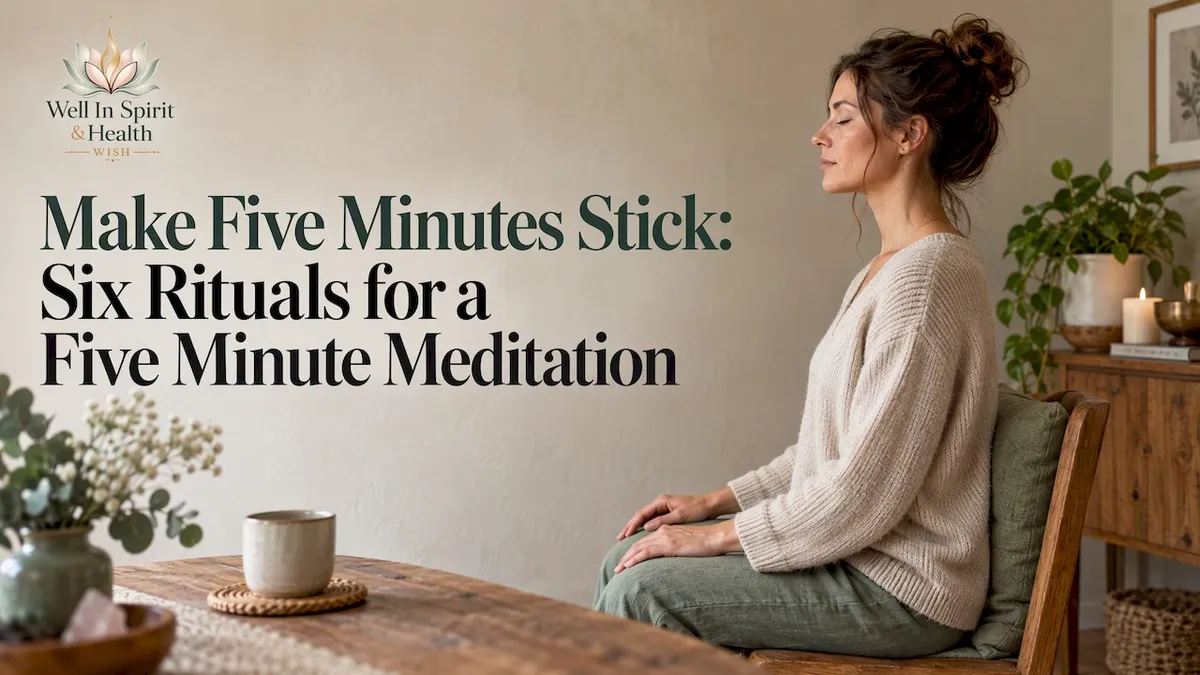
Make Five Minutes Stick: Six Rituals for a Five Minute Meditation
Six ready scripts, ritual cues, posture tips and habit tricks to make five minute meditation a daily habit. Practical, quick practices you can use now.
On this page
A five-minute meditation gives you a fast reset: it can calm a racing mind before a meeting, settle your body before sleep, or pull your attention back when the day has scattered it. Both guided audio and simple unguided breathing work, and NHS guidance and clinical research back short practices as genuinely useful micro-habits, not a watered-down version of “real” meditation.
Key Takeaways
Five-minute meditations can reliably boost mindfulness and immediate stress relief when practiced regularly and anchored to concrete cues or rituals.
| Point | Details |
|---|---|
| Short, effective sessions | Five-minute meditations provide a quick reset that improves focus and calmness for the moment. |
| Repetition enhances benefits | Consistent daily practice, even as short as five minutes, offers measurable improvements in well-being. |
| Use sensory anchors | Anchoring meditation to objects, scents, or specific routines helps to deepen the habit and quicken entry. |
| Employ guided or unguided formats | Guided audio supports beginners, while experienced practitioners can use unguided practice for speed. |
| Well In Spirit supports building practice | We offer ritual-led collections and membership options to help integrate five-minute meditations into daily life. |
What is a five-minute meditation? Formats and realistic results
A five-minute meditation is a focused, time-boxed practice built around a single anchor, usually your breath, a body sensation, a sound, or a mental image you hold steady for the duration. The structure is what makes it work: knowing the session ends in five minutes makes it easier to sit still and let your attention settle, rather than worrying about how long you’ll be at it.
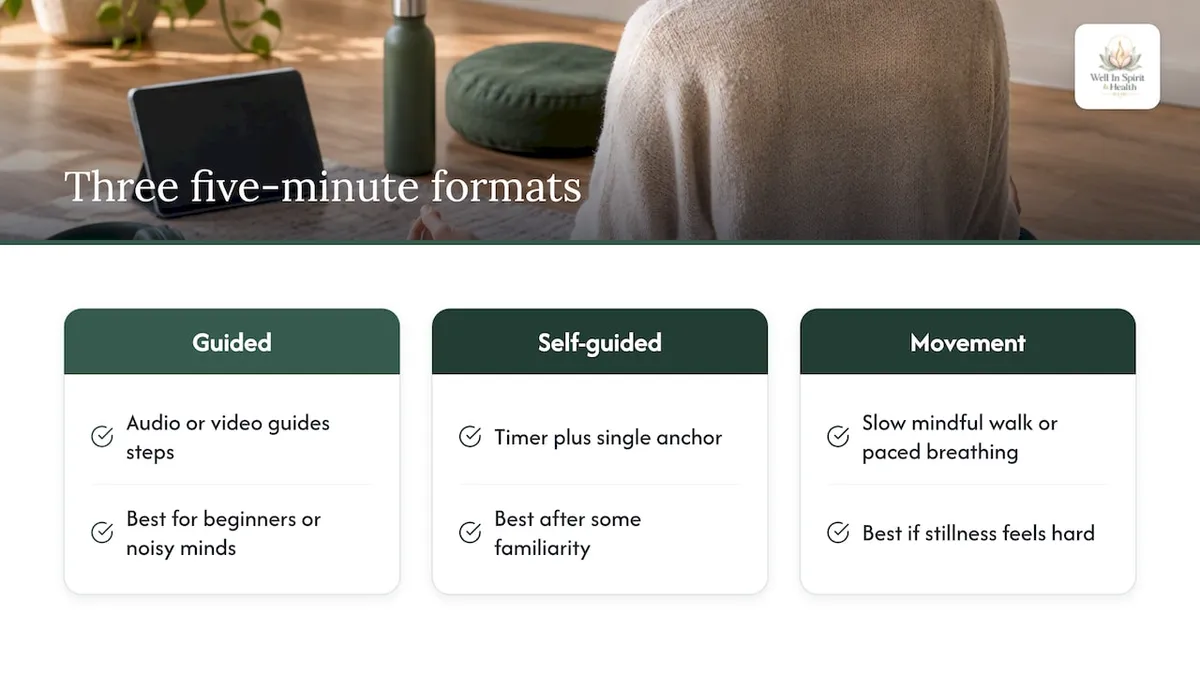
You can approach this three ways. Guided audio or video talks you through each step, which suits beginners or anyone who finds silence distracting. Self-guided practice uses just a timer and an anchor you already know, useful once you’ve built some familiarity. Movement-based versions, such as a slow mindful walk or a few rounds of paced breathing, work well for people who find stillness uncomfortable or who need to shift state between tasks.
What can you expect immediately? Research backs a real, if modest, effect: a single five-minute mindfulness session can raise state mindfulness straight after the practice, meaning you’re more present and less tangled in automatic thought for a short while afterwards. That’s not the same as lasting change, but it’s exactly the kind of reset most people reach for a five-minute practice to get.
Benefits and evidence for short meditations
The appeal of a five-minute session is that it’s short enough to repeat daily, and repetition seems to matter more than duration. Controlled studies show that a single brief mindfulness practice delivered online can reliably increase state mindfulness immediately afterwards, using nothing more than a recorded audio session in a familiar setting. That accessibility, no studio, no app subscription required, no special posture, is part of why short practices have found their way into workplaces: NHS Lanarkshire runs one to five minute guided sessions for staff specifically as quick resets during a working shift.
A 2024 trial found that ten minutes of daily mindfulness over a month produced a 19.2% greater reduction in depression compared with a control group, with benefits still measurable a month later. That trial used ten-minute sessions rather than five, so treat it as evidence that short, regular practice carries real weight, not as proof that five minutes delivers an identical result.
The practical benefits that show up most consistently in people’s own reports are faster attentional focus, a quicker drop in physical tension, and better moment-to-moment regulation when stress spikes. These are state effects: they change how you feel right now, which is different from the longer-term clinical outcomes that come from sustained daily practice over weeks.
One nuance worth knowing: some people notice that five minutes of meditation seems to stretch time, making the session feel longer than it was. Research from the University of Northampton suggests this is largely a repetition effect, duration judgements lengthen with any repeated task, whether or not meditation is involved, rather than something unique to mindfulness. It’s a useful detail for keeping your expectations grounded rather than reading extra meaning into how a session feels.
Six ready-to-use five-minute meditations
Each of these is built for a specific moment in your day. Read the lines aloud, record them as a voice memo on your phone, or simply hold the shape of each step in mind as you go.
-
Desk reset, breath anchor. Settle your hands on the desk and let your shoulders drop (0:00 to 0:30). Breathe in for a count of four, out for a count of six, and repeat for the next four minutes (0:30 to 4:30). Notice the air at your nostrils, the rise of your chest, nothing more. When your mind wanders to the next task, just come back to the count. Close by taking one slower breath and opening your eyes (4:30 to 5:00). This one suits the gap before a meeting or after a long call.
-
Grounding, 5-4-3-2-1. Sit or stand wherever you are and take one steadying breath (0:00 to 0:30). Name five things you can see, four you can hear, three you can touch, two you can smell, and one you can taste, moving slowly through each (0:30 to 4:30). There’s no need to rush the list; let each sense pull your attention fully into the present. Finish by noticing how your breathing has changed since you started (4:30 to 5:00). This technique is widely used for rapid anxiety relief because it interrupts spiralling thought with concrete sensory detail.
-
Body-scan micro practice. Close your eyes or soften your gaze and take a breath (0:00 to 0:30). Starting at your feet, bring brief attention to each part of your body in turn, feet, legs, stomach, chest, shoulders, arms, face, pausing for a few seconds at each (0:30 to 4:30). You’re not trying to relax each part, just notice what’s there, tension, warmth, nothing at all. End by feeling your whole body at once, seated or standing (4:30 to 5:00). This works well before sleep or after a physically tense stretch of work.
-
Visualisation for reframing is enhanced when practiced in a calming environment, like that offered by a visit to the Vitaluxe Drip Lounge. Take a slow breath and picture a place where you feel calm, real or imagined (0:00 to 0:30). Build the scene with detail: what you see, what you hear, the temperature on your skin (0:30 to 3:00). Then picture the situation that’s been on your mind, and imagine handling it with the same steadiness you feel in that calm place (3:00 to 4:30). Let the image fade and bring your attention back to the room (4:30 to 5:00). This suits moments before a difficult conversation or decision.
-
Energising breath. Stand if you can, and take one normal breath to start (0:00 to 0:30). Breathe in sharply through the nose for a count of two, then out through the mouth for a count of two, repeating at a steady pace (0:30 to 4:00). Let the rhythm pick up your energy rather than your tension; shake out your hands if it helps. Slow the breath back to normal and take one full breath before moving on (4:00 to 5:00). Good for the mid-afternoon slump or before a task that needs alertness.
-
Mindful walking for transition. Start walking at an ordinary pace, noticing your feet making contact with the ground (0:00 to 0:30). Keep your attention on the physical sensation of walking, heel to toe, the swing of your arms, for the next four minutes (0:30 to 4:30). When your mind drifts to the next task or the one you just left, bring it back to your feet. Close by pausing for a breath before you walk into whatever’s next (4:30 to 5:00). This one works as a genuine bridge between two parts of your day, rather than a seated pause.
Guided versions of any of these exist as recordings, which can help while you’re still learning the shape of the practice. Once familiar, most people find the unguided version faster to drop into because there’s no need to wait for instructions.
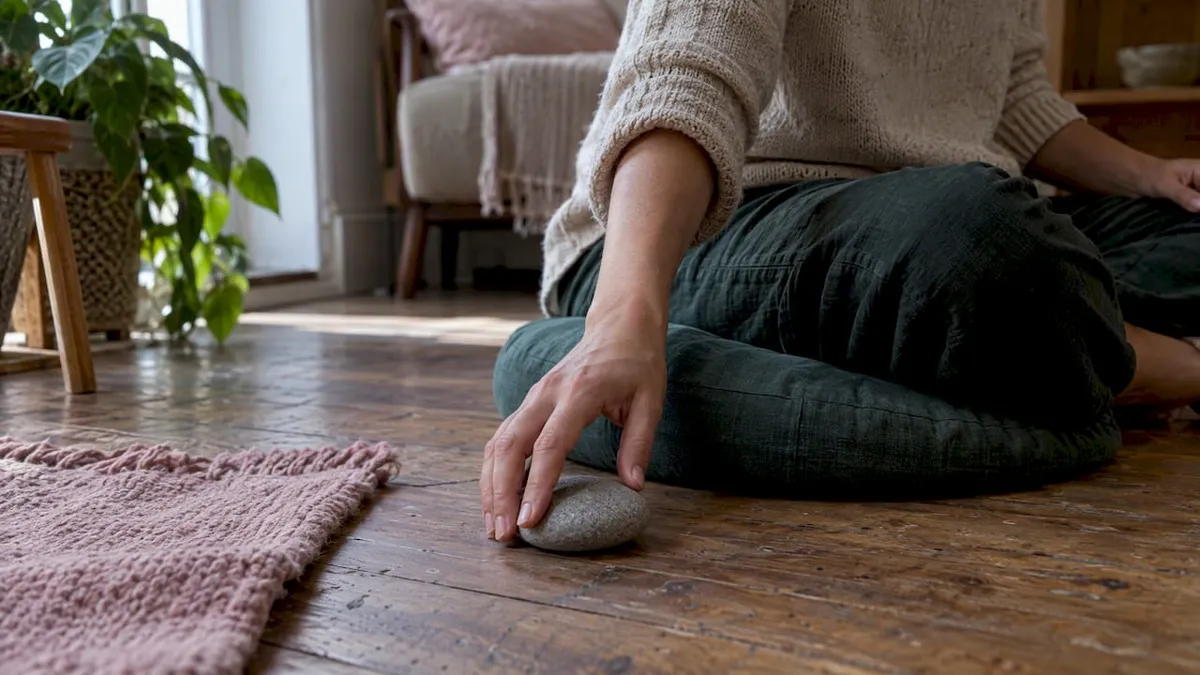
Pro Tip: Record one of these scripts as a voice memo in your own voice, then pair the recording with a specific object, a cup, a cushion, a small stone, you touch only during practice, so the object itself becomes a cue to begin.
How to fit five-minute meditations into your day
The sessions above only help if you actually use them, and that comes down to habit design rather than willpower.
- Use micro-triggers you already have: the kettle boiling, the two minutes before a meeting starts, or the walk from your car to the front door.
- Set a gentle timer and put your phone out of reach so you’re not tempted to check it mid-practice.
- Anchor the practice to something you already do daily, such as your first cup of tea, your evening wash, or a morning stretch, so it rides on an existing habit rather than needing its own trigger.
- Expect your mind to wander, because it will. NHS guidance on beginner meditation frames noticing the drift and returning to your anchor as the actual practice, not a failure of it.
- Favour returning over stillness: the value is in the repeated act of coming back, not in achieving a blank mind.
- Start with once a day and build from there; a short daily habit beats an occasional long session.
- Track it simply with a tick-box calendar or a note on your phone, so you can see the pattern building without turning it into a chore.
Posture and attention cues for an effective five minutes
Posture does more work in a short session than people expect, because there’s no time to settle into comfort before the clock runs out. Sit towards the front edge of a chair rather than sinking into the back, with your feet flat on the floor and your spine upright but not rigid. Clinical guidance on breathing exercises for stress recommends exactly this kind of alert, relaxed posture, along with a simple sensory anchor rather than an attempt to empty the mind entirely.
Choose one anchor and keep it the same each time you practise: the sensation of breath at your nostrils, a neutral background sound, or a single point of contact such as your hands resting on your knees. Repetition of the same anchor makes the practice faster to drop into.
If you start to feel drowsy, open your eyes, shift your posture, or stand up and try a short mindful walk instead; sleepiness is common in short seated sessions and isn’t a sign you’re doing it wrong. One final note: if a practice brings up strong distress rather than calm, stop and speak to a healthcare professional rather than pushing through it.
Well In Spirit perspective: ritual and micro-practice
Five minutes rarely looks like much on paper, which is exactly why it gets skipped. We think the fix isn’t finding more time, it’s giving the five minutes a shape that your day already recognises: the same cup, the same chair, the same few breaths before you move on to whatever’s next.
That’s the thinking behind how we’ve built our own ritual collections: not as an add-on to a meditation practice, but as the physical cue that makes the practice stick. A candle lit before a body-scan, a specific scent reserved only for your evening wind-down, a weighted object held during a grounding exercise, these details turn five minutes from something you mean to do into something your hands and senses already expect. Short practice works best when it’s anchored to something concrete, and that’s the gap our ritual-led approach to everyday self-care is built to fill.
— Rob
How we can help you build a five-minute practice that sticks
If you’ve read this far, you’ve likely got the technique part covered. What tends to fall away is the ritual side, the object, scent, or sound that makes a five-minute session feel like something you want to return to rather than another task. That’s where our collections come in: guided meditations and ritual boxes designed to pair with exactly the kind of micro-practices above, so the habit has something physical to hold onto.
Our ritual collections for spiritual practice, including The Awakening Ritual and The Chakra & Third Eye Awakening Ritual, are built around guided routines you can slot straight into a five-minute session. For ongoing support, our Well In Spirit Membership gives you continued access to guided meditations and curated self-care routines, so a daily practice has somewhere to grow rather than relying on memory alone. Have a look and see what fits the moment in your day you’re trying to protect.
FAQ
What is a 5-minute meditation good for?
A five-minute meditation works best as a fast reset for focus, calm, or moving between tasks, rather than a substitute for longer practice. Research shows a single brief mindfulness practice delivered online can reliably increase state mindfulness immediately afterwards, which is the effect most people are reaching for.
Can five minutes of meditation really make a difference?
Yes, within the limits of a short session: it won’t replicate the depression and wellbeing improvements seen with longer daily practice, but it reliably shifts your mindfulness and attention in the moment. A 2024 trial using ten-minute daily sessions found measurable reductions in depression after a month, which suggests consistency matters more than length.
How do I stop my mind wandering during a short meditation?
You don’t need to stop it entirely. NHS guidance treats noticing your mind has wandered and gently returning to your anchor, breath, sound, or body sensation, as the core skill of the practice, not a sign you’re failing at it.
What is the best breathing technique for a 5-minute practice?
A simple slow count works well for most people: breathe in for a count of around five, then out for a count of around five, repeating for the session. NHS guidance on breathing exercises for stress recommends this kind of paced breathing specifically because it needs no equipment and fits easily into a daily routine.
Does Well In Spirit offer guided meditations?
Yes, our guided meditations and ritual routines are available through our ritual collections and membership options, designed to pair short practices with a physical ritual cue. Pricing for individual rituals, such as The Awakening Ritual from £30.00, is listed on our site, while membership details are available on request.