Rituals for Letting Go: 8 Practices, Even Without Fire
Explore eight rituals for letting go, including a worked burning bowl method, flameless and digital options, plus mindfulness practices supported by the NHS.

On this page
Short, symbolic rituals, burning, burying, planting or a written release, give you an embodied marker that helps you release an emotion and create space for renewal; for those who prefer reading-led approaches, consider Books on Letting Go: Top Picks for Emotional Healing. The burning bowl ritual is a simple place to start, with smoke-free versions for anyone who cannot burn indoors. Pairing a ritual with a short mindfulness practice such as RAIN helps the feeling settle rather than resurface.
Key Takeaways
Embodied symbolic rituals like burning or burying help release emotions effectively and support emotional healing better than reflection alone.
| Point | Details |
|---|---|
| Use physical elements for release | Choosing an element like fire, water, earth, or air creates a meaningful metaphor suited to the emotion. |
| Select a suitable disposal action | Burning is ideal for anger; burying or planting suits grief; digital deletion works with a physical anchor. |
| Pair rituals with mindfulness practices | Practices like RAIN or grounding help feelings settle and prevent resurfacing later. |
| Design personalized rituals based on goals | Object, action, and timing should match whether you want to honor, let go, or transform. |
| Wellinspirit offers guided rituals and memberships | Their collections include smoke-free options and ongoing guided practices for emotional release. |
Quick ritual ideas: eight ready-to-use rituals
A ritual only needs three things: an object, an action and a moment of quiet attention. Research into personal grief rituals found that disposal through fire, water, earth or air helps people move on when grief or resentment feels stuck, because the physical transformation of an object mirrors the emotional shift you are trying to make.
- Burning bowl: write what you want to release on paper, burn it in a fireproof bowl outdoors, then scatter the ashes. This ritual typically lasts a short period and is best done at dusk.
- Letter burial: bury a written letter in a garden pot or a quiet outdoor spot, letting the earth hold what you cannot carry any further.
- Water release: write a word or phrase on biodegradable paper and let it dissolve in a bowl of water, or release a flower into flowing water if one is nearby.
- Wind release: speak the thing you are letting go of aloud, facing open air, then take three slow breaths and walk away from the spot.
- Written release, then shred: write freely for ten minutes, then shred or tear the pages into a bin as a smoke-free alternative to burning.
- Cord-cutting visualisation: picture a cord between yourself and the person, memory or habit, then mime or visualise cutting it while stating a short closing phrase.
- Planting a seed: plant a seed or seedling while naming what you are releasing, letting new growth stand for the next chapter.
- Digital release: write the release in a notes app, read it aloud, then delete it, following with one small physical gesture, such as lighting a candle, so the action does not feel incomplete.
Fire and water rituals suit anger and resentment well, since the transformation feels decisive. Planting and digital release suit everyday clearing or forward-looking changes, while burial suits grief, where something needs to be laid down gently rather than destroyed.
Burning bowl ritual: a step-by-step worked example
The burning bowl is one of the most widely used rituals for letting go because it is fast, concrete and endlessly adaptable. Use a fireproof bowl, matches, paper and a safe outdoor space with no overhanging branches; indoors, swap the flame for the smoke-free version below.
- Ground yourself for one minute with three slow breaths, feet flat on the floor.
- Name what you are releasing in one sentence, spoken aloud or silently.
- Write it on paper, as plainly as it comes, without editing.
- Read it back once, then light it in the fireproof bowl.
- Watch it burn, saying a short closing line such as “this is released”.
- Let the ashes cool fully, then scatter or bury them outdoors.
- Sit for a minute before returning to your day, rather than rushing off.
Embodied, symbolic actions like burning or burying appear to support emotional processing in ways that quiet reflection alone does not, according to research on ritual and psychological change.
Pro tip: Indoors, tear the paper into small pieces over a bin, or steep it in a cup of water until the ink dissolves, both carry the same change-of-state that fire provides.
Elemental variations: earth, water, fire and air options
Choosing an element is really choosing a metaphor. Fire suits a sharp, final release; earth suits something you want held gently; water suits something you want carried away; air suits something you simply need to say out loud and let go.
- Earth: bury a letter or object in a plant pot, or plant a seed over it so the release becomes future-facing.
- Water: dissolve written words in a bowl, or release a biodegradable item into contained, calm water rather than fast-moving rivers.
- Fire: burn paper in a fireproof bowl outdoors; indoors, use a single candle flame to burn a small torn phrase held safely with tongs.
- Air: speak the release aloud facing a window or garden, or use three deliberate exhales as the physical marker of letting go.
Pick by what you have access to and what feels true to the situation rather than what looks most dramatic. A balcony candle flame works as well as a bonfire if it is the one that fits your space and your intention.
Designing your own ritual: object, action and timing framework
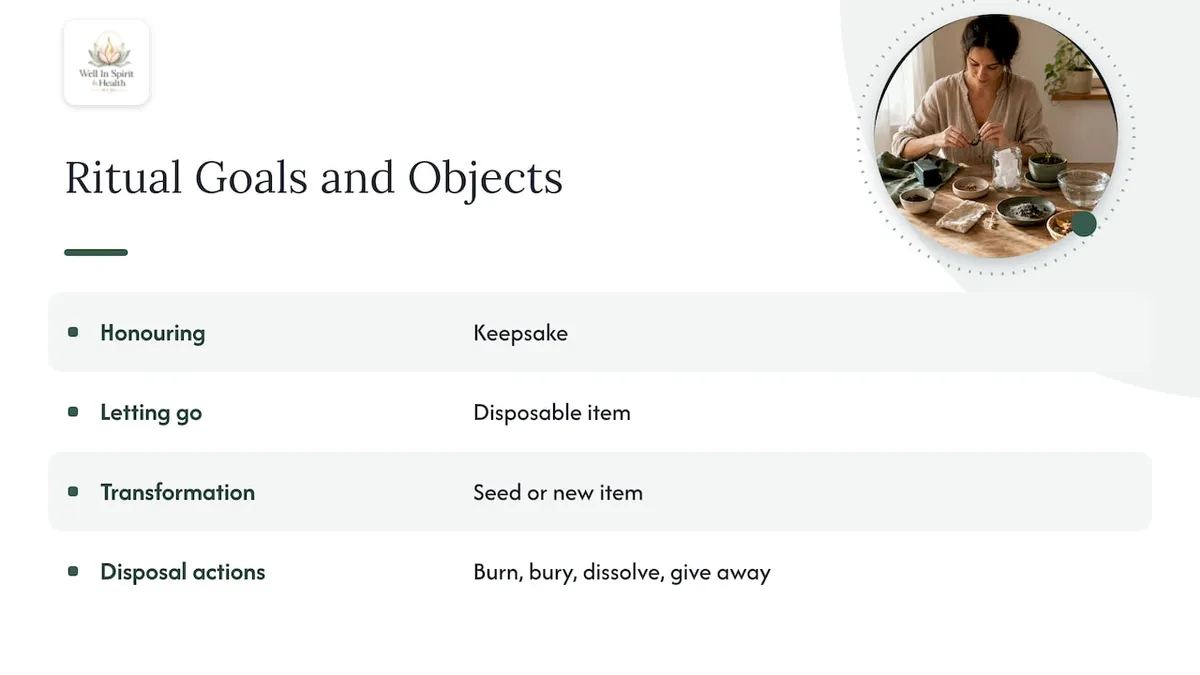
Grief-ritual research from Lancaster University identifies three common goals: honouring what mattered, letting go of pain, and marking a personal transformation. Naming which one you need first makes the rest of the design simple.
Pick an object to match: a keepsake for honouring, something disposable for letting go, or a seed or new item for transformation. Then choose a disposal action, burn, bury, dissolve or give away, that fits the object and the setting you have.
Digital possessions need a companion action, since deletion alone often feels incomplete. Print a photo before deleting the file, write a farewell message and schedule its deletion for a specific date, or plant a seed as you delete, so the digital act gets a physical echo.
Cadence matters too. A one-off ritual suits a single event or ending; a seasonal ritual, timed to a new moon or year-end, suits recurring themes; a daily or weekly micro-ritual, such as a breath and a phrase, suits ongoing, low-level release.
Mindfulness and self-compassion practices to support ritual work
A ritual marks the moment; mindfulness helps the feeling settle afterwards rather than resurfacing an hour later.
- RAIN: recognise the feeling, allow it to be there, investigate it with curiosity, then nurture yourself with a kind phrase, around five minutes in total.
- Two-minute grounding: feel your feet on the floor, name five things you can see, then take three slow breaths.
- Loving-kindness phrase: silently repeat “may I be gentle with myself today” a few times after the ritual closes.
NHS-affiliated guidance on grief and self-compassion frames these practices as a way to stay present with pain rather than rush past it. A ritual creates a resting place for difficult feelings, not an instant fix, and if grief or resentment keeps disrupting daily life, a GP or bereavement service is the right next step.
Author perspective: our approach to letting-go rituals
We provide ritual collections, guided meditations and smoke-free kits designed to support various moments of letting go, so it is easier to start a practice. Our Members’ library holds ongoing guided practices, and our low-sensory home cleansing guide covers smoke-free options for shared or indoor spaces. Ritual supports release well, but complicated or prolonged grief deserves professional support alongside it.
— Rob
Curated ritual collections and membership
Ritual collections and guided meditations are available to help run release rituals without assembling every object, and a membership offers ongoing access to guided practices for quieter, in-between moments.

If a written release speaks to you, our spiritual ritual collections pair candles and prompts for exactly that. For a grounding somatic practice before or after any release ritual, our short somatic meditations for grief work well alongside the steps above, and our intention-setting ritual is a natural follow-on once the releasing is done.
| Need | What helps | Where to start |
|---|---|---|
| A guided kit for burning or writing rituals | The Awakening Ritual, from £30.00 | Spiritual rituals |
| Smoke-free indoor option | Low-sensory cleansing kit | Home cleansing guide |
| Ongoing guided practice | Well In Spirit Membership | Explore membership |
FAQ
Is a full moon a good time to let go?
Many people choose a full moon for release rituals because it marks a natural turning point in the month, though no research ties the timing itself to better outcomes. Any moment that feels symbolically right, an anniversary, a season change or simply a free evening, works just as well.
What are some grief rituals?
Common grief rituals include burying or burning a letter, planting a seed in memory of someone, or lighting a candle at a set time each week. Writing rituals and a short mindfulness practice such as RAIN often sit alongside these to help the feeling settle.
How do I do a cleansing ritual?
A simple cleansing ritual pairs a physical action, tidying a space, lighting a candle or airing a room, with a short spoken intention about what you want to clear. Smoke-free versions use sound, water or scent instead of burning herbs, which suits shared or low-sensory spaces.
What are the five types of rituals?
Definitions vary across traditions, but rituals are often grouped by purpose: rites of passage, healing or release rituals, rituals of honouring or remembrance, seasonal or calendar rituals, and daily or micro-rituals. The letting-go rituals in this guide mostly fall under healing or release, with some crossing into remembrance.
Sources
- Designing personal grief rituals (Lancaster EPrints)
- How to move through grief with self-compassion (NHS-affiliated guidance)
- Rituals and psychological processing (PubMed)