Fall Asleep Tonight with Yoga Nidra: Research Backed 10–60 Min Rituals
Try research-backed yoga nidra to fall asleep faster. Pick a ready-to-play 10–60 minute session, follow minute-by-minute scripts, and use guided tracks...
On this page
Yoga nidra is a guided, supine meditation that reliably reduces arousal and can help you fall asleep. In one trial, four weeks of consistent practice raised sleep efficiency and cut time spent awake at night, and a single afternoon session led many first-time practitioners to fall asleep during the practice. Tonight, you can try a version of it yourself: lie down, listen to a slow body scan, and let your breath settle before you set an intention for rest.
TL;DR:
- Yoga nidra can swiftly lower arousal levels and induce sleep, with one session helping most beginners fall asleep during practice.
- Four weeks of regular practice can modestly improve sleep efficiency and reduce wakefulness after sleep onset.
- Shorter sessions of 10 to 15 minutes are effective for quick sleep onset, while longer sessions focus on emotional processing or deeper relaxation.
- Proper setup, like dim lighting, comfortable positioning, and guided audio, enhances relaxation and supports consistency in practice.
- It complements behavioral sleep strategies but is not a substitute for medical treatment or first-line therapies like CBT-I.
What Yoga Nidra Is and Why It Works for Sleep
Yoga nidra, often translated as “yogic sleep,” is a structured relaxation practice that guides you through a state between waking and sleeping while you lie still and listen. The modern form widely taught today traces back to the Satyananda lineage, which formalized it as a sequence of stages rather than a loose relaxation exercise. Unlike sleep itself, you stay conscious and aware throughout, even as your body settles into deep stillness.
A traditional session moves through several components, though teachers vary the order and emphasis:
- Settling into a comfortable position, usually lying on your back with support under the knees and head.
- Stating a sankalpa, a short personal intention repeated silently at the start and end of the practice.
- Rotating awareness through the body, part by part, without moving.
- Noticing the natural rhythm of the breath without trying to change it.
- Visualizing simple images or sensations to deepen the sense of letting go.
- Returning awareness to the room and slowly reawakening the body.
The physiological logic behind the practice is straightforward. Systematically shifting attention through the body and breath tends to quiet sympathetic nervous system activity, the fight-or-flight response, while nudging the body toward parasympathetic dominance, the state associated with digestion, recovery, and rest. As muscles release tension and breathing slows, many practitioners drift into hypnagogia, the transitional zone between wakefulness and sleep where thoughts loosen and become dreamlike. The Sleep Foundation’s explainer on yoga nidra describes this hypnagogic state as central to why the practice can help people fall asleep faster and sleep more soundly, while noting that research on its use for chronic insomnia is still developing.
This is also why yoga nidra differs from simply lying in bed trying to sleep. Instead of leaving your mind to wander toward tomorrow’s problems, the guided structure gives it somewhere specific to go, which is often enough to short-circuit the racing thoughts that keep people awake.
Research Summary: Measured Effects on Sleep, Anxiety, and Mood
The evidence for yoga nidra’s sleep benefits has grown more concrete in recent years, though it remains an emerging field rather than a settled one.
A 2023 randomized trial found that four weeks of regular practice improved sleep efficiency modestly and reduced wake after sleep onset duration, a measurable reduction in the time participants spent lying awake during the night (PubMed, 2023). That kind of change, sustained over a month, points to a real effect on sleep continuity rather than a placebo response tied to novelty.
Single-session data is just as striking in a different way. A preliminary clinical trial found that a large majority of yoga-nidra-naive adults fell asleep during a single afternoon session, with several extending their rest into the following hour (PMC, 2023). That result says less about long-term insomnia treatment and more about how quickly the practice can lower arousal in people who have never tried it before.
Mood effects show up quickly too. An exploratory study of 33 adults found that a single 30-minute session reduced negative affect scores, covering stress and anxiety, by 31% (PMC exploratory study). That kind of same-session shift suggests yoga nidra has value as an acute stress reliever even on nights when a longer wind-down routine isn’t realistic.
Zooming out, the picture holds up but comes with caveats:
- A 2025 systematic review and meta-analysis of many studies with over five thousand participants found moderate-to-large effects of yoga nidra on stress, anxiety, and depression, but the authors cautioned that low methodological quality across many of the included studies likely inflates those effect sizes (systematic review and meta-analysis).
- Smaller qualitative and clinical studies report that the practice is well tolerated and may help with perceived sleep quality, anxiety, and even pain, but the authors consistently call for larger, more rigorous trials before drawing firm conclusions (qualitative and exploratory studies).
Taken together, this body of research places yoga nidra as a promising, low-risk practice for supporting sleep and easing pre-sleep tension, best understood as an adjunct to good sleep habits rather than a standalone cure for chronic insomnia.
Bedtime Protocol: Step-By-Step Yoga Nidra for 10 to 30 Minutes
A good bedtime yoga nidra session depends as much on setup as on the practice itself. Practical guides from experienced teachers recommend starting the practice 20 to 60 minutes before your intended sleep time, giving your body enough runway to shift out of daytime alertness (American Baba bedtime protocol).
Before you begin, prepare the room:
- Dim the lights or turn them off entirely, and silence notifications on any device you’re not using for the practice.
- Set the room temperature slightly cool, since body temperature naturally drops as you approach sleep.
- Lie on your back with a pillow under your head and, if it helps your lower back, a rolled blanket or bolster under your knees.
- Cover yourself with a light blanket, since body temperature drops further as you relax.
- Choose a guided audio track between 10 and 30 minutes, matched to how much time you have before you want to be asleep.
Once you’re settled, the sequence itself typically unfolds like this:
- Spend the first one to two minutes simply noticing your body’s weight against the bed and letting your breath settle into its own rhythm.
- Silently state your sankalpa, a short, present-tense intention such as “I sleep deeply and wake refreshed,” repeating it two or three times.
- Follow a rotation of consciousness through the body, moving attention from fingers to toes to face, usually taking five to ten minutes depending on session length.
- Bring attention to the natural rhythm of the breath for a minute or two, without trying to control its pace or depth.
- Follow a brief visualization sequence, often simple images like a beach, a forest clearing, or drifting clouds, lasting three to five minutes.
- Return briefly to the sankalpa, repeating it once more before the session closes.
- Let the guidance fade rather than snapping back to alertness, since the goal at bedtime is to stay in that drowsy state.
If lying on your back is uncomfortable, side-lying with a pillow between the knees works nearly as well, and a reclined seated position with back support is a reasonable substitute if lying down at all triggers reflux or breathing discomfort.
What happens if you fall asleep partway through, which is common and, at bedtime, exactly the point? Simply let it happen. There’s no requirement to finish the recording, and drifting off during the rotation of consciousness or the breath awareness section is a sign the practice is doing its job.

Pro Tip: Keep your guided track on a sleep timer so it stops automatically if you doze off, rather than looping and potentially waking you back up.
Session Lengths, Minute-By-Minute Templates, and Sample Scripts
Not every night calls for the same length of practice, and matching the session to your situation makes the ritual easier to sustain.
Short sessions, 10 to 15 minutes, work well when you’re already drowsy or short on time. These compress the rotation of consciousness into a faster body scan, spend less time on visualization, and lean on breath awareness to bridge you into sleep. A rough template: one minute of settling and sankalpa, six to eight minutes of body scan, two minutes of breath awareness, and a brief closing without an extended visualization.
Medium sessions, 20 to 30 minutes, are the most common choice for a nightly bedside ritual and match the length used in several of the research protocols described above. A typical structure gives two minutes to settling and sankalpa, ten minutes to the rotation of consciousness, five minutes to breath awareness, five to eight minutes to visualization, and a short return to the sankalpa before closing.
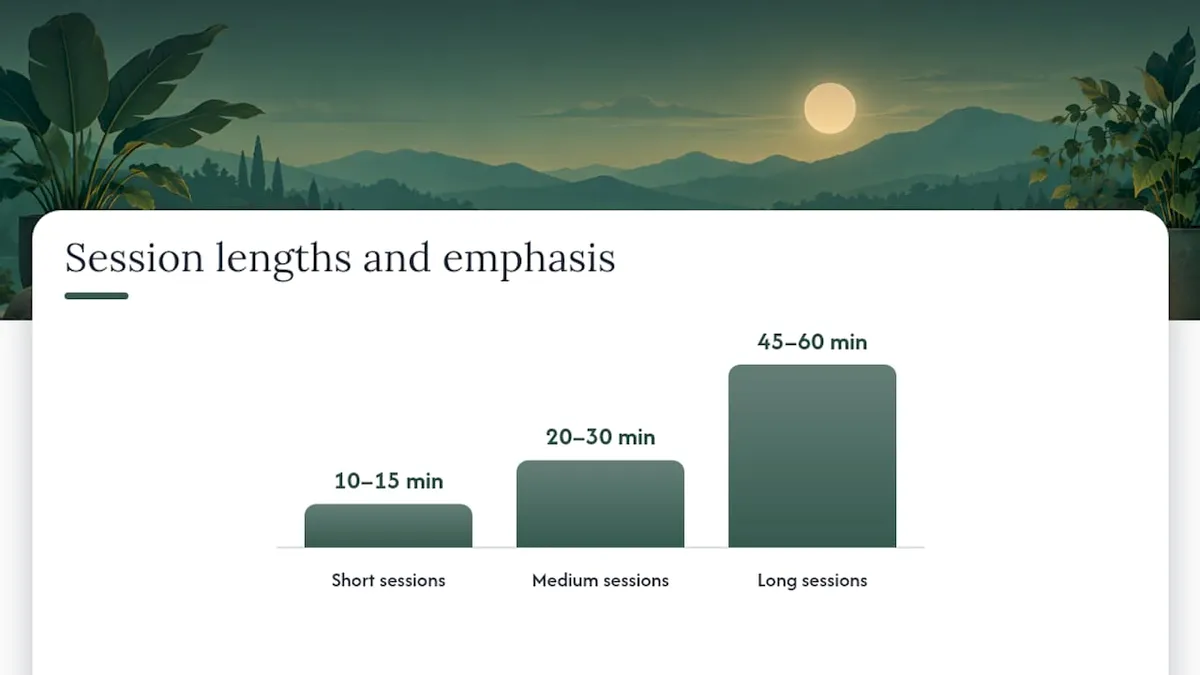
Long sessions, 45 to 60 minutes, suit weekends or moments when you want deeper emotional processing rather than pure sleep onset. These allow more time in each stage, particularly visualization, and sometimes add a body-sensation phase focused on opposites like heaviness and lightness, or warmth and coolness. Practitioner guides suggest that longer, more gently paced sessions with careful language are better suited to emotional processing work, while shorter sessions that emphasize body scan and breath are more efficient when sleep onset is the only goal.
A few starting points for personalizing your own practice:
- Sankalpa examples: “I release the day and welcome rest,” “My body knows how to sleep,” or “I am safe, calm, and ready to let go.”
- Visualization seeds: a slow tide moving in and out, a candle flame settling into stillness, or warm sand holding the shape of your body.
- Keep whichever phrase or image you choose consistent across sessions, since repetition is part of what makes a sankalpa effective over weeks rather than a single night.
Choosing session length by how much time you have, rather than forcing a fixed routine every night, keeps the practice sustainable instead of becoming one more task to complete before bed.
How Yoga Nidra Fits With Clinical Insomnia Treatment
Yoga nidra is a supportive tool, not a replacement for established insomnia treatment. The American Academy of Sleep Medicine’s practice parameters identify cognitive behavioral therapy for insomnia, known as CBT-I, as the first-line treatment for chronic insomnia, while noting that relaxation training, which yoga nidra falls under, is an effective supportive therapy (AASM practice parameters). Yoga nidra falls squarely into that relaxation-training category, useful alongside behavioral changes rather than in place of them.
In practice, this means pairing the bedtime protocol with habits that address the root causes of chronic sleep difficulty:
- Keep a consistent sleep and wake window, even on weekends, since irregular timing undermines the body’s own sleep drive.
- Reserve the bed for sleep and intimacy only, a core principle of stimulus control that helps the brain associate the bed with rest rather than wakeful frustration.
- Use yoga nidra as the wind-down ritual within that consistent window, rather than as a substitute for it.
One useful way to think about the practice’s role: it lowers arousal and can modestly improve measurable sleep metrics, but for chronic insomnia it works best combined with structured behavioral changes rather than alone (discussion of relaxation training and CBT-I).
Certain symptoms call for medical evaluation rather than a longer meditation practice. Loud snoring paired with gasping or choking during sleep can signal sleep apnea and warrants a conversation with a doctor. Excessive daytime sleepiness that persists despite adequate time in bed, or a sudden, unexplained change in sleep patterns, also deserves professional attention rather than a self-directed fix. Yoga nidra is a low-risk complement to good sleep habits, but it isn’t a diagnostic tool or a substitute for care when something more serious is at play.
Troubleshooting: Common Problems and How to Adjust Your Practice
Most difficulties with yoga nidra come down to a mismatch between the session and what your body needs that night, and small adjustments usually solve them.
Falling asleep mid-session is the most common “problem,” and at bedtime it isn’t one at all. Simply accept it. If you’re practicing during the day and need to stay alert afterward, switch to a shorter session and choose lighter, less immersive imagery rather than a deep, drowsy visualization.
If the practice feels activating rather than calming, which can happen when visualization stirs up unexpected emotion, drop the imagery altogether for that session. Lengthen your exhale relative to your inhale and rest your attention on the breath alone until the activation passes.
Physical discomfort has straightforward fixes:
- For lower back pain, place a bolster or rolled blanket under the knees to release lumbar tension.
- For dizziness upon finishing, take an extra minute lying still before sitting up, rather than moving straight from stillness to standing.
- For restless legs, try a side-lying position with a pillow between the knees instead of lying flat on your back.
A simple practice log, just a line a night noting session length, how quickly you fell asleep, and how you felt on waking, helps you notice patterns without turning the ritual into a chore. Consistency matters more than duration: a short session most nights tends to build the association between the practice and sleep faster than an occasional long one.
Pro Tip: If a particular guided track consistently leaves you more alert than relaxed, the issue is usually the pacing or voice, not the practice itself. Try a different recording before concluding yoga nidra doesn’t work for you.
Why We Treat Bedtime Yoga Nidra as a Ritual, Not a Task
The research is encouraging, but what keeps people practicing isn’t a study, it’s how the ritual feels in the moment. At Well In Spirit, we think about guided meditation the same way we think about the rest of what we curate: as something meant to be lived with, not just used once and forgotten.
This reflects a philosophy of approaching guided meditations and ritual collections as complete moments, combining selected products with guided rituals designed to create calm, reflection, and connection at home, rather than treating relaxation as an isolated fifteen minutes squeezed between other obligations. A bedtime practice sticks when it feels less like therapy homework and more like something you look forward to, and that’s the gap we try to close.
None of this replaces the evidence covered above. It just reflects our conviction that consistency, not perfection, is what turns a good technique into an actual habit.
— Rob
Bring the Ritual Home With Well In Spirit
Knowing the protocol is one thing. Doing it, night after night, without it becoming another chore, is another. That’s where a bit of structure helps: a set audio, a familiar scent, a small object that signals “this is the wind-down part of the evening” rather than another screen to manage.

Certain guided meditations and ritual collections are designed for that kind of repeatable use. Some ways they pair naturally with bedtime protocols include:
- Guided audio through the Well In Spirit Membership gives you a consistent, ready-to-play track instead of hunting for a new recording every night.
- The Awakening Ritual and Chakra & Third Eye Awakening Ritual pair a guided practice with grounding, sensory cues you set up once and reuse.
- Calming essential oils can anchor the start of your wind-down, so your body starts associating the scent with the coming practice.
- Seasonal options like The Snowfall Stillness Ritual give the ritual a bit of occasion during the darker months.
If you’re building a self-care evening around more than meditation, a warm soak from our bath and body range makes a natural first step before you lie down. For readers who prefer an in-person wind-down alongside their home practice, Vitaluxe Drip Lounge offers complementary wellness treatments worth exploring.
Start small: pick one guided track from the membership page and try it tonight, before you decide whether a fuller ritual collection is worth adding.
Key Studies and Trustworthy Explainers
The following sources back the claims made throughout this article:
- The 2023 randomized trial supports the sleep efficiency and WASO figures.
- The preliminary clinical trial supports the single-session sleep-onset finding.
- The exploratory affect study supports the negative affect reduction figure.
- The 2025 systematic review supports the meta-analysis findings on stress, anxiety, and depression.
- The Sleep Foundation explainer supports the hypnagogia and general sleep-benefit claims.
- The AASM practice parameters support the CBT-I and relaxation training guidance.
This article is general information, not a substitute for advice from a qualified doctor. Consult a qualified healthcare professional about your own circumstances before acting on anything here.
Sources
- PubMed: 2023 study on Yoga Nidra and sleep
- PMC: Preliminary clinical trial on Yoga Nidra
- PMC: exploratory study on Yoga Nidra and affect
- Systematic review and meta-analysis on Yoga Nidra
- Sleep Foundation: Yoga nidra for sleep
- AASM practice parameters for behavioral treatment of insomnia
FAQ
Does yoga nidra help you fall asleep?
Yes, research supports this: a preliminary clinical trial found that 89% of first-time practitioners fell asleep during a single afternoon session, and a separate trial found measurable improvements in sleep efficiency after four weeks of practice. It works by lowering nervous system arousal and guiding the mind into a drowsy, hypnagogic state rather than leaving it to wander.
What are the disadvantages of yoga nidra?
For some people, lying still with eyes closed can feel activating rather than calming, especially if visualization stirs up unexpected emotion, and the evidence base, while promising, still relies on studies with limitations in size and design. It also isn’t a substitute for first-line insomnia treatments like CBT-I or for medical evaluation of conditions like sleep apnea.
What is the best yoga nidra for sleep?
There’s no single definitive script, but practitioner guides suggest that sessions of 10 to 25 minutes emphasizing body scan and breath awareness are best suited to sleep onset, while longer sessions suit emotional processing rather than a quick wind-down. Choosing a shorter, breath-focused track and using it consistently tends to work better than switching styles frequently.
Can I do yoga nidra by myself?
Yes, though most practitioners use a guided audio track rather than practicing from memory, since following a voice makes it easier to stay present without having to direct your own attention. A recorded guide also makes the sequence, from sankalpa to rotation of consciousness to closing, consistent night after night, which supports the kind of repeated practice the research points to.