Spiritual Gifts for Women: 6 Gifts That Fit Daily Rituals
Find spiritual gifts for women that support mindfulness without demanding a new routine, from curated ritual kits and crystals to journals and meditation...

On this page
The best spiritual gifts for women fall into six categories: curated ritual kits, crystals, journals and oracle decks, meditation and mindfulness tools, scented gifts like candles and incense, and symbolic jewellery. Choose based on whether the recipient leans toward hands-on practice or simple, beautiful objects to keep nearby. The examples below show what works in each category and why.
Key Takeaways
The most meaningful spiritual gifts for women support personal practice and are tailored to individual preferences, sensitivities, and routines, often enhanced by thoughtful presentation.
| Point | Details |
|---|---|
| Choose based on practice style | Select gifts aligned with whether the recipient prefers hands-on activity or symbolic objects to keep close. |
| Prioritize practicality and sensitivities | Check for allergies, smoke tolerance, and the recipient’s routine before selecting scent, material, or ritual items. |
| Incorporate thoughtful presentation | Add a short ritual prompt or note to increase the gift’s purpose and encourage ongoing engagement. |
| Use curated ritual kits for ease | Build or buy themed collections that combine related items to reduce decision fatigue and boost use. |
| Wellinspirit offers comprehensive options | We create themed ritual collections that combine elements like oils, candles, crystals, and intention cards. |
1. Crystals and crystal gift sets
Crystals remain popular because they carry simple, widely understood meanings: amethyst for calm, rose quartz for self-love, labradorite for intuition. None of these associations are medical claims, but the ritual of holding or displaying a stone can anchor a quiet moment in a busy day.
Three formats suit different budgets and relationships. A single tumbled stone works as a small, affordable token. A crystal pendant turns the same idea into something worn daily. A curated crystal gift set gives more variety but costs more and risks feeling impersonal without context.
- Look for honest product photos showing natural colour and shape variation, since crystals are never uniform.
- Choose sets that include a short card explaining each stone’s traditional meaning.
- Avoid anything presented with exaggerated healing claims.
Pro Tip: A single well-chosen stone with a handwritten note often feels more personal than a large assorted set.
2. Journals, intention cards and oracle or tarot decks
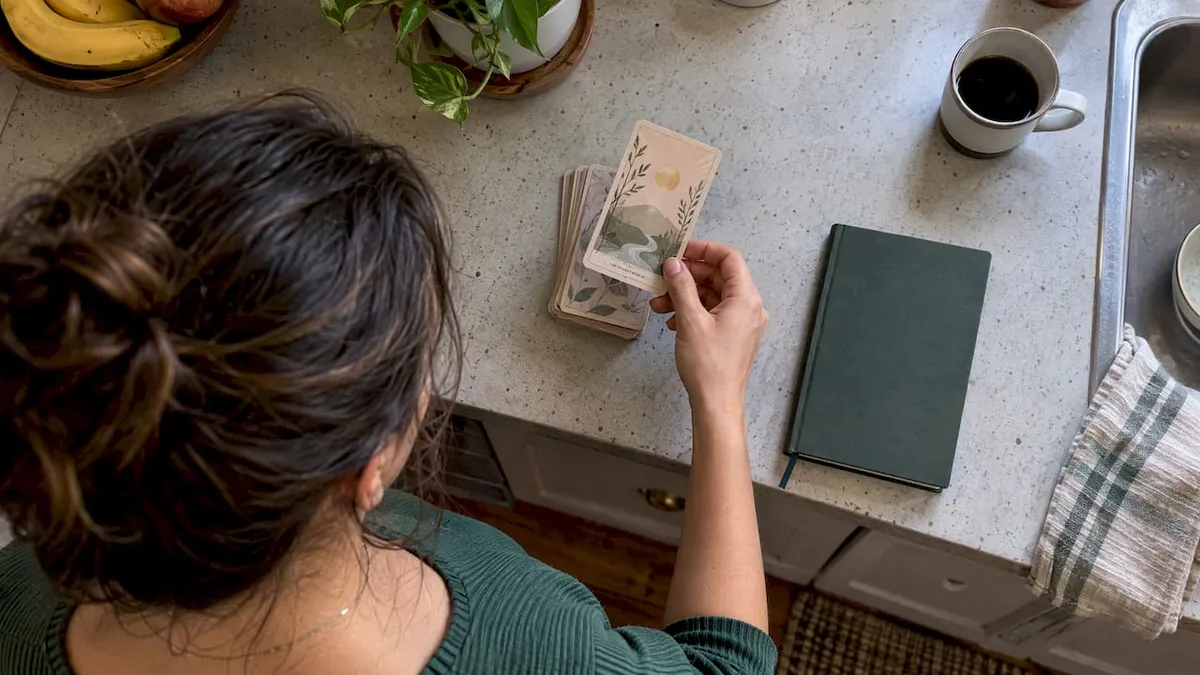
Paper-based gifts support reflection in ways objects alone cannot. Guided journals use prompts to ease someone into regular writing, intention-setting planners focus on goals and daily focus, and blank ritual journals suit someone who already has a practice and wants space to record it freely.
Oracle and tarot decks work similarly, giving a woman a single card to reflect on each morning rather than a blank page to fill. The habit of returning to a journal or deck daily echoes the present moment focus that NHS mindfulness guidance recommends as a starting point for managing stress.
- Check prompt quality: vague questions produce vague answers, so look for specific, varied prompts.
- Choose a size that fits a bag or bedside table, since a journal left at home rarely gets used.
- Confirm a deck includes usage notes if the recipient is new to oracle cards.
3. Meditation and mindfulness tools for daily use
Not every spiritual gift needs to be ornamental. A zafu cushion, a simple meditation timer, a gift card for a guided audio app, or a shower steamer designed to prompt a short pause can all fit into an existing routine rather than demanding a new one.
The Mental Health Foundation notes that gentle, guided or self-paced mindfulness tools suit beginners best, and that these techniques work as practical skills rather than belief-specific practices, which is why they appeal across different spiritual outlooks.
- Give a zafu cushion to someone who already sits for short periods but wants more comfort.
- Give a timer or app subscription to someone curious about meditation but unsure where to start.
- Give shower steamers to someone who wants a ritual cue built into a routine they already have.
One UK charity notes that formal mindfulness practice is valuable for many people but is not suitable for everyone, which is why a short, optional guided practice included with the gift tends to land better than a demand to start a new habit cold.
4. Candles, incense and scent-based gifts
Scent is one of the fastest ways to shift a room’s mood, which is why soy or vegetable-wax candles, quality incense, and essential-oil bath or shower products remain reliable gifts. Which? highlights candles and similar wellbeing items as gifts that support relaxation precisely because they slot into an existing routine rather than requiring a new one.
Safety matters here more than with most gift categories. Check for CLP labelling on any candle or oil, confirm essential oil products carry clear warnings, and choose smoke-free diffuser options for anyone with respiratory sensitivities or small children at home.
- Choose soy or vegetable-wax candles over paraffin where scent sensitivity is a concern.
- Check the packaging for CLP hazard symbols and usage warnings before buying essential oils.
- Offer a smoke-free diffuser alternative if you are unsure about the recipient’s sensitivities.
Pro Tip: Pair a candle with a one-line ritual suggestion, such as lighting it for five minutes before bed while naming one thing you are grateful for.
5. Spiritual jewellery and wearable tokens
Jewellery turns a spiritual idea into something worn and seen daily. Zodiac or celestial necklaces, gemstone pendants, mala beads for counting breaths or mantras, and small talismans with a clear, simple meaning all work well because they carry intention without needing explanation every time.
Material choice affects both comfort and ethics. Hypoallergenic metals such as surgical steel or solid gold suit sensitive skin better than plated pieces, which can tarnish or irritate over time.
- Choose hypoallergenic materials for anyone with metal sensitivities.
- Check whether a piece is plated or solid, since plating wears thin with daily use.
- Add a short note explaining the symbol’s meaning so the gift feels intentional rather than decorative.
6. Curated ritual kits and self-care boxes
A curated ritual kit solves the hardest part of gifting: deciding what goes together. Rather than choosing a candle, an oil and a crystal separately, a themed collection, built around sleep, awakening or chakra balancing, arrives with everything matched and ready to use.
Reporting on modern ritual practice notes that curated kits reduce decision fatigue for the giver and make the recipient more likely to actually try a new practice, since nothing is missing and a guided ritual is included. A typical box might pair a crystal, an oil, a candle and a printed intention card, each one reinforcing the same theme rather than competing for attention.
- Add the recipient’s name to the included ritual card for an instant personal touch.
- Write a short intention on the card yourself if the kit allows for a custom note.
- Choose a themed collection that matches a specific moment, such as a new job, a birthday or a season change, including a Natural Soap - Lavender & Rosemary for an extra touch of pampering.
How to choose the right spiritual gift: a quick checklist
Narrowing six categories down to one gift is easier with a short process. First, identify whether the recipient leans toward active practice (journalling, meditation) or aesthetic objects (jewellery, crystals). Second, check practical sensitivities: scent allergies, smoke tolerance, and how much time they realistically have for a new ritual. Third, decide on presentation, since a note or short ritual prompt often matters more than the object itself.
- What does she already do, if anything, that counts as a spiritual or reflective practice?
- Does she have any scent, skin or smoke sensitivities I should avoid?
- Is this a small everyday token or a special occasion gift that can carry more weight?
| Budget range | Occasion fit | Example category |
|---|---|---|
| Small token | Just because | Single crystal or pendant |
| Mid-range | Birthday | Journal, candle or jewellery piece |
| Special occasion | Milestone or holiday | Curated ritual kit |
How to present the gift: simple rituals, notes and small extras
Presentation often matters as much as the object itself. A short card with a ritual prompt turns a candle or journal into something with purpose rather than just a nice item.
- For a morning gift, write a one-line intention prompt such as “light this and name one thing you’re looking forward to today.”
- For an evening gift, suggest a short unwinding ritual, such as five slow breaths before bed.
- For a gratitude-focused gift, suggest naming three small things from the day while holding the object.
Add a ribbon, a seed packet, or a link to a short guided intention-setting ritual to reduce the effort needed to start. Any occasion works, a birthday, a milestone, or no occasion at all.
Pro Tip: A five-minute guided audio link costs nothing to add and removes the biggest barrier to actually using a mindfulness gift.
Understanding the different types of spiritual gifts
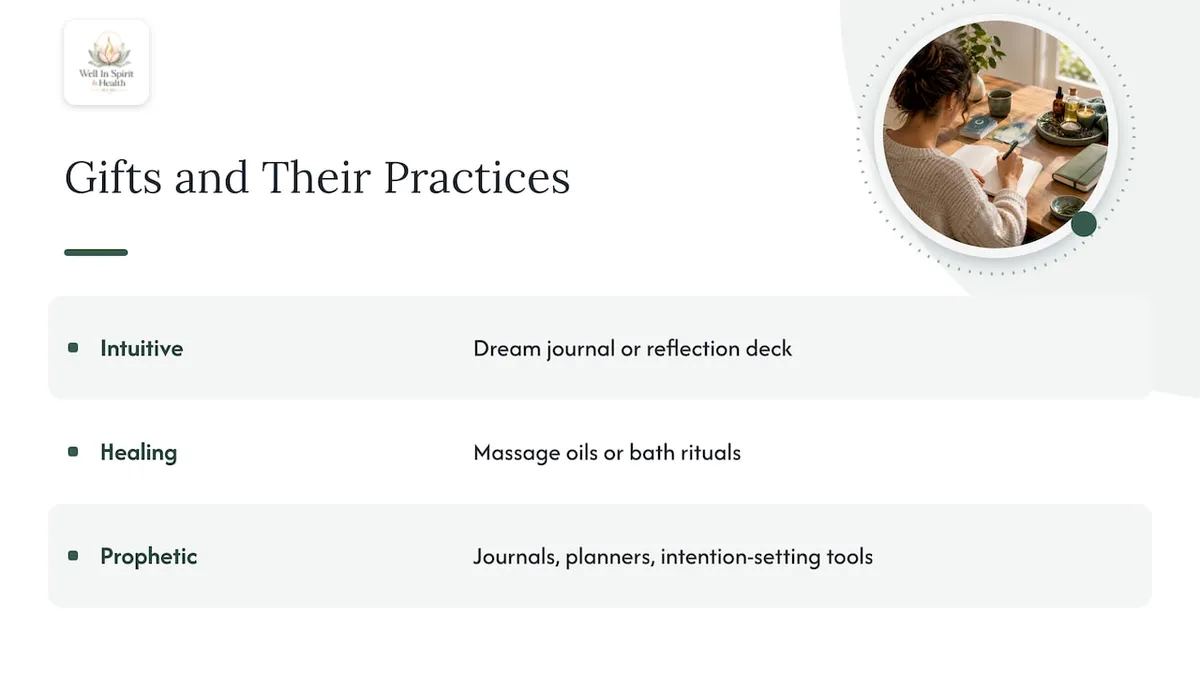
Spiritual gift, in the gifting sense used here, usually means an object that supports a personal practice rather than a formally defined spiritual ability. That said, many women do think in terms of gifts of the self, often grouped loosely as intuitive, healing and prophetic.
Intuitive gifts refer to a strong sense of inner knowing or reading situations and people accurately. A gift that supports this might be a journal for recording dreams or hunches, or a deck of cards used as a daily reflection prompt rather than a fortune-telling tool.
Healing gifts describe a capacity for comforting, soothing or supporting others, often expressed through touch, presence or care-taking. Gifts that support this side of a woman’s practice tend to be hands-on: massage oils, bath rituals, or anything that lets her extend care to herself before extending it to others.
Prophetic gifts, in a looser everyday sense, describe a tendency toward vision, foresight or guiding others through change. Journals, planners and intention-setting tools suit this inclination well, since they give structure to forward-looking reflection.
None of these categories are mutually exclusive, and most women will recognise themselves in more than one. The point of naming them is practical: it helps narrow a gift choice toward what someone already leans into, rather than guessing at a generic “spiritual” label.
How to identify your own spiritual gifts through reflection
Discovering a spiritual gift rarely happens through a single quiz or checklist. It tends to surface through noticing patterns: what do people consistently come to you for, what activities leave you feeling most like yourself, and what feels effortless compared with what feels forced.
A simple starting exercise is to keep a short journal for two weeks, noting moments when you felt calm, useful or clear-headed, and what you were doing at the time. Patterns tend to emerge faster than expected.
Guided reflection also helps. A deck of oracle cards used daily, a short meditation practice, or simply asking a trusted friend what they think you are naturally good at can surface things you overlook in yourself. The NHS notes that paying attention to the present moment, rather than judging it, is itself a skill that takes practice, and that skill is often the first step toward noticing your own inclinations more clearly.
There is no fixed timeline for this kind of discovery, and treating it as a slow, ongoing process tends to work better than expecting a single moment of clarity.
Historical and cultural background of spiritual gifts for women
Across many cultures, women have historically held recognised roles tied to intuition, healing and ritual, from folk healers and midwives to oracular figures consulted for guidance. These roles varied enormously by region and era, but they shared a common thread: women were often trusted as intermediaries between the everyday and the unseen.
In the twentieth and twenty-first centuries, much of this tradition has moved from formal roles into personal, everyday practice. Modern interest in crystals, tarot, journalling and ritual objects draws loosely on older traditions while reframing them as accessible self-care rather than specialised vocation.
This shift matters for gifting because it explains why the categories covered here, crystals, decks, journals, jewellery, feel both ancient and completely ordinary at once. They carry symbolic weight without requiring any particular belief system, which is part of why they work as gifts across such a wide range of recipients.
Ways to nurture spiritual gifts after receiving them
A spiritual gift only has lasting value if it gets used, so nurturing it after the wrapping paper comes off matters more than the object itself. The simplest approach is consistency: using a journal for two minutes each morning, or holding a crystal during one quiet moment a day, builds a habit far more reliably than occasional, longer sessions.
Revisiting the gift’s intention card periodically helps too. A ritual kit or jewellery piece that came with a short note explaining its meaning works best when that note gets reread occasionally, not just on the day it arrived.
Community or guided support can also help sustain a new practice. Joining a reflective group, following a guided audio series, or simply checking in with a friend who gave the gift keeps momentum going past the first enthusiastic week.
Common misconceptions about spiritual gifts for women
One persistent myth is that spiritual gifts or practices require a specific belief system to be meaningful. In reality, UK mental health guidance treats mindfulness and reflective techniques as practical skills, not religious commitments, which is exactly why these gifts work for a wide range of recipients regardless of faith.
Another misconception is that more expensive or elaborate gifts are automatically more meaningful. A single crystal with a handwritten note often resonates more than an expensive assorted set with no personal context attached.
A third myth is that spiritual gifts are inherently fragile or impractical, something to display rather than use. Most of the categories covered here, journals, jewellery, meditation tools, are designed for daily contact, not a shelf.
Finally, some assume spiritual gift-giving is a trend specific to recent years. Given the long history of ritual objects and symbolic gifts across cultures, it is closer to a very old habit wearing modern packaging.
Author perspective: everyday ritual matters
Small objects earn their place by what they prompt, not what they cost. A candle lit before bed, a card read each morning, these give attention somewhere to land. In curating rituals, we have seen that guided prompts turn a nice object into an actual habit. When choosing a gift, intention beats price almost every time.
— Rob
Recommended Well In Spirit gift options
We build themed ritual collections for exactly this kind of gifting, from The Awakening Ritual to seasonal and birthday sets. A typical collection pairs a few matched items, such as an oil, a candle, a crystal and a printed intention card, so the recipient has everything needed without piecing it together themselves.
- Browse spiritual gift collections for ready-made ritual kits built around a single theme.
- Explore wellness and wellbeing gifts for spa-style and everyday self-care options.
- Check availability for seasonal sets like The Snowfall Stillness Ritual on our Christmas rituals page.
FAQ
What to gift a woman who has everything?
A curated ritual kit works well here because it offers an experience rather than another object to store, pairing items like a candle, oil and intention card around a single theme. A themed collection such as The Chakra & Third Eye Awakening Ritual (from £50) gives her something to use rather than display.
What are some good gift ideas for a druid-inspired practice?
Nature-connected gifts tend to suit anyone drawn to earth-based or seasonal practice, including natural crystals, botanical incense, or a seasonal ritual box. Reporting on nature connection notes that sensory, nature-focused activities support wellbeing, which is why items tied to the outdoors or changing seasons often resonate most.
How can I know what my spiritual gift is?
There is no single test, but noticing patterns, what people consistently ask you for help with, what leaves you feeling clear-headed, often reveals an inclination toward intuitive, healing or forward-looking strengths. Keeping a short journal and reflecting regularly, which the NHS links to improved present-moment awareness, tends to surface these patterns over a few weeks.
What is the best gift to give to a spiritual woman?
The best choice depends on whether she prefers hands-on practice or symbolic objects, but a curated ritual kit covers both by combining a few meaningful items around one theme. Our Birthday Queen Ritual (from £45) is one example built specifically for celebratory gifting.
Are scented candles and essential oils safe to give as gifts?
Most are safe when properly labelled, but it is worth checking for CLP hazard symbols and clear usage warnings before buying, since UK safety alerts have flagged some candles for fire risk due to faulty wicks or containers. Choosing a smoke-free diffuser is a sensible alternative for anyone with respiratory sensitivities.
Sources
- Mindfulness | Mental Health Foundation
- Mindfulness - NHS
- Best Christmas wellness gifts 2026: reset, recharge and unwind - Which?
- Connect with natural world through forest bathing - BBC News