30–60 Minute Sleep Rituals: A la Carte Mix and Match Menu
Build a wind down with a 30–60 minute a la carte menu of sensory, movement, mental, audio, and prep rituals. Mix and match to fall asleep.

On this page
A consistent 30 to 60 minute nightly buffer of low-stimulation rituals reliably cues your body and brain for sleep. This article gives you a la carte menu of sensory, movement, cognitive, and environment ideas so you can build a routine that actually fits your life, plus the research-backed timing rules that make it work.
TL;DR:
- Keeping a consistent bedtime and limiting weekend sleep fluctuations to about an hour supports your circadian rhythm and improves sleep quality.
- A warm bath or shower scheduled 1 to 2 hours before bed accelerates the natural core temperature drop, helping you fall asleep faster.
- Limiting electronics use and dimming household lighting 30 to 60 minutes before bed creates a sensory environment conducive to sleep.
- Building a personalized routine with two to four low-stimulation activities, tested over several weeks, increases the likelihood of sustainable sleep improvements.
- Avoiding heavy meals, vigorous exercise, and caffeine close to bedtime reduces disruptions to your sleep onset and overall rest quality.
Why bedtime rituals help you fall asleep faster
Your body runs on a circadian rhythm, an internal clock that expects consistent cues about when to wind down and when to wake. Adults need 7 to 9 hours of sleep per night, and keeping your sleep and wake times steady, with weekend drift limited to about an hour, helps that clock stay accurate.
A 30 to 60 minute buffer before bed gives your nervous system time to shift out of “doing” mode. This is where stimulus control matters too: using your bed only for sleep (and sex) trains your brain to treat it as a sleep cue rather than a place for scrolling or working.
Timing backs this up directly. Taking a warm bath or shower 1 to 2 hours before bedtime helps you fall asleep faster because it speeds up the natural drop in core body temperature that happens once you leave the warm water for a cooler room. Dimming lights and stepping away from caffeine in the hours before bed reinforce the same signal.

Your quick nightly checklist: anchors and things to avoid
Before you build a longer ritual, a few basics do most of the heavy lifting.
- Pick a consistent bedtime and wake time, and keep weekend drift to about an hour.
- Start an electronics curfew and dim household lighting 30 to 60 minutes before bed.
- Keep your bedroom cool, dark, and quiet, and reserve the bed for sleep and sex only.
- Cut caffeine by early afternoon and limit alcohol close to bedtime, since both disrupt sleep quality.
- If you are hungry, choose a light snack rather than a heavy meal right before lying down.
Pro Tip: Put your phone charger outside the bedroom. It removes the temptation to check one more notification and turns the nightstand back into a sleep-only zone.
These anchors work whether you add nothing else or build a full ritual on top of them, because they remove the biggest obstacles to falling asleep on schedule.
A la carte menu of ritual ideas to mix and match
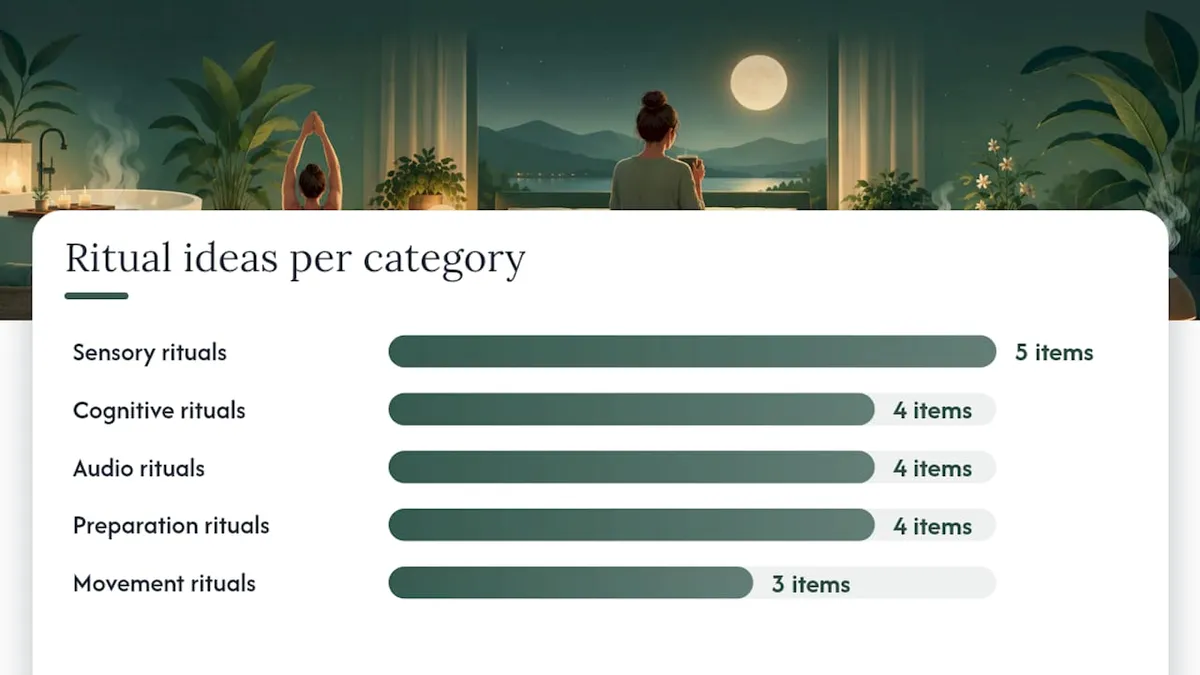
Think of this as a menu, not a prescription. Pick two to four ideas that fit your evening and your personality, then repeat them consistently.
Sensory rituals
- Warm bath or shower, timed 1 to 2 hours before bed, to trigger the temperature drop that helps you fall asleep faster.
- Chamomile tea or warm milk, sipped slowly as a low-stimulation cue that signals the evening is winding down.
- Aromatherapy with lavender, whether as a diffuser, a pillow spray, or a few drops on a cotton ball by the bed.
- Low-wattage warm lighting, swapped in for overhead lights during the last hour before sleep.
- A silk pillowcase for the tactile comfort of less friction against your skin, a small sensory upgrade some people find genuinely relaxing.
Movement rituals
- Gentle stretching, five to ten minutes focused on the neck, shoulders, and lower back.
- Restorative yoga, a short sequence of floor-based poses held for several breaths each.
- Progressive muscle relaxation, tensing and releasing each muscle group from feet to face, a technique linked to easier sleep onset.
Cognitive and emotional rituals
- Journaling as a brain dump, writing down tomorrow’s to-do list to get it out of your head.
- A short gratitude practice, naming three things from the day worth appreciating.
- Reading a physical book, which avoids the blue light and notifications of a screen.
- Listening to an audiobook, useful on nights when your eyes are tired but your mind is still busy.
Audio and sound rituals
- A guided meditation, ten to twenty minutes long, focused on breath or body scan.
- A sleep playlist, low tempo and instrumental, played at low volume.
- Pink or white noise, especially useful in noisy apartments or shared bedrooms.
- A short candle ritual, lighting one for twenty minutes while you do something quiet, then blowing it out as your signal to get into bed.
Preparation rituals
- Packing tomorrow’s bag, so your morning starts calmer.
- Laying out clothes for the next day, one less decision to make when you are half awake.
- A light tidy of the bedroom, clearing clutter that otherwise nags at your attention.
- A short skin care ritual, cleansing and moisturizing as a physical marker that the day is done.
Short options for busy nights
- A five-minute breathing exercise: inhale for four counts, hold for four, exhale for six.
- A ten-minute walk around the block to shift out of work mode before you get home.
A few cautions apply across all of these. Avoid heavy meals and vigorous exercise in the hour or two before bed, since both raise your core temperature and alertness right when you want them dropping.
How to build your own ritual and test it
Building a ritual is less about finding the perfect routine and more about testing what actually helps you personally.
- Work backward from your target bedtime and block out 30 to 60 minutes as your wind-down window.
- Choose two to four low-stimulation elements from the menu above rather than trying all of them at once.
- Sequence them loosely: dim the lights first, handle hygiene next, add gentle movement or mindfulness, then finish with something low-stimulus once you are already in bed.
- Track your consistency for two to four weeks, changing only one variable at a time so you know what is actually helping.
- Watch for persistent insomnia. If you are still struggling to fall or stay asleep after a few weeks of consistent effort, cognitive behavioral therapy for insomnia is the recommended next step, and a clinician can guide you there.
Pro Tip: Give any new ritual at least ten nights before judging it. One rough night rarely means the routine failed, it usually means you need more repetitions for the cue to stick.
Research-backed timing rules worth following
A few rules show up consistently in sleep guidance and are worth applying directly.
- Aim for 7 to 9 hours of sleep and keep your schedule consistent, including on weekends.
- Time a warm bath or shower 1 to 2 hours before bed so your body temperature has already started dropping by the time you lie down.
- Follow stimulus control: if you are still awake after about twenty minutes, get up and do something quiet in another room until you feel sleepy, and reserve the bed for sleep and sex.
- Use proven relaxation techniques such as progressive muscle relaxation, guided imagery, or slow breathing when your mind is racing.
A full hour of unwind time before bed is one of the specific steps recommended in NHS self-help guidance on managing insomnia, alongside the stimulus control rules above.
Why I think rituals work best when they feel personal
A ritual works because it is predictable, not because it is elaborate. The most effective one I have come across is often the simplest: the same three or four steps, repeated in the same order, night after night.
Pick elements that mean something to you rather than copying someone else’s routine wholesale. A curated collection can offer a useful starting point when you want inspiration rather than a blank page.
— Rob
Let Well In Spirit help you start tonight
If picking twenty separate products sounds like more effort than you want, a packaged ritual solves that in one step. Ritual collections that pair products with guided routines are available, so the sequencing and sourcing are already done for you.

- For sensory rituals like baths, scent, and skin care, browse Bath & Body and Essential Oils.
- For audio and mindfulness rituals, guided meditations can pair naturally with a quiet, low-light evening.
- For a full sequence in one box, The Awakening Ritual and Forest Spirits Spa Ritual combine sensory and preparation elements from the menu above.
- Ongoing practices with continued access to guided routines may be available through membership programs.
Visit Well In Spirit to browse the collections and find a starting point that fits your evening.
Sources
- Healthy Sleep | American Academy of Sleep Medicine (Sleep Education)
- Take a warm bath 1–2 hours before bedtime to get better sleep, researchers find | UT News
- Sleep disorders and problems (insomnia): Learn More – InformedHealth.org - NCBI Bookshelf
- Managing Insomnia and Sleep Problems | NUH NHS Self-help
FAQ
What is the 3-3-3 rule for sleep?
The 3-3-3 rule is not part of the clinical stimulus control guidance covered in this article, and definitions of it vary widely online. Rather than following an unverified rule, stick to the tested basics: a consistent schedule, a wind-down buffer, and a cool, dark, quiet bedroom.
What are 7 things I should do before bed?
A strong seven-step wind-down might include dimming the lights, taking a warm shower, doing five minutes of gentle stretching, journaling a quick brain dump, reading a physical book, brushing your teeth, and getting into a bed reserved only for sleep. Pick whichever combination from the menu above suits your evening rather than forcing all seven every night.
What is the tongue trick to fall asleep?
This is not a technique covered by the sources behind this guide, so we cannot confirm its effectiveness. Proven relaxation methods like progressive muscle relaxation, guided imagery, and slow breathing have more established support for easing sleep onset.
What is the best thing to drink every night before bed?
Chamomile tea or warm milk are common low-stimulation choices that fit naturally into a wind-down ritual. Whatever you choose, avoid caffeine in the afternoon and evening, since it interferes with falling asleep on schedule.
How long before bed should my wind-down routine start?
Aim for a 30 to 60 minute buffer of low-stimulation activities before you get into bed. If a bath is part of your routine, time it 1 to 2 hours before bedtime so your body temperature has already begun to drop.