3 Short Meditations for Anxiety That Calm in Under 3 Minutes
Use three short evidence backed meditations to ease anxiety in minutes. Add simple ritual cues to make the habit stick and know when to get help.
On this page
Meditation can reduce anxiety symptoms, and it works best as a regular practice alongside whatever else you’re already doing to manage stress, not as a replacement for it. Right now, try this: breathe in for four counts, hold for four, exhale for six, and repeat for two minutes. That alone won’t fix chronic anxiety, but it can take the edge off a spike in under three minutes. The research and safety details below explain why, and what to expect if you stick with it.
TL;DR:
- Regular mindfulness practices can match the effectiveness of medication like escitalopram over a 12-week period for some people with diagnosed anxiety.
- Online and shorter mindfulness interventions tend to have small to moderate effects, and consistency in daily practice is more crucial than session length.
- Meditation helps reduce anxiety by improving attention, enabling reappraisal of anxious thoughts, and gradually lowering physiological stress responses over time.
- Short, guided practices such as breath anchors, body scans, and grounding countdowns are effective tools for specific anxiety episodes, especially when paired with sensory cues.
- Meditation is safe for most but should not replace professional treatment when anxiety severely interferes with daily functioning or includes thoughts of self-harm or panic attacks.
Does Meditation for Anxiety Actually Work?
The strongest evidence comes from a 2023 randomized trial of 208 participants, which found that Mindfulness-Based Stress Reduction (MBSR) performed as well as escitalopram, a common anxiety medication, over a 12-week protocol with daily practice. That’s not a small claim. It means a structured meditation program can match a first-line medication for some people with diagnosed anxiety disorders, at least over three months.
Outside the clinic, results are more modest. Systematic reviews of online mindfulness-based interventions report pooled effect sizes around g=0.25 to 0.35, which researchers classify as small to moderate. Pandemic-era trials found similar numbers, with effects holding up at follow-up rather than fading, and longer programs tended to outperform shorter ones.
The World Health Organization’s 2023 guidance reflects this nuance. It recommends considering stress-management techniques, including mindfulness training, for adults with generalized anxiety disorder or panic disorder, but labels the recommendation conditional with low certainty evidence.
What this means practically:
- Expect gradual, measurable improvement over weeks, not instant relief from a single session.
- Structured programs with daily homework (like MBSR) tend to outperform casual, occasional practice.
- Meditation works best stacked with other tools, not used alone as your only anxiety strategy.
The realistic takeaway: meditation is a legitimate, evidence-backed lever for anxiety, not a miracle cure. Treat it as one solid piece of a larger plan.
How Does Meditation Help With Anxiety?
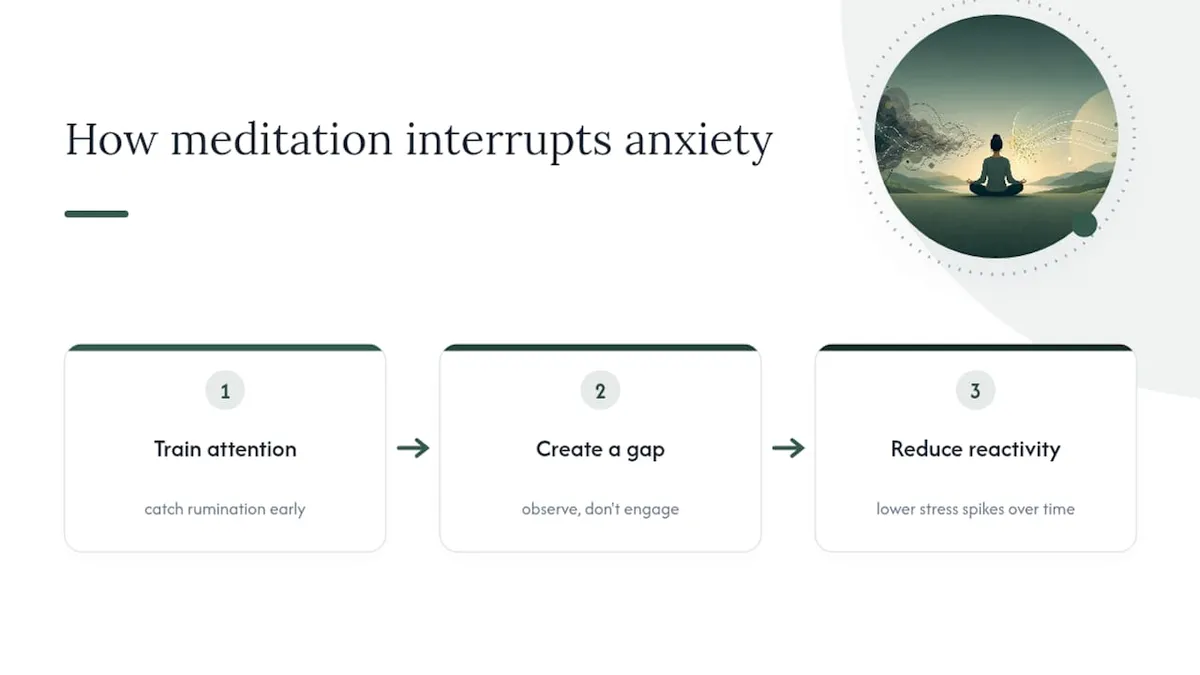
Anxiety often runs on autopilot: a thought triggers a spiral, and the spiral triggers a physical stress response before you’ve even noticed what happened. Meditation interrupts that chain in three specific ways.
First, it trains attention. Sitting with your breath and noticing when your mind wanders builds the mental muscle to catch a rumination loop early, before it snowballs. Georgetown researchers describe this as shifting your relationship to thoughts: you learn to observe a worried thought rather than automatically engaging with it, which creates a gap between stimulus and reaction.
Second, that gap supports reappraisal, the same skill cognitive behavioral therapy relies on. Once you can notice “I’m having an anxious thought” instead of just being swept into it, you can question whether the thought is accurate or useful.
Third, regular practice appears to dial down physiological reactivity over time. Your body’s stress response doesn’t disappear, but repeated calm repetitions seem to build a less reactive baseline, so the same trigger produces a smaller spike.
Three Short Guided Practices to Try Right Now
You don’t need 45 minutes and a silent room. Here are three time-boxed practices, ordered by how much time and intensity they need.
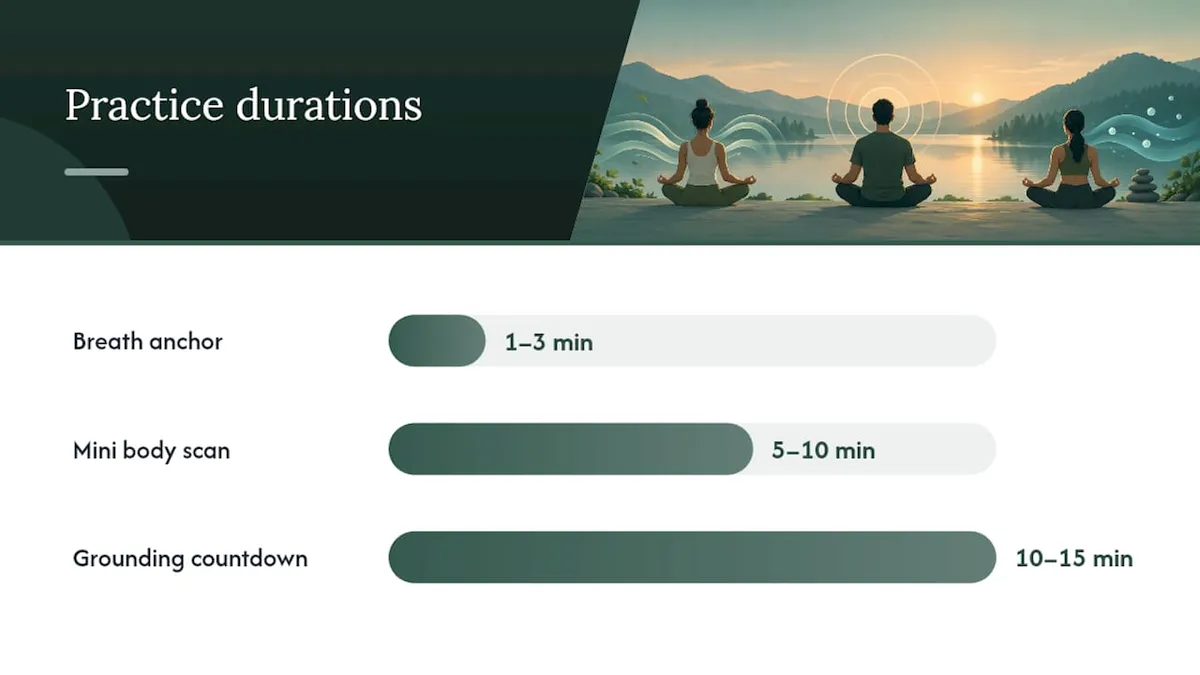
- The 1 to 3 minute breath anchor. Sit or stand comfortably. Inhale through your nose for four counts, hold for four, exhale slowly for six. Repeat for six to eight cycles. This is your go-to for a sudden spike of nerves before a meeting or a hard conversation.
- The 5 to 10 minute mini body scan. Close your eyes and mentally move from your feet to your scalp, pausing three seconds on each area to notice tension without trying to fix it. This works well when anxiety shows up as physical tightness, jaw clenching, or a knotted stomach.
- The 10 to 15 minute grounding countdown. For stronger anxiety episodes, name five things you can see, four you can touch, three you can hear, two you can smell, one you can taste, then spend the remaining time on slow breathing. This longer format suits moments when your thoughts feel too loud for a quick fix.
Pick the breath anchor for acute, in-the-moment spikes. Save the body scan for tension that’s built up over a stressful day. Reach for the grounding countdown when anxiety feels bigger than a few slow breaths can handle.
Pro Tip: Pair each practice with the same small cue, like a specific chair or a lit candle. Your brain starts associating that cue with calm, which shortens the time it takes to settle once you begin.
How Often Should You Meditate for Anxiety?
Consistency beats duration. Harvard Health’s guidance on mindfulness practice suggests starting with five minutes a day rather than aiming for a heroic 30-minute session you’ll skip after three days. Add short “mindful moments” between meetings or during a commute to reinforce the habit without adding pressure.
A realistic weekly starting point looks like this:
- Five minutes of guided breath work each morning.
- One 10-minute body scan in the evening, three or four times a week.
- A 2-minute grounding pause whenever you notice anxiety building during the day.
Guided audio, a simple timer, or a ritual you already do (like a bath or tea routine) all help you stay consistent when motivation dips. Mind-wandering is normal and not a sign you’re doing it wrong. Missed days don’t erase progress. Track how you feel weekly rather than daily. Look for subtler markers of improvement, like recovering faster after a stressful event, not the total absence of anxiety.
When Meditation Isn’t Enough on Its Own
Meditation is generally safe for healthy adults, according to NCCIH’s review of complementary approaches, but it’s not risk-free for everyone. One review found that roughly 8% of meditation participants reported adverse effects like increased anxiety or distress, a rate comparable to some psychological therapies.
Seek professional support rather than relying on meditation alone if you notice: thoughts of self-harm or suicide, panic attacks that feel unmanageable, or anxiety that’s interfering with work, relationships, or basic daily functioning. Meditation pairs well with therapy and medication. It’s not a substitute for either when symptoms are severe. If you’re already seeing a clinician, mention that you’re adding meditation to your routine. They can help you time it around therapy sessions or watch for any change in symptoms.
A Practical Perspective on Making It Stick
The gap between knowing meditation helps and actually doing it consistently isn’t a willpower problem. It’s a design problem. Most people quit not because meditation doesn’t work, but because a bare, unguided sit feels awkward and easy to skip. Attaching a short practice to something you already enjoy, lighting a candle, applying a favorite oil, dimming the lights, gives your brain a reliable cue to shift gears. It’s the same principle behind micro-meditations that outperform sporadic long sits for adherence: small, ritualized, repeatable beats occasional and ambitious every time.
— Rob
Make Your Practice Easier to Keep
This approach is built around exactly this problem: showing up once won’t change your anxiety, but a five-minute ritual you actually repeat can. Instead of hunting for a new guided track every week or trying to build a calming space from scratch, you get curated collections that pair short guided meditations with sensory cues, like scent and touch, designed to work together.
The Well In Spirit Membership gives you ongoing access to guided practices and ritual resources built for consistency rather than one-off use. If you’d rather start with a themed set, The Awakening Ritual and other spiritual collections combine guided meditation with grounding ritual elements you can use the same day it arrives. Browse membership options or ritual collections and pick the format that fits how you actually want to build this habit.
Sources
- Randomized trial: MBSR vs escitalopram (2023)
- WHO issues new and updated recommendations on treatment of mental, neurological and substance use conditions
- Effects of online mindfulness-based interventions (MBIs) on anxiety symptoms in adults: systematic review and meta-analysis
- Anxiety and Complementary Health Approaches | NCCIH
FAQ
How Long Should a Meditation for Anxiety Session Last?
Five to ten minutes daily is enough to start noticing benefits over several weeks. Longer sessions, closer to the 12-week structured protocols used in clinical trials, tend to produce stronger, more durable results.
Can Meditation Replace Anxiety Medication?
Not automatically, and not for everyone. One trial found MBSR performed comparably to escitalopram over 12 weeks, but this doesn’t mean meditation works the same way for every person or every anxiety diagnosis. Never stop medication without talking to your prescriber first.
What’s the Best Short Meditation for Sudden Anxiety?
The 1 to 3 minute breath anchor, inhaling for four counts, holding for four, exhaling for six, is the fastest tool for an acute spike. It requires no equipment and works anywhere you can pause for a minute.
Does Wellinspirit Offer Guided Meditations for Anxiety?
Yes. The Well In Spirit Membership provides ongoing access to guided practices, and themed collections like The Awakening Ritual pair short meditations with ritual elements to support a consistent routine.
Is It Normal for Meditation to Feel Uncomfortable at First?
Yes, a wandering mind or restlessness during early sessions is common and not a sign of failure. A small percentage of people, around 8% in one review, report increased distress, so scale back intensity or talk to a clinician if discomfort persists.