Research Backed Manifestation Ritual That Forces Action in 10 Minutes
Research backed, action first guide to manifestation rituals. Use a six step template, WOOP and if then plans, then take one small action within 10 minutes.
On this page
A manifestation ritual is a short, repeatable routine that directs your attention toward a goal and pushes you into action, not a guarantee that the universe will hand you an outcome. Done well, it works because it borrows real psychological tools like implementation intentions and mental contrasting, not because writing a wish nine times physically bends reality. This guide gives you templates, timing, and the research behind why some versions work far better than others.
TL;DR:
- Rituals are most effective when they involve specific intentions, a clear obstacle, and a concrete action to be completed within 10 minutes.
- The 369 method benefits from repeated physical writing to reinforce focus, rather than any mystical significance of the numbers.
- Successful routines are anchored to existing habits and tracked regularly, with adjustments made based on action results and consistency.
- Common techniques like mental contrasting and implementation intentions are backed by research and enhance goal achievement through structured planning.
- Using curated ritual kits with guided steps and physical materials simplifies setup and increases the likelihood of forming lasting habits.
What Is a Manifestation Ritual and When Should You Use One?
A manifestation ritual is an intentional routine that pairs a clear goal with a cue for action, usually through writing, visualization, or a small ceremony that marks the moment you commit to something. Think of it as a structured checkpoint: you name what you want, picture it in enough detail to plan around it, then do something small immediately afterward.
Rituals work best for goals you can actually influence through your own behavior. A promotion you’re working toward, a fitness habit, a creative project, or repairing a relationship all respond well to focused attention and repeated action. A ritual is a weaker tool for outcomes entirely outside your control, like a stranger’s decision or a random lottery draw. It can still help you stay calm while you wait, but it won’t change the odds.
Common formats include:
- A journal or scripting practice where you write the goal as if it’s already happening
- A candle ritual that marks a start or a release point
- A vision board that keeps the goal visually present
- A short guided meditation that combines breathing with visualization
The Core Ritual Template You Can Adapt to Any Goal
Every effective manifestation ritual follows a similar skeleton, no matter which method you layer on top. Here’s the sequence:
- Clear the space. Spend two minutes tidying your desk, lighting a candle, or simply closing your laptop. This signals to your brain that you’re switching into a focused mode.
- Write one specific intention. Skip vague lines like “I want more abundance.” Instead write something measurable: “I will submit two job applications this week” or “I will save $200 this month.” Specificity is what separates a ritual from wishful thinking.
- Visualize for 30 to 60 seconds, no longer. Picture the outcome briefly, then immediately picture the obstacle most likely to stop you. This pairing, contrasting the goal with a realistic barrier, is what separates productive visualization from daydreaming.
- Write an if-then plan. Format it exactly like this: “If [obstacle happens], then I will [specific response].” Example: “If I feel too tired to job search after work, then I will apply to one listing before I open Netflix.”
- Release the moment. Close your journal, blow out the candle, or simply say the intention aloud once. This gives your brain a clear end point instead of looping the thought all evening.
- Take one tiny action within 10 minutes. Send the email, open the fitness app, put $5 in the savings account. The ritual only has teeth if it’s followed by movement.
Here’s a sample script you can adapt: “I am building a business that supports my family. This week, my biggest obstacle is procrastinating on outreach. If I feel like avoiding it after lunch, then I will send three messages before checking email. I release this intention and start with one message right now.”
Pro Tip: Keep your if-then plan to one sentence and say it out loud once before you close the ritual. Research on implementation intentions shows these short, situationally anchored plans work even when you’re tired or distracted, which is exactly when rituals tend to fall apart.

Popular Manifestation Techniques and How to Perform Them
Different methods suit different goals and different personalities. Here’s how the most common ones actually work.
- The 369 method: Write your intention 3 times in the morning, 6 times midday, and 9 times before bed. Handwrite it rather than typing, and keep a simple tracker (a checkbox per session works fine). The value isn’t in the numerology; it comes from repeated attentional priming and the habit loop the schedule itself creates. It suits goals that benefit from daily reinforcement, like building confidence before a big event.
- Vision boards and scripting: Build a board with images tied to specific, near-term goals rather than abstract ones, and look at it for 30 seconds each morning. Scripting works the same way but in sentence form. Both function as visual or written reminders that keep the goal in your peripheral awareness all day.
- Full moon and candle rituals: Use the full moon as a monthly checkpoint to release a habit or intention that isn’t working, and the new moon to set a fresh one. Light a candle safely on a heatproof dish, away from curtains or paper, and never leave it unattended. This cadence suits people who want structure without a daily commitment.
- WOOP and mental contrasting: Wish, Outcome, Obstacle, Plan. State the wish, picture the outcome for under a minute, name the realistic obstacle, then write the if-then plan. This is the single technique most directly backed by research on mental contrasting, and it can be folded into any of the rituals above.
How to Choose a Method (and Mistakes That Undercut It)
Pick a method based on how much time you have, how believable the goal feels to you, and whether it fits into a habit you already have. A five-minute journaling ritual attached to your morning coffee will outlast an elaborate full-moon ceremony you only remember twice a season.
Watch for these red flags:
- Visualizing the outcome for ten minutes or more without naming an obstacle (this is “indulging,” and it tends to lower motivation rather than raise it)
- No if-then plan or concrete next action attached to the ritual
- Affirmations so vague you couldn’t tell if they came true (“I am abundant”)
- Doing the ritual once, then not again for three weeks
Before you start, run through this quick check: Is my intention specific? Have I named one obstacle? Do I have a plan for it? Is there an action I can take in the next 10 minutes?
Making Your Ritual Stick: Cues, Tracking, and Tiny Actions
A ritual only helps if you actually repeat it, and that comes down to habit design more than willpower.
- Anchor it to an existing cue. Pair the ritual with something you already do daily: brewing coffee, brushing your teeth, or your commute. Fixed timing beats “whenever I feel inspired.”
- Attach a tiny action every time. The ritual isn’t complete until you’ve done something physical, even if it’s just opening an app or writing one line.
- Track it simply. A three-column log works: date, the day’s intention, and the one action you took. No app required, a notebook page is enough.
- Reassess monthly. If a ritual consistently produces no action, either the intention is too vague or the format doesn’t fit your schedule. Change the format before you abandon the goal.
Why Some Manifestation Techniques Actually Work
The three mechanisms that explain most of the real benefit are implementation intentions, mental contrasting, and expectancy effects, and each has a distinct research trail behind it.
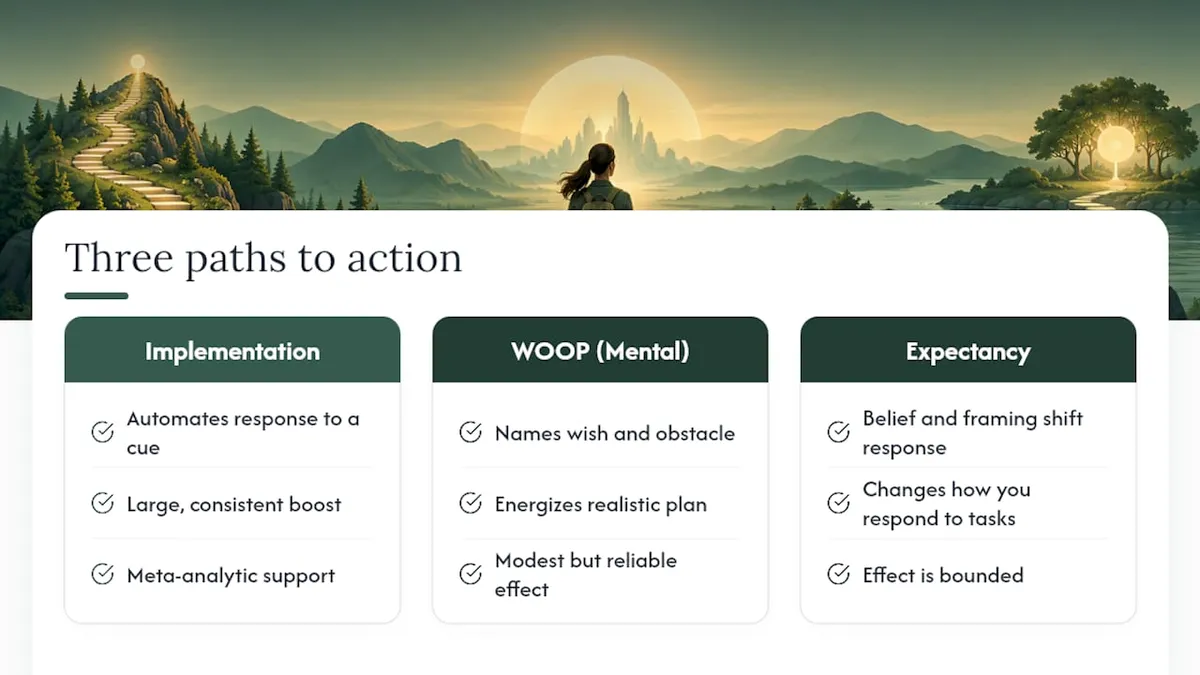
Implementation intentions automate your response to a specific cue, and meta-analytic reviews across dozens of studies show they produce a large, consistent boost in goal completion. WOOP, or mental contrasting, works differently: it converts vague hope into an energized, realistic plan by forcing you to name the obstacle alongside the wish, and the meta-analytic effect shows up as modest but reliable across many domains. Expectancy effects are real too. Belief and framing can shift behavior and even some physiological markers, but the effect is bounded. It changes how you respond to a task, not the outside world’s response to you.
Use Rituals as Tools, Not Guarantees
Rituals earn their keep by focusing attention and forcing a decision point, not by promising outcomes. Track what action each ritual actually produced, not just how it felt, and drop what isn’t working. Wellinspirit’s curated ritual collections exist to make that structure easier to hold onto.
— Rob
Start With a Ritual Kit Instead of Building One From Scratch
Assembling a ritual from a candle, a journal, oils, and a guided script takes trial and error most people don’t have time for. Wellinspirit’s curated collections solve the setup problem: each kit pairs physical materials with a guided routine, so you’re not guessing what to write, light, or say next.

The spiritual ritual collection includes options like The Awakening Ritual and The Chakra & Third Eye Awakening Ritual, both built around guided steps rather than a blank page and a vague intention. If you’d rather build your own setup piece by piece, the Essential Oils shop covers the aromatherapy side, and the broader ritual collections page covers bath and body add ons that round out a full sensory routine. For those who want ongoing access to guided content beyond a single kit, the Well In Spirit Membership offers a way to keep building the habit month over month. Browse the spiritual collection and pick the kit that matches the goal you’re working on right now.
Sources
- Implementation intentions research (Gollwitzer) — planning and goal pursuit
- Mental contrasting research (Oettingen) — WOOP and goal pursuit
- Expectancy effects and belief’s influence on behavior (journal article)
- How to manifest: techniques and research summary — Verywell Mind
FAQ
What Is a Powerful Manifestation Ritual?
A powerful ritual is one that pairs a specific, believable intention with a named obstacle and an immediate action, not one with the most elaborate setup. The strongest versions borrow mental contrasting and if-then planning rather than relying on visualization alone.
What Are the Rules of Manifestation?
Definitions of specific numbered “rules” vary widely across sources, and no single official list exists. The consistent themes across credible guidance are specificity, believability, repeated attention, and pairing the intention with real action, which is what the research on effective techniques actually supports.
What Is the 369 Method for Manifestation?
The 369 method involves handwriting your intention 3 times in the morning, 6 times midday, and 9 times before bed. Its benefit comes from repeated attentional priming and the daily habit it builds, not from the numerology itself.
How Do You Perform a Manifestation Ritual?
Clear your space, write one specific intention, visualize the outcome briefly while naming a likely obstacle, then write a short if-then plan for that obstacle. Close the ritual and take one small action within 10 minutes, which is the step most people skip and the one that matters most.
Does Wellinspirit Sell Ready-Made Ritual Kits?
Yes. Wellinspirit’s spiritual ritual collection includes kits like The Awakening Ritual starting from £30 and The Chakra & Third Eye Awakening Ritual starting from £50, each combining materials with a guided routine.